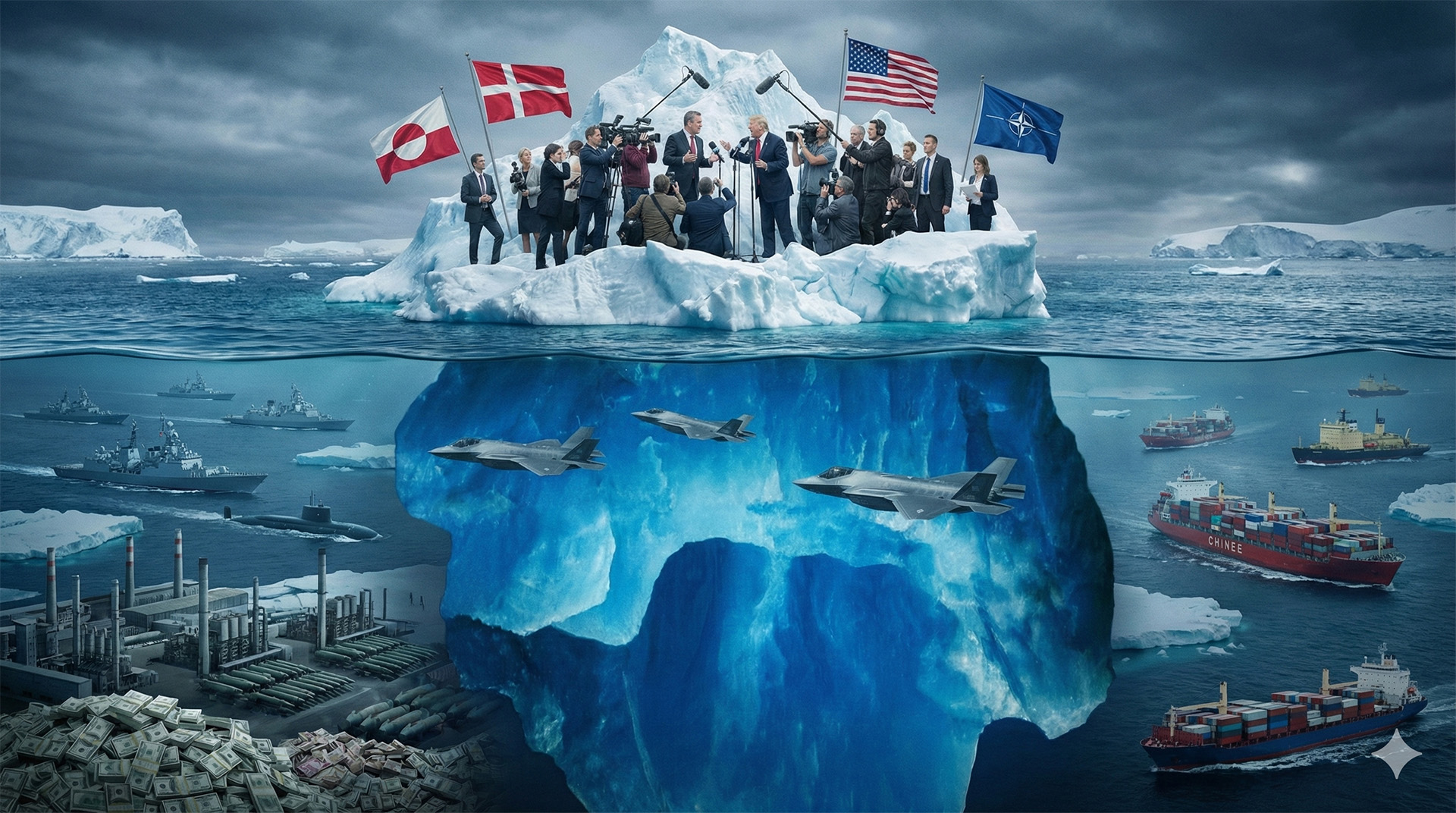
While they argued over an island they took your welfare state
Posted on: 13 January 2026
Something doesn't add up in the Greenland crisis. An American president threatens to annex a NATO ally's territory by force. Seven European leaders sign indignant declarations. Denmark announces billions in military spending. Greenlanders proclaim they don't want to be Americans. Yet nobody calls the bluff. Nobody says: show us your cards.
The reason is straightforward, and rather unsettling: nobody wants to see the cards, because everyone is winning a different game from the one on display.
Let's start with the bare facts. On 10 January 2026, Trump declared he would take Greenland "the hard way" if he couldn't manage "the easy way." The White House confirmed that military action "is always on the table." Danish Prime Minister Frederiksen responded that an American attack on a NATO country would mean "the end of everything, including NATO." Greenlandic leaders issued a joint statement: "We don't want to be Americans."
One would expect a head-on collision. Yet observe what happens behind the curtain.
In 2025 alone, Denmark allocated over $10 billion to Arctic defence: $2.3 billion in January, another $4.26 billion in October, plus $4.5 billion for sixteen additional F-35 fighters. A country that until 2024 hadn't even reached the NATO 2% GDP threshold jumped to 3.22% and committed to 5% by 2035. Arctic vessels, long-range drones, surveillance radar in eastern Greenland, a new Arctic Command headquarters in Nuuk, transatlantic subsea cables. A transformation that under normal circumstances would have required a decade of parliamentary debate and public resistance, compressed into twelve months.
Denmark isn't alone. The European Union launched the "ReArm Europe" plan targeting €800 billion by 2030. The SAFE programme provides €150 billion in defence industry loans. European military spending rose from €218 billion in 2021 to an estimated €392 billion for 2025: nearly doubled in four years. The NATO Hague summit enshrined the commitment to 5% of GDP by 2035, with 3.5% for core defence and 1.5% for related infrastructure.
In the United States, the defence budget for fiscal year 2026 reached $1.01 trillion. The proposal for 2027, announced on 8 January 2026, stands at $1.5 trillion. A financial analyst wrote, without apparent irony, that "the peace dividend of the post-Cold War era has been officially replaced by a security premium."
Now the clinical question: if everyone knows Trump is bluffing on Greenland, why doesn't anyone call it?
The answer requires looking at what's happening on the other side of the planet.
In October 2025, Russia and China signed an agreement for joint development of the Northern Sea Route, the Arctic passage connecting Western Eurasia to Asia-Pacific along Russia's coastline. In 2025, the route recorded 103 transits carrying 3.2 million tonnes of cargo. Chinese container traffic increased from 2 experimental voyages in 2020 to 14 in 2025, with expansion plans for 2026. In September, a container ship completed the first direct China-UK connection via the Arctic in just 20 days, compared to 35-plus via the traditional Suez route.
The figure that ought to concentrate minds: the West is entirely absent from this route. Due to sanctions, access barriers, insurance costs. While Russia and China build infrastructure, nuclear icebreakers, and ports along the entire Russian Arctic coast, Western companies have withdrawn. The Atlantic Council writes that "Northern Sea Route ports could become increasingly important for Russian and Chinese naval power projection, both in the Arctic region and beyond."
Here's the pattern nobody is articulating explicitly: Russia and China are constructing an alternative to the Western commercial system that bypasses Suez, Panama, and every NATO-controlled chokepoint entirely. A route that cannot be blocked by Western sanctions. A route that shortens Asia-Europe transit times by 40%. A route that, with climate change, will become navigable for longer periods each year.
Greenland isn't important for rare earth minerals. The business case has been dismantled by every serious analyst: ore concentrations below 1% versus 5-10% at operating mines, no infrastructure, impossible climate, and even if you extract you must send everything to China for processing because Beijing controls 90% of global refining. One expert called the idea of extracting rare earths in Greenland "absurd." Trump himself said: "We need Greenland for national security, not minerals."
Greenland matters because it sits on the transpolar route, the Western alternative to Russia's Northern Sea Route. Whoever controls Greenland controls Western access to the Arctic. This isn't a property transaction: it's positioning for the next half-century of global competition.
Now the collective theatre assumes crystalline logic.
Trump doesn't actually want to "buy" Greenland. He wants three things: strategic positioning in the Arctic, negotiating leverage with European allies on military spending, and domestic political credit as the president who "made Europeans pay for their own defence." The bluff works precisely because it's indecipherable: nobody knows whether he's genuinely prepared to use force, and after the Venezuela operation on 3 January 2026, the threat acquired credibility.
Europe cannot publicly admit it's sacrificing the social model to prepare for a new Arctic Cold War. Italian trade unions have already denounced that "the social model must be totally sacrificed on the altar of war." But it's far easier to sell military spending to the public as a "response to American threats" than as "preparation for a decades-long confrontation with Russia and China over Arctic route control." Trump provides the perfect villain: an ally behaving like a bully, against whom one can express outrage while doing exactly what he demands.
Denmark gets billions it could never have justified to its electorate without "the Trump threat." A Nordic welfare state increasing military spending by 60% in a year would have provoked uproar. The same welfare state doing so "to defend against American threats" becomes heroic. Meanwhile, F-35 contracts go to Lockheed Martin, radar systems to American companies, NATO interoperability strengthens. Everyone wins.
Greenland receives global attention, infrastructure, and negotiating leverage with Copenhagen for greater autonomy. The Greenlandic Prime Minister addressed the European Parliament. The EU designated Greenlandic mining projects as "strategic." Investment that would never have arrived without the crisis.
The global defence industry is experiencing what analysts call "a golden age." Record orders, backlogs filled for years, revenue visibility that no other sector can match. One analyst wrote that defence contractors have become "sovereign-backed tech plays."
This is a positive-sum game disguised as conflict. A coordinated rearmament where everyone pretends to quarrel whilst building together the security architecture for the next half-century.
The question nobody is posing: what exactly are we preparing for?
The figures suggest something larger than simple "deterrence." €800 billion European plus $1.5 trillion American annually cannot be explained by defence against today's Russia, a country whose GDP is smaller than Italy's. They can be explained by preparation for a scenario where global trade routes bifurcate, where the Arctic becomes the new Mediterranean, where the Bretton Woods system gives way to separate economic blocs.
The Kiel Institute published a report titled "Fit for War by 2030?" analysing whether Europe will be ready for conventional conflict by decade's end. Not "fit for deterrence." Fit for war.
Forty years ago, anyone suggesting Europe was preparing for war would have been dismissed as paranoid. Today it's a policy document from Germany's most respected economic think tank.
The Greenland theatre is surface noise. Beneath it, the tectonic plates of world order are shifting. All actors know the bluff isn't really a bluff: it's the agreed script for a transition that nobody can publicly admit but everyone is preparing for.
The "peace dividend" has ended. Welcome to the era of the security premium.
Those who don't grasp this today will understand when the European welfare state begins to be dismantled to pay for fighters and Arctic vessels. And by then, as always, it will be too late to ask: couldn't we have done things differently?
The answer, regrettably, is probably not. Not when the alternative route is already under construction on the other side of the world, and we arrived late to the game.