When writing well becomes a crime
Posted on: 2 February 2026
Francesco Marinoni Moretto is a Milan-based AI Architect, Bocconi-trained, with expertise in Constitutional AI. He works on systems designed to make artificial intelligence more reliable. In January 2026, he attempts to publish on LessWrong, one of the most influential forums in the AI safety community, a technical paper on improving epistemic quality in RAG systems: the retrieval-augmented generation architectures that allow language models to draw from external document bases.
The paper is titled "Clarity Gate: Open-Source Epistemic Quality Verification for RAG Systems". It addresses a genuine problem: when a scientific document gets chunked for indexing, the context that reconciles apparently contradictory data disappears. A parameter appearing with three different values in different sections of the same paper, all correct for different regimes, becomes a source of hallucinations when the AI responds without access to the explanation that reconciles them, perhaps fourteen pages later.
Marinoni Moretto proposes a solution: verify epistemic quality of documents before they enter knowledge bases, not after. He has built an open-source tool, tested it on synthetic benchmarks, documented methodology and limitations with almost pedantic honesty. He writes things like "These are early results" and "What I cannot claim yet". He explicitly invites falsification.
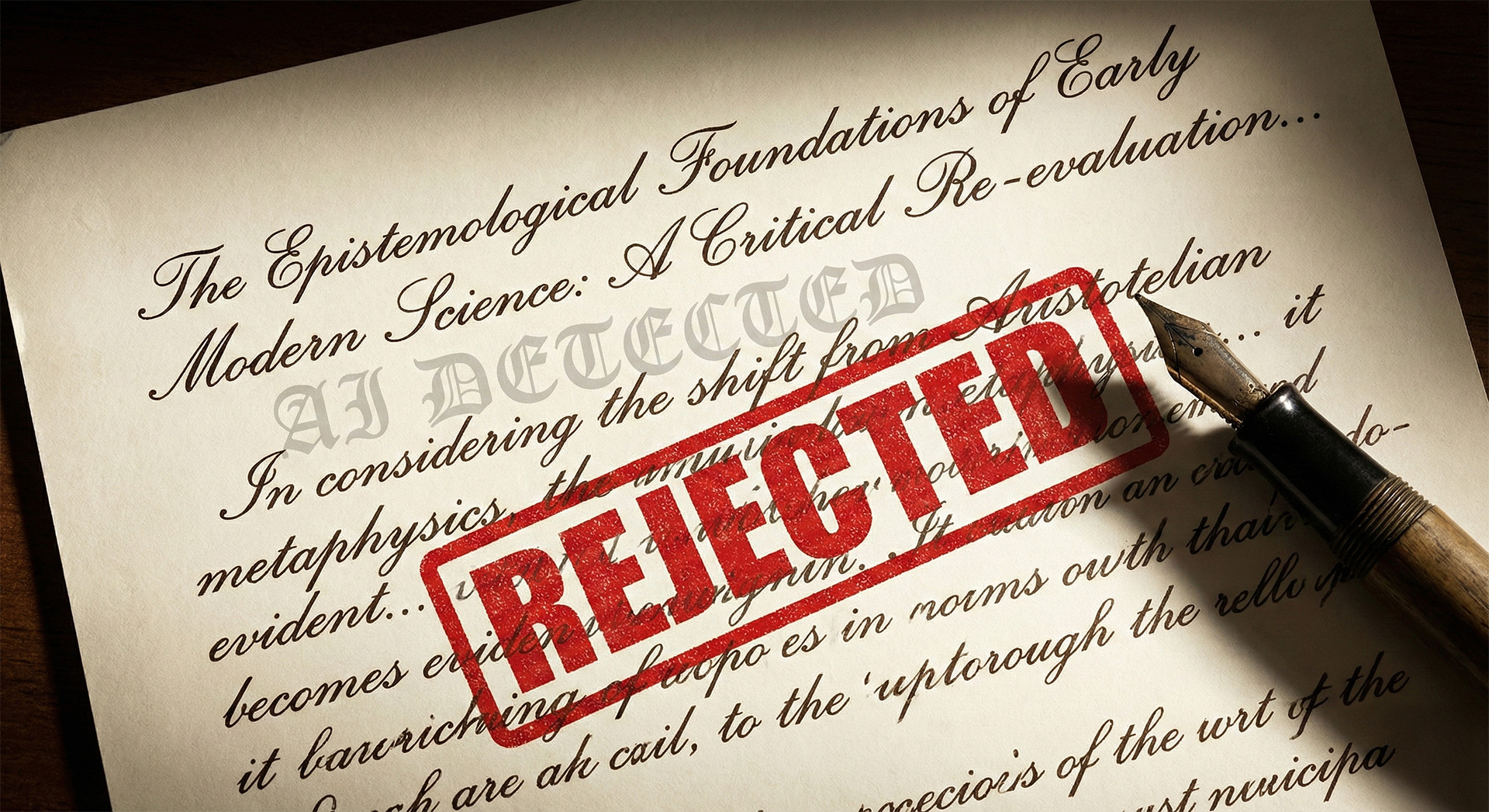
The paper is automatically rejected. The stated reason: "This is an automated rejection. No LLM generated, heavily assisted/co-written, or otherwise reliant work."
Marinoni Moretto rewrites. Changes the title, reformulates, keeps the substance. The new version is called "Pre-Ingestion: An Overlooked Source of RAG Hallucinations". Same rigorous methodology, same explicit limitations, same invitation to collaborate on validation.
Rejected again. This time the reason reads: "Not obviously not Language Model."
That phrase deserves attention. "Not obviously not Language Model" means: we cannot prove it is not AI, so we reject it anyway. The burden of proof has inverted. You no longer need to demonstrate copying; you must demonstrate you have not written too well.
The irony layers until it becomes unbearable. A paper on epistemic verification gets rejected by a system that verifies nothing. A contribution on information quality gets blocked by a filter that cannot distinguish quality from origin. A work proposing an "enforcement layer" for documents gets stopped by a defective enforcement layer.
The underlying mechanism warrants examination. AI detection tools work primarily by measuring text "perplexity", an indicator of how predictable the word sequence is. Low perplexity means accessible vocabulary, logical structure, clear progression. Precisely the qualities that make writing effective. The system interprets expository clarity as a signature of automatic generation.
Empirical research confirms this is not an isolated case. Weber-Wulff and colleagues tested 14 detection tools: all scored below 80% accuracy. Liang and colleagues, in a study published in Patterns, demonstrated that several popular detectors misclassify over 61% of essays written by non-native English speakers as AI-generated, while accuracy on American students' texts is near-perfect. Pratama identified a particularly insidious trade-off: GPTZero, the most accurate tool tested, shows statistically significant bias against non-native speakers, with 25% of non-native authors at risk of false accusation versus 11% of native speakers.
The pattern emerging is broader than mere technical inaccuracy. Detection systems are creating perverse incentives that degrade communication quality. Authors learn to avoid the clarity that triggers detection. They produce texts optimised for algorithms rather than comprehension.
Marinoni Moretto's case, documented in his own academic abstract presented at the DINAMICA 2026 conference, includes a revealing detail. In a previous ban experience on LessWrong, he had rewritten a text thirty times by hand. GPTZero assigned radically different scores to different sections of the same document: 17% AI probability for narrative sections, 85% for explanatory sections. The 68-point differential did not correlate with who had written the text. It correlated with how clearly it was written.
The dynamic recalls what happened with traditional SEO, but with a crucial difference. Degraded SEO filled the web with content optimised for stupid machines, but did not actively prevent good writers from existing. AI detection tools instead create an active filter that excludes on the basis of communicative competence. Those who genuinely know how to write have two options: deliberately degrade their prose to pass filters, or face permanent suspicion. Those who write poorly through incompetence pass undisturbed.
There is a structural irony worth noting. For decades academic writing has been criticised for being needlessly opaque, stuffed with specialist jargon, structurally contorted. Finally tools arrive that could help people write better. The institutional response is: if you write too well, you are suspect.
Luciano Floridi, in his recent paper on the new editorial gatekeepers based on LLMs, identifies the risk of "content homogenisation". But the term captures only half the problem. It is not merely homogenisation. It is homogenisation downward. A race to the bottom where the winner is whoever best manages to appear incompetent.
The question nobody is asking openly: if detection tools cannot distinguish excellent human writing from AI output, perhaps the problem is not in the tools. Perhaps the distinction we are trying to make does not exist in the terms we have framed it. Clarity, structure, and accessibility are not machine signatures. They are characteristics of effective communication, whoever produces it.
But this is a question that challenges the entire edifice. Easier to adjust the parameters and continue excluding those who write too well.
The discrimination is not only against non-native speakers with simple vocabulary. It is against anyone who has learned to communicate with precision. An AI Architect working on making AI more reliable gets excluded from an AI safety forum because his work appears too well-written to be human.
The metric has become the destiny. And the destiny is to write worse.