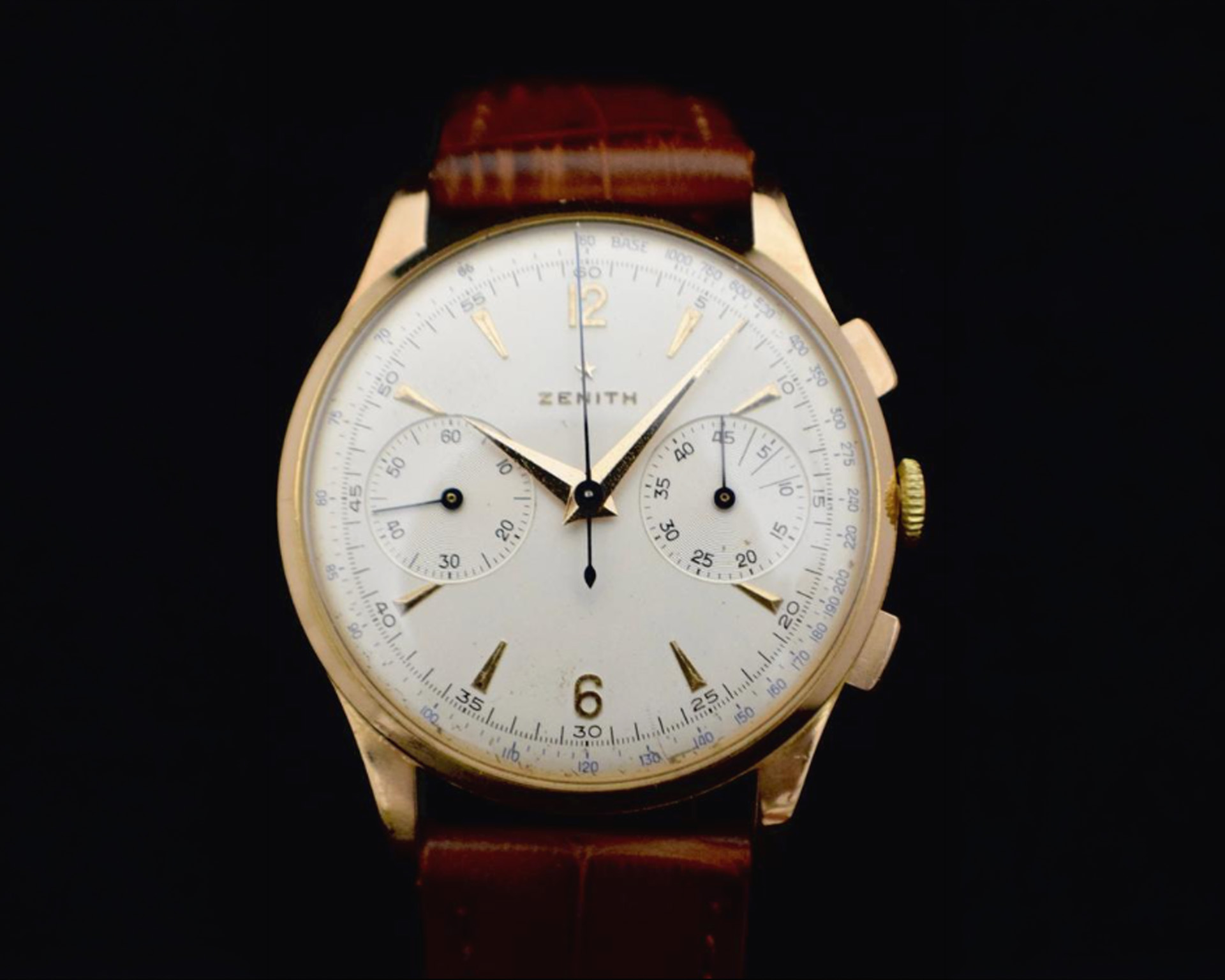
What's written round the edge
Posted on: 1 July 2026
Round the outer edge of a 1960s chronograph dial runs a numbered scale, starting from some high figure and tightening to the right until it stops near sixty. Beside it, one small word: tachymeter. Yet the instrument does not measure speed. It measures time, as any watch does, and the speed is a gift from the scale printed round the rim, calibrated against a base of one thousand metres. Time how long it takes to cover a measured kilometre and the scale gives you the speed in kilometres an hour. The mechanism knows none of this. It counts seconds, nothing more.
Change the scale and the same movement becomes a different trade. Print a graduation calibrated to the speed of sound and the tachymeter becomes a telemeter: start when you see the flash, stop when the sound reaches you; the scale gives you the distance. It was the instrument of the artilleryman and the officer, who read off how far away a gun stood from the flash of its muzzle. Print instead a graduation calibrated to thirty pulsations and you have a pulsometer, with which the doctor would start the hand, count thirty beats, stop it and read the rate per minute directly. One contrivance and three trades that never speak to one another, separated only by what someone decided to write round the edge.
This is where it is worth pausing. The intelligence of those instruments did not live in the mechanism, in the gears that anyone with patience could reproduce; it lived in the calibration of the right reference, in knowing that to turn a measurer of time into a measurer of speed you had only to know the distance covered and print it as a constant on the scale. The knowledge was not in the machine but in the choice of scale, and that choice assumed someone had understood why time and speed, over a known distance, are the same piece of information seen from two angles.
Take a second example, humbler and more common. The doctor who counts the pulse for fifteen seconds and multiplies by four is not being lazy; he is using a point of balance between speed and precision that someone, before him, had worked out. Fifteen seconds are enough for a reliable sample and few enough not to steal time from the consultation, but the good clinician also knew when that balance stopped holding, so that, faced with an irregular beat, they would abandon the shortcut and count the full minute, because a short sample, taken over an uneven rhythm, lies. The real competence was not the multiplication. It was knowing when the multiplication does not hold.
The third example sits in a gesture many of us learned as children, in the Scouts, and almost none of us understood. To find your bearings without a compass you point the hour hand at the sun, and the line bisecting the angle between the hand and the twelve gives you south. It works, not by magic but because the sun completes its circuit in twenty-four hours while the hand completes its own in twelve; it runs at twice the speed. Halving the angle between the hand pointed at the sun and the noon mark on the dial compensates exactly for that ratio of two to one, and recovers the direction that at solar noon coincides with south. Whoever knows the reason for the gesture also knows where it fails: under daylight saving, or in the southern hemisphere where the bisector has to be taken the other way. Whoever repeats it from memory does not.
Three objects, one structure. In each the apparatus is mute and the intelligence lives elsewhere, in the relation between what the instrument actually measures and what we want to know. Today that relation has been inverted. The instrument has become extremely intelligent and the operator no longer knows what happens inside it. The twenty-pound pulse oximeter counts the pulse better than any clinician and gives you the oxygen saturation as well; the satnav finds south in a tunnel at midnight, where the sun and the hour hand would be of no use at all.
And here a thing must be said that nostalgia prefers to leave unsaid: the new instrument, almost always, is objectively better. The satnav beats the sun method in every condition, without exceptions worth defending. To mourn the solar compass would be a pose. The real loss is not giving up the old method, which is a sensible thing to do; the loss is giving up the understanding of it. These are two different things, and keeping them apart is everything. You can perfectly well hand the calculation to the machine while keeping the mental model of how that calculation is done. What happens instead is that the mental model evaporates along with the practice, and all that remains is blind trust in the figure that appears on the screen.
There is a position, in this story, worth isolating. Anyone who lived through the passage from analogue to digital holds something the generations born inside the screen cannot reconstruct: they have seen both sides of the black box. They know what was inside before the lid came down. This is not a generational medal, nor has it anything to do with the silly notion that people were better before; it is simply a vantage point. The only one who can make the comparison is the one who was there before and is here after. Anyone who knows the principle of the pulsometer does not mourn the pulsometer, which was awkward and imprecise; but they can recognise what the convenience of the oximeter has made them stop thinking about, and they keep an eye on a question that does not even occur to the digital native: when the instrument is wrong, how do I notice?
Because this is the point that survives every technical advance. The intelligent instrument gets things wrong, sometimes silently and plausibly, returning a clean figure that is false. The oximeter on a cold hand, giving a reassuring and meaningless value; the satnav routing you into a river because the map is older than the collapsed bridge. Whoever knows the mechanism beneath the figure has a handhold for doubt; whoever knows only the figure has none. The competence that remains is not the old trick, the counting of beats or the reading of the sun, but the capacity to interrogate the box rather than submit to it.
To know the mechanism, then, is not erudition, nor the archaeology of a gesture; it becomes a form of freedom from blind delegation. We delegate the calculation gladly, and rightly so; but the understanding we delegate only once, and nobody notices, until one day the instrument gives a figure that ought to be contradicted and there is nothing written round the dial that we still know how to read.