What decides without speaking
Posted on: 14 August 2026
In the second half of the 2000s I spent a good deal of time in an encoding suite off the Via Tuscolana in Rome, where Microcinema prepared film files for distribution to digital screens. The work amounted to feeding the machine a master and waiting. The encoder made a first pass across the entire film, measuring the complexity of motion frame by frame, and then decided on its own how to allocate the available bits, generously to the fast action and sparingly to the static wide shots, with a gradation of judgements in between that none of us examined in any detail. That decision was irreversible, because it went into the distribution master, which is to say into the copy audiences would see for the whole commercial life of the film.
Nobody in that room would have thought to call it intelligence. It was called encoding. It was a line item on a quotation, machine time to be budgeted for, something that occasionally got it wrong and then you ran the pass again. The room was cold because the racks threw off heat and the air conditioning had to be kept low, and the first pass was the moment everyone went downstairs for coffee, because there was nothing else to do but wait for the machine to finish forming an opinion about the film.
The other half of the work involved keys. An encrypted film arriving at a cinema does not open by itself. It requires a key issued for that specific projector, bound to its certificate, valid within a window of dates set upstream. We built that mechanism on Microsoft technology, before the international standard arrived to codify it, and the principle was already the one that governs every screen in the world today. The system verified and it decided. If the certificate did not match, then at half past eight with a full house the film did not start, and the projectionist had nobody to argue with. He had an outcome. Some years later, in 2010, that infrastructure fed into ISIDE, a project funded by the European Space Agency through its ARTES programme, with Microcinema in consortium alongside OpenSky, Skylogic and Digital Pictures. A single film ran to more than three hundred gigabytes and came down at a hundred and twenty megabits per second across two satellites in parallel, sixty apiece. It ended up covering more than ninety per cent of Italian digital screens.
Twenty years on, that sort of decision has acquired a new name. It has also acquired a public image, a parliamentary debate, an existential panic and an asset bubble. But the new name did not attach itself to that sort of decision. It attached itself only to the part that talks.
The figure that makes this measurable comes from the American Food and Drug Administration, which since 1995 has maintained a public register of authorised medical devices incorporating artificial intelligence. By the end of 2025 the register held roughly one thousand four hundred and fifty devices, seventy-six per cent of them in radiology. The first, authorised in 1995, was PAPNET, a rescreening tool for cervical cytology that reread slides already examined by a human eye in order to catch what the human eye had missed. The interesting detail is not the volume but an absence: none of those devices uses generative artificial intelligence or rests on a language model. Not one. Thirty years of clinical artificial intelligence in production on real patients, and there is no chat window anywhere in it.
These systems have no conversational interface because they have no use for one. They work on inputs that are not questions, being density values, greyscale gradients, time series, coordinates. They return outputs that are not answers but classifications, thresholds and alerts. The form of the exchange is that of a measuring instrument rather than an interlocutor, and it is precisely this that keeps them invisible to public argument while they sit inside decision chains bearing on the health of millions.
From which follows the proposition I want to put, and I put it as mine rather than as settled fact: the public visibility of a technology depends neither on its power nor on its diffusion, but on the existence of a conversational way in. What can be interrogated becomes mass culture, whereas what decides without answering to anyone remains infrastructure, and infrastructure does not generate an imaginary. It generates bills.
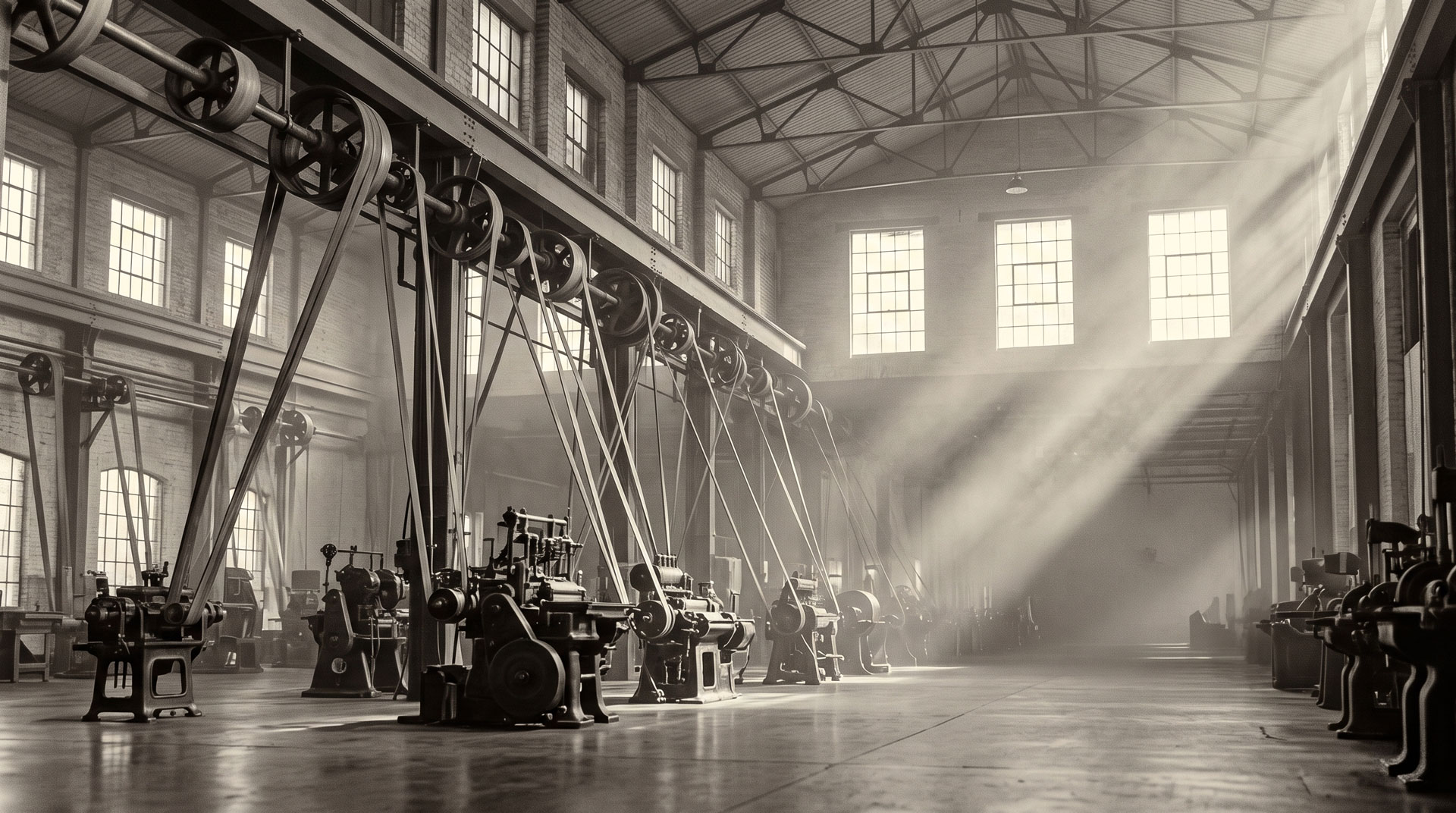
There is a precedent that survives scrutiny, and it comes from economic history. Paul David, in a paper published in the American Economic Review in May 1990, reconstructed what happened to American factories when electricity arrived. In the first phase the manufacturers did the apparently obvious thing and replaced the steam engine with a dynamo while retaining the whole centralised line shaft that distributed power mechanically to every machine on the floor. The dynamo was a single object, large and conspicuous, and as such it entered perception. Only in the 1920s did the unit drive arrive, meaning an individual electric motor mounted on each machine, and it is at that point that productivity takes off, because the physical layout of the shed changes. David argues about productivity and the lag before it appears; the extension I am making concerns perception, and it is an extension he does not make. The electric motor, in multiplying, disappears. There are dozens in the average European home today and nobody could count them, while the word dynamo remains stuck to a century that has gone.
The artificial intelligence that works on parameters is already at the unit drive stage, so widely distributed that it has become invisible through saturation. The one that talks is still at the dynamo stage, a single celebrated object, because it has a face and it answers when called.
That much is observation. What makes the argument operational happened this month, and it repays close attention because confirmation rarely arrives this cleanly. Regulation (EU) 2026/1744, the Digital Omnibus on artificial intelligence, was published in the Official Journal on 24 July 2026 and entered into force on the 27th, six days before the deadline that was to have brought the AI Act's heaviest obligations into application. The deferral covers the high-risk systems of Annex III, meaning those operating on creditworthiness assessment, recruitment, access to education and essential services, with application pushed from 2 August 2026 to 2 December 2027. For artificial intelligence embedded in products already regulated, from medical devices to machinery, the date slips to 2 August 2028. What was not deferred by a single day is Article 50, the transparency and content-marking obligations, in application since 2 August.
Put in the sequence as a European citizen encounters it: a generated image must now be labelled as such, while the system determining whether you are granted a mortgage has been given sixteen further months of latitude.
The lazy reading of this is conspiracy and should be discarded at once, because it does not hold. The Commission's stated grounds are verifiable: the harmonised standards CEN and CENELEC were to have produced were not ready, and the conformity assessment infrastructure the AI Act presupposes simply did not exist. The mechanism, in other words, is that regulating something with an interface is cheap, because it is enough to impose a label on the output and verification is immediate, whereas regulating something that decides on parameters is enormously expensive, because it requires building a technical apparatus capable of inspecting a process no citizen can observe directly. Visibility and regulability coincide, not through anyone's design but because both depend on the same structural property.
Britain, having left before the AI Act came into force, offers the cleanest test of that claim, because it took the opposite route and arrived at the same asymmetry. There is no horizontal statute here and no AI bill before Parliament, as the House of Commons Library confirmed in a briefing on 10 June this year. Artificial intelligence is regulated at the point of use, by the regulators that already existed, applying the law that already applied to them. It is a defensible position and in several respects a more intelligent one than the Brussels approach, since it avoids legislating in advance of understanding. What it does not avoid is the same distribution of attention. When Lord Holmes of Richmond brought the case for cross-sector legislation to the Lords on 4 June, the harms he set out were precisely the silent ones: young people not shortlisted for jobs without knowing that an automated system had removed them from the process, and without meaningful redress once they did know. Benefit claimants in the same position. Nobody has to conceal these systems for them to escape argument. They escape it because there is nothing there to argue with.
What follows is a consequence nobody chose and everybody will live with. The law across Europe is stratifying quickly around what we can see and interrogate, while the systems that decide about real people on measurements those people never see are left to settle into practice without contest. They are not hidden, note. They are public, documented, in many cases authorised by serious agencies. They simply have no mouth with which to answer objections, and public argument runs on objections.
There is a counter-example that bothers me, and I would rather not bury it, because burying it would make the argument more elegant and less true. Civil nuclear power never had a conversational interface, never answered to anyone and operates on parameters opaque to the public, and yet it generated seventy years of the fiercest argument any technology has produced in Europe, and it has moved governments. So my proposition, taken literally, is false.
What rescues the argument, while correcting it, is that nuclear power had an image. It had the mushroom cloud, it had the cooling tower, and in this country it had Windscale before anyone had heard of Chernobyl. An interface is not required to enter the collective imagination. A figure is required, something the eye can seize and the memory retain. A chat window is an extraordinarily powerful figure because it places the machine in the position of interlocutor, which is the oldest position our brains know how to recognise. The classifier reading a mammogram has no figure at all. It has no mushroom cloud and no cooling tower. It has a report that looks like every other report.
It is worth asking what it would take for that thing to become visible. Not an accident, probably, since the failures of diagnostic systems are already documented and have produced nothing resembling a debate. Perhaps it takes only the time it always takes, which is the arrival of a generation that takes those systems entirely for granted and starts asking who wrote them.
In that suite off the Tuscolana, at any rate, the machine was right almost every time. It was the almost that was interesting, and we never gave it nearly enough thought.