The watch that needs no battery needs no explanation
Posted on: 25 February 2026
There is a test that works in any boardroom in the world. Look at the wrists around the table. Not the suit, not the shoes, not the bag: the wrist. The person wearing a Rolex Submariner is telling you they can afford one and want you to know it. The person wearing an A. Lange & Söhne Zeitwerk is telling you something else entirely. And if you cannot work out what, the message was never meant for you.
This distinction reveals more about the nature of genuine luxury than any consultancy report on the watch market, a market in which Swiss exports alone reached 25.9 billion francs in 2024, according to the Federation of the Swiss Watch Industry. An extraordinary sum for objects whose primary function has been rendered obsolete by any mobile telephone. The paradox deserves attention: the more useless the mechanical watch becomes as a time-telling instrument, the more valuable it becomes as an instrument for reading the person who wears it.
The mechanism is counterintuitive only on the surface. Beneath it lies a precise structural logic involving scarcity, costly signalling and the difference between buying an object and understanding one.
Start with a fact the Swiss watch industry prefers not to advertise too loudly. Rolex produces roughly 1.24 million watches per year. Every single one sells. Waiting lists for a Submariner have shortened since the frenzy of 2021; today one might wait six months, perhaps a year, compared with the three or four years common during the pandemic. But the mechanics of managed scarcity remain intact: authorised dealers decide who may buy and who may not, based on purchase history and the buyer's "relationship" with the shop. In practice, to buy the watch you want you must first buy those you do not. It is a system of compelled loyalty that transforms the purchase into a ritual of commercial submission. The fact that millions of people accept this without complaint tells us something about the psychology of status that no marketing textbook could explain more clearly.
So far, nothing particularly interesting. Inaccessible luxury generates desire; Thorstein Veblen understood this in 1899. The point lies elsewhere: what happens when the object everyone desires becomes the wrong signal?
Consider what has happened to the Submariner over the past decade. From a tool designed in 1954 for professional divers, rated to three hundred metres of water resistance, it has become the wrist ornament of people who have never been near salt water except from the rail of a chartered yacht. The Submariner is now the universal signal for "I have arrived"; it is worn by hedge fund managers, rappers, cryptocurrency influencers and anyone wishing to communicate financial success in the quickest, most legible manner possible. Which is precisely why it has ceased to function as a signal of genuine distinction. When everyone at the table wears the same watch, the watch says nothing about the wearer. It merely confirms the right credit facility.
This is where the story becomes interesting. Because whilst the mainstream market crowded around Rolex, Patek Philippe and Audemars Piguet, the so-called "Holy Trinity" of Swiss watchmaking, something different was happening at the margins. Independent watchmakers producing a few dozen pieces per year were becoming the true objects of desire for those possessing the competence to understand what they were looking at.
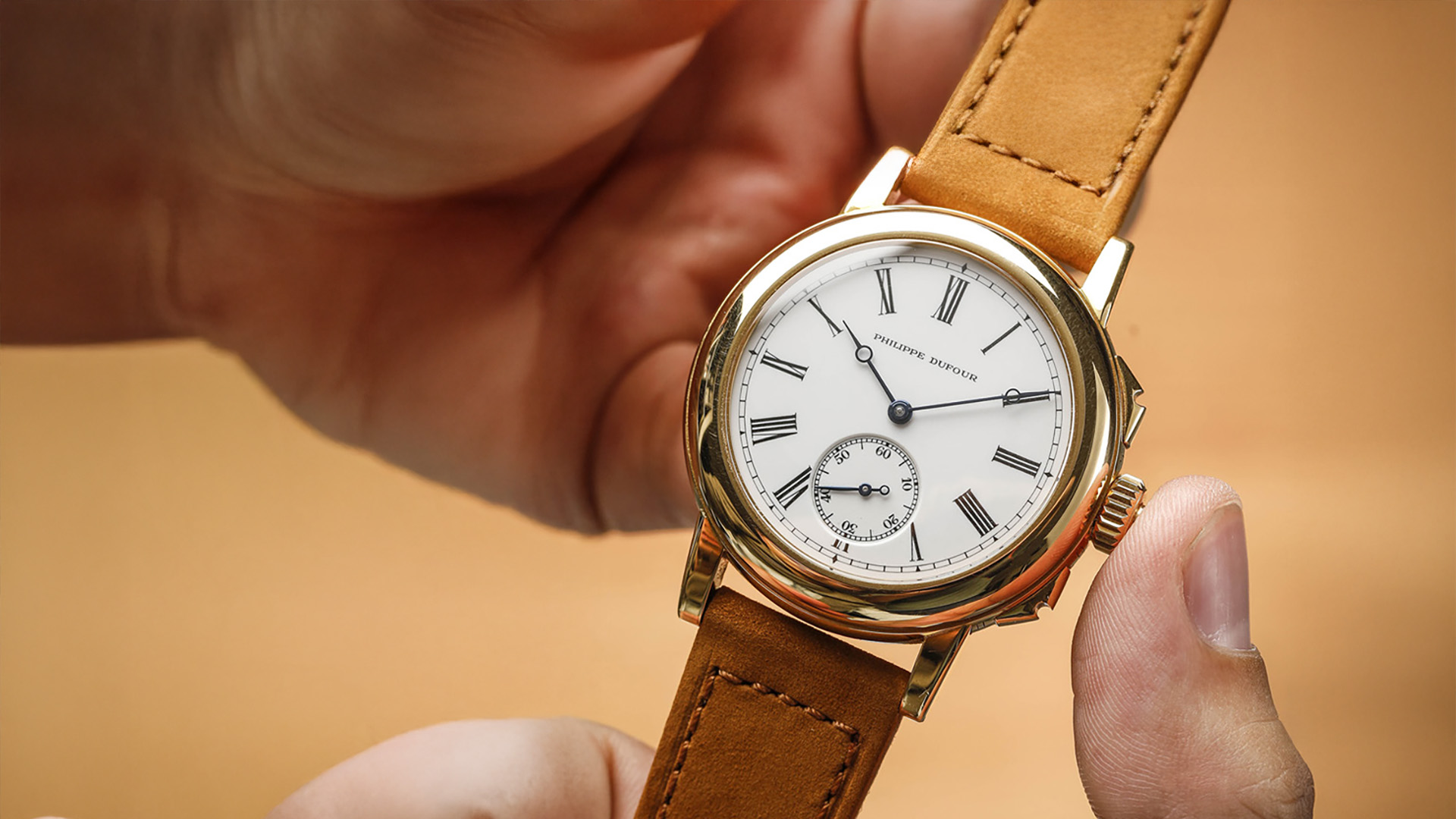
Philippe Dufour is the most extreme case study. A Swiss watchmaker from the Vallée de Joux, he has produced approximately two hundred and fifty watches in his entire career. Not per year: in total. His Simplicity model, which to the untrained eye looks like any other dress watch, sells at Phillips auctions for figures that would embarrass a Daytona. But the fundamental difference is not the price. It is that buying a Dufour required knowing someone who knew someone: clients came from a tight circle of collectors, their names written by hand on small cards placed beside movements still being worked on. No algorithmically managed waiting lists, no dealers judging your purchase history. Only competence recognised by competence.
The contrast with the Rolex model is architectural, not merely commercial. Rolex sells 1.24 million pieces annually and resale values exceed purchase prices: a Datejust has appreciated by three hundred per cent over fifteen years, according to data from Bob's Watches. It is, to all intents and purposes, a liquid safe-haven asset. You can convert it to cash at any moment, in any city. But that very liquidity is the signal of the problem: if a watch is principally an investment, it is no longer a watch. It is a financial instrument with hands.
And then there is the definitive test. Say "Seiko" to someone wearing a Submariner and observe the reaction. A condescending smile, in the best case. Open laughter, in the worst. For the average Rolex wearer, Seiko is the two-hundred-pound quartz watch one picks up at the airport duty free. End of discussion. That reaction is the most accurate X-ray available of the difference between having money and having knowledge.
Because Grand Seiko, the haute horlogerie division of Seiko, produces watches that on a technical level humiliate everything Switzerland offers at the same price point. The Spring Drive calibre, introduced in 2004, combines the mainspring of a mechanical watch with a quartz-controlled regulator requiring no battery: a system called Tri-synchro that no other manufacturer in the world has managed to replicate. The seconds hand sweeps in continuous motion, without ticking, with a fluidity that once seen is never forgotten. Accuracy sits at plus or minus one second per day against the two seconds of a Rolex certified Superlative Chronometer. The dials are finished using the Zaratsu technique, a distortion-free mirror polish requiring months of apprenticeship, producing surfaces no machine can replicate. In 2025 Grand Seiko unveiled the 9RB2 calibre, the most precise mainspring-powered wristwatch movement ever produced: plus or minus twenty seconds per year.
A Grand Seiko loses value the day after purchase, between five and twenty per cent on the pre-owned market. To the Submariner wearer this appears to confirm that it is "not worth anything". And that reasoning is precisely what reveals the problem: someone who judges a watch by its resale curve is not judging a watch. They are judging an equity with a strap. The collector who chooses a Grand Seiko knows they are purchasing the finest horological engineering available at that price. But they also know the person sitting beside them with the Submariner will never understand this. And in that asymmetry of comprehension lies the entire meaning of the word "distinction".
The same dynamic repeats at a higher level of complication. A. Lange & Söhne, the Glashütte manufacture in Saxony, presented the Minute Repeater Perpetual at Watches & Wonders 2025: a watch combining a perpetual calendar (accurate until the first of March 2100, when the Gregorian calendar skips a leap year) with a minute repeater, the mechanism that sounds the time on demand through hand-tuned hammers and gongs. The repeater mechanism alone comprises 194 components. Only watchmakers with years of specific experience may assemble it; the process requires disassembly, tuning, reassembly and repeated testing until the sound achieves perfection. The platinum case was chosen because the acoustic properties of the metal produce a timbre that other materials cannot replicate.
Compare this with a Submariner. The Submariner is an excellent watch, built to exceptionally high industrial standards. But it is an industrial watch: series-produced, with minimal variation between specimens, optimised for robustness and recognisability. The Lange Minute Repeater Perpetual is an individual act of craftsmanship in which each example sounds different because it was tuned by hand by a different human being. One is a product. The other is a gesture.
Here the pattern emerges that connects this story to the series we have been building. The thread running through handwriting, slow-leavened bread and now the mechanical watch is always the same: the time invested is not a cost; it is the product. Sourdough fermentation cannot be accelerated; Zaratsu polishing cannot be automated; the tuning of a minute repeater's gongs cannot be delegated to an algorithm. In all three cases, the temporal constraint is what produces the value. Remove the constraint and you remove the value itself.
The mainstream luxury industry has spent twenty years attempting to separate the status signal from the object that generates it. The result is a market in which the waiting list has become the product, the logo has become the value and the capacity to purchase has replaced the capacity to understand. But signals that everyone can read cease to function as signals at the precise moment everyone reads them. It is information theory applied to the wrist: when noise becomes indistinguishable from signal, the signal must move elsewhere.
And it has moved. Towards dials without recognisable logos. Towards complications requiring ten minutes of explanation before you grasp what you are looking at. Towards watchmakers producing thirty pieces a year who have no need for anyone to recognise them in the street. Towards objects that function the way mid-century design furniture functions in interior decoration: those who know, see immediately. Those who do not, walk past without noticing.
The Zeitwerk Minute Repeater has 771 components, two dedicated watchmakers who spend over a month assembling each one. And a launch price of 467,000 dollars. It does not hold its value like a Rolex on the secondary market. It is not recognised by the restaurant waiter. It does not appear in Instagram selfies. It is not a rational investment. And precisely for this reason it communicates something no Submariner can ever communicate: that its wearer chose to invest in understanding rather than recognisability.
In traditional horological terminology, "complications" are functions beyond the simple reading of time: the perpetual calendar, the chronograph, the tourbillon, the minute repeater. It is a revealing word. Every added complication makes the watch harder to build, more fragile, more expensive and paradoxically less precise in its basic function of keeping time. In a world obsessed with optimisation, efficiency and simplification, the horological complication is the precise opposite: deliberate complexity in the service of the mechanism's own beauty. The complicated watch does not work better than the simple one. It works more interestingly. And "interesting" is a category of value that the economics of efficiency cannot measure.
Perhaps this is the final cut. We live in an age in which every object is judged by what it does. The mechanical watch with complications is judged by how it does it. The difference between those two criteria is the difference between buying a Submariner because "it is a good investment" and buying a Dufour Simplicity because the name itself is a statement of intent. Simplicity that requires an entire lifetime of mastery to achieve. The artisan's gesture that needs no explanation to those who can recognise it.
If you cannot recognise it, the watch was not meant for you. And that is perfectly fine.