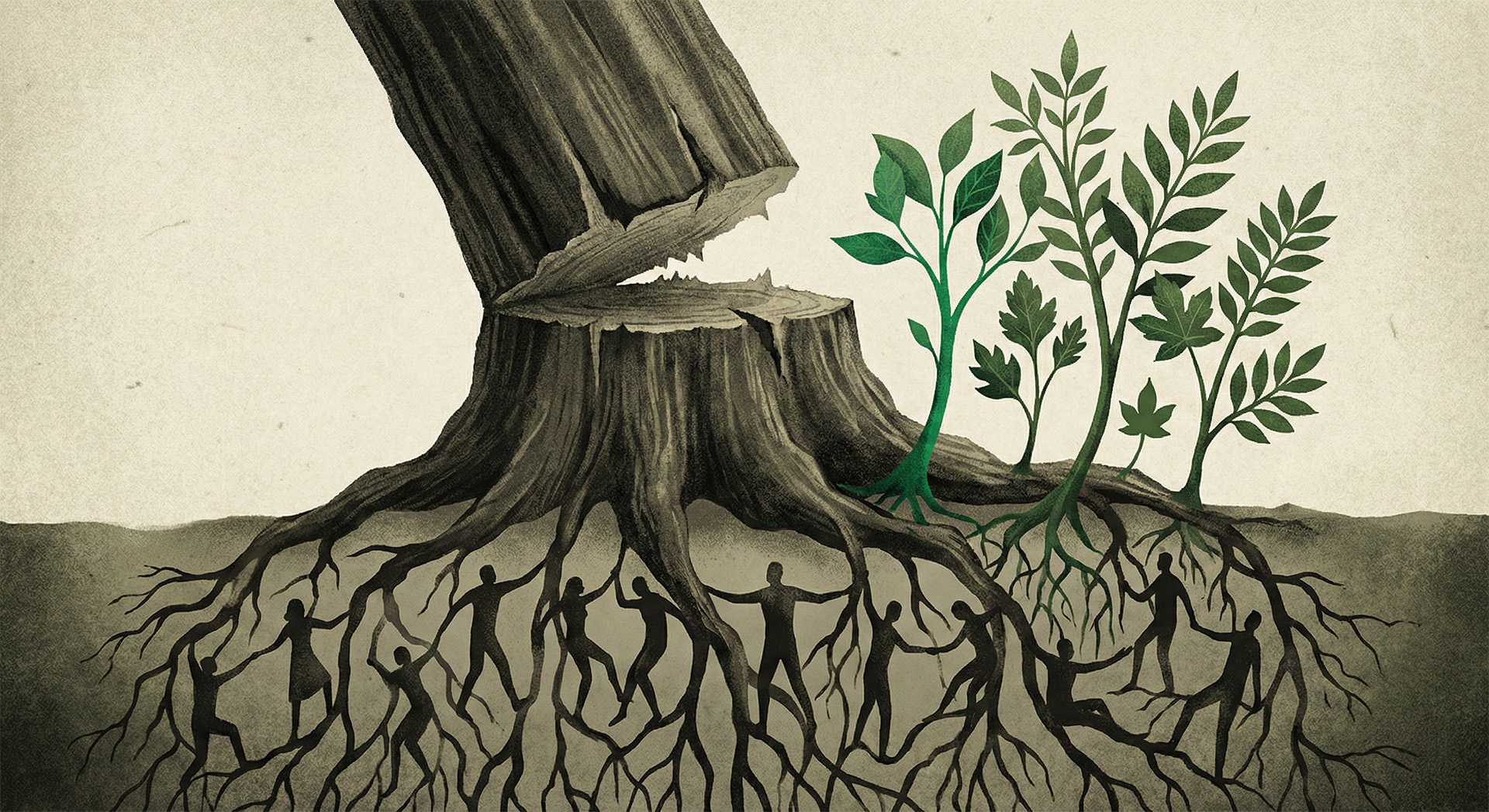
The tree and the roots
Posted on: 16 February 2026
There's a line that Berkshire Partners' consultants probably never heard, spoken by Chris Cooper, founder of Two-Brain Business and mentor to hundreds of CrossFit box owners: "Affiliates aren't the fruit of CrossFit's tree. They're the roots."
That distinction — deceptively simple — contains the entire diagnosis of what's happening to the most recognisable fitness brand on the planet. And it explains why a competitor born in 2017 in a Hamburg warehouse is systematically colonising the infrastructure CrossFit spent twenty years building.
The numbers tell the story
CrossFit's trajectory reads with surgical clarity. At its 2018 peak, the network counted over 15,000 affiliated gyms across 162 countries. Today, roughly 9,900 paying affiliates remain. Registrations for the 2025 Open — the event that has always measured the community's pulse — dropped 30%, landing at approximately 234,000 participants. Top-tier athletes including Patrick Vellner, Laura Horvath, and Annie Thorisdottir chose to sit out the 2025 season entirely.
In March 2025, Berkshire Partners — the private equity fund that acquired the brand in 2020 for approximately $200 million — officially put CrossFit up for sale, engaging Moelis & Company to find buyers. A year later, in February 2026, the sale has yet to materialise. Multiple negotiations have collapsed, announced deadlines have passed without outcome, and ownership remains unchanged.
How to kill an ecosystem
To understand what went wrong, you first need to understand what CrossFit actually is. It's not a product. It's not a retail chain. It's not a scalable technology service. It's a community ecosystem. Its value resides in the relationship between the brand and the boxes, in the trust of coaches, in the passion of athletes. It's a system where value is created from the bottom up — every session, every local competition, every friendship forged under a barbell.
Private equity operates with the opposite logic. Buy, optimise margins, sell within five to seven years. It's a machine designed to extract value, not to cultivate it. When Berkshire Partners raised the affiliation fee from $3,000 to $4,500 in 2024, they applied a logic that was perfectly rational from a financial standpoint. But they ignored the signal that increase sent to the tree's roots: we don't care about your economic balance, we care about our return.
Then came the 2024 Games disaster: the death of Serbian athlete Lazar Đukić during the open-water swim event in Fort Worth. The response from headquarters was a textbook case of what not to do in crisis communication: refusal to publish the independent investigation, an internal safety board instead of an autonomous one, maintenance of the existing leadership despite community demands. Every decision communicated the same message: control matters more than transparency.
In social design terms, CrossFit violated three fundamental principles simultaneously. It broke the trust contract with its base (constitutional school: those who govern must be accountable). It misaligned incentives between ownership and community (economic school: when the manager's interest diverges from the ecosystem's, the system deteriorates). And it ignored weak signals from the network (network school: the value of a central node depends on the health of peripheral connections).
Two machines, two logics
To appreciate the elegance of the HYROX manoeuvre, you need to understand that the two business models are structurally opposite.
CrossFit is essentially a licensing company. The revenue engine is affiliation fees: $4,500 per year for the right to use the name. The Games are a cost centre disguised as marketing, the Open is virtual and free. Headquarters doesn't own gyms, doesn't deliver services directly to practitioners, doesn't control the quality of the experience. It collects rent on the brand and hopes perceived value justifies the price.
HYROX, founded in 2017 by Moritz Fürste — an Olympic gold medallist in field hockey — and entrepreneur Christian Toetzke, who comes from the world of major endurance events, is the opposite: an events company that uses gym affiliation as a feeder channel, not as a primary revenue source. Each HYROX race attracts between 3,000 and 5,000 paying participants, plus thousands of spectators. The 2023 London event reached 12,500 athletes over three days, with 2024 forced to introduce a lottery system to manage 15,000-plus requests. The machine generates immediate, predictable cash flow. Gym affiliation costs roughly £999 per year — less than a quarter of what CrossFit charges — and is perceived as an investment that brings clients in, not as a feudal tax.
The numbers tell the speed of this machine: from 800 affiliated gyms in March 2023, to 2,700 by end of 2023, to 5,000 by end of 2024 at a 260% annual growth rate, to over 7,000 in 2025. Partnerships with chains including PureGym, F45, Fitness Park, and GymNation. Over 550,000 athletes expected at 2025 races. Projected revenues of approximately $140 million. Puma as global sponsor through 2030. Red Bull, MyProtein, and — a detail worth more than any analysis — Mat Fraser, five-time CrossFit Games champion, sponsoring HYROX events through his HWPO brand.
When the greatest athlete in your sport's history goes to sponsor the competition, the signal is hard to ignore.
The Trojan horse
But the real strategic genius isn't in the numbers. It's in the architecture of penetration.
HYROX didn't build its own gyms. It colonised existing ones. CrossFit boxes have SkiErgs, rowers, kettlebells, sandbags, sleds, wall balls — precisely the equipment needed to train for a HYROX race. The physical infrastructure was already there, built and paid for by the very owners CrossFit was neglecting. HYROX only needed to offer a reason to use it differently.
The strategy follows three phases, readable through the lens of game theory as a textbook case of symbiotic parasitism evolving into direct competition.
Phase one: complementary positioning. "We're not CrossFit competitors, we're an additional opportunity." Boxes can affiliate with both. HYROX offers an extra revenue stream, everyone's happy. Hari Singh, one of the longest-serving CrossFit affiliates in the world, owner of CrossFit NYC, describes the transition with disarming pragmatism: he added HYROX classes without significant investment, using equipment he already owned.
Phase two: base capture. New members discover HYROX is more accessible. No Olympic snatches, no muscle-ups, no handstand walks. Run, row, push a sled, throw a wall ball. Movements anyone can perform from day one. The consistent format allows participants to compare their times against anyone in the world, creating a powerful and democratic motivational mechanic. As Allison Outlaw, HYROX coach at CrossFit Central in Houston and world champion in her age group, put it: "There are people who simply aren't interested or are unable to squat with a barbell overhead. That doesn't mean they don't love the intensity and community of CrossFit."
Phase three: silent substitution. The client walks into a box still called "CrossFit XY" but trains for HYROX. When the CrossFit affiliation renewal comes around — perhaps at $10,000, as the Diebner consortium's business plan proposed — the owner does the maths: my clients want to do HYROX, do I really need the word "CrossFit" on the door? The answer is increasingly no.
Complexity and identity: the double-edged sword
Here, though, a clarification is needed that rushed analyses tend to skip. CrossFit's technical complexity — those snatches, those butterfly pull-ups, those handstand walks — isn't merely a barrier-to-entry problem. For years it was the engine of tribal identity that made CrossFit a cultural phenomenon, not just a workout format. Difficulty created belonging. Overcoming a technical obstacle together generated a community bond that no standardised format can replicate.
The point isn't that CrossFit was too technical. It's that when trust in the system breaks — fees rise, safety falters, communication disappears — technical complexity shifts from a belonging engine to an uncompensated cost. As long as I feel part of something special, I invest time and effort to learn handstand walks. When I sense that those managing the brand don't care about me, that same effort becomes a reason to leave for something simpler and more immediate.
HYROX intercepts exactly this segment: people who love intensity and community but no longer have (or never had) the motivation to clear the technical barrier. It's a proposition that works magnificently during a moment of distrust toward the dominant brand. The question is whether it will work equally well once the novelty fades.
The hidden vulnerability
Because HYROX has a structural fragility that few are discussing: monotony. The format is always identical. Eight kilometres of running, eight stations, same movements, same sequence, in every city in the world. This standardisation is today's strength: it enables global leaderboards, predictability for investors, scalability for partners. But it's also the potential Achilles heel.
Those with good memories will recall Tough Mudder: explosive growth, millions of participants, global media coverage, then progressive saturation and decline. The lifecycle of a standardised format is structurally different from that of a community ecosystem. The format depends on novelty and enthusiasm; the ecosystem depends on relationships and identity. The first has an implicit expiration date; the second can last generations, if it's cared for.
CrossFit, paradoxically, had built the latter. And is losing it. HYROX is building the former. And may discover in a few years that today's attracting standardisation becomes tomorrow's bore. The game isn't as settled as it appears.
The impasse
In February 2026, CrossFit occupies a textbook strategic stalemate. Berkshire Partners wants out but can't find buyers at an acceptable price. The latest interested consortium — led by investor Wade Diebner and fitness entrepreneur Mark Mastrov, founder of 24 Hour Fitness — missed every declared deadline. Its business plan (doubling affiliate fees, a home workout app, a multi-level marketing programme for supplements) was met with open hostility by the community, revealing a total disconnect between those wanting to buy and those who would need to make the system work.
An IPO is theoretically possible but practically unrealistic: with declining affiliates, contracting revenues, likely negative margins, and a brand stained by a mishandled tragedy, no analyst would write a positive note. Public markets don't forgive downward curves, especially after Peloton — listed in 2019, stratospheric Covid-era valuations, then vertical collapse — made investors allergic to fitness sector promises.
Meanwhile, every month CrossFit remains in limbo is a month in which new boxes affiliate with HYROX, new athletes discover the format, new sponsors sign contracts. Time works against CrossFit and in favour of its competitor, with an asymmetry that amplifies.
The structural lessons
If you manage a community-based ecosystem — whether a franchise network, a creator platform, a voluntary organisation, or a professional network — this story contains lessons worth more than any financial model.
Don't confuse the asset with the infrastructure. Berkshire Partners thought they'd bought a brand. In reality, they'd bought an ecosystem that worked because thousands of local entrepreneurs invested passion, capital, and personal reputation every day. The brand was the glue, not the substance. Stripping resources from the glue doesn't optimise the asset: it disintegrates it.
Infrastructure built by others can be colonised. HYROX didn't invest a penny in building gyms. It leveraged an existing global infrastructure, built and maintained by owners seeking new reasons to justify their investment. It's the same pattern Uber applied to taxis, Airbnb to real estate, and every platform that grasped that owning infrastructure is expensive while orchestrating it is profitable.
Complexity is a double-edged sword that depends on trust. CrossFit's difficult movements weren't a design error: they were the engine of community identity. But complexity only works when the system containing it enjoys trust. Without trust, that same complexity becomes the first reason to leave for something simpler. Accessibility doesn't beat complexity in absolute terms: it beats it only when complexity is no longer sustained by the relationship.
The revenue model determines incentives, and incentives determine behaviour. CrossFit earns from licences: its natural incentive is to maximise the licence price, regardless of value delivered. HYROX earns from events: its natural incentive is to maximise participant numbers, which drives it to invest in experience, communication, and support for the gyms that feed its athlete pool. Two different machines producing different behaviours — and different results.
Trust is an asset that accumulates slowly and is destroyed instantly. It took twenty years to build the CrossFit community. Four years of financial management were enough to damage it potentially beyond repair. Đukić's death didn't cause the crisis: it revealed the fragility of a trust structure already compromised. Had the relationship with the base been solid, the community would have absorbed the trauma. Instead, it became the breaking point.
Provisional epilogue
CrossFit built something extraordinary over twenty years: a global community ecosystem with a powerful tribal identity, constructed on the passion of thousands of local entrepreneurs. HYROX is demonstrating that you can inherit that value in three years, if the rightful owner stops caring for it.
But the story isn't over. The standardisation that makes HYROX soar today could become its ceiling tomorrow. And CrossFit, if it found ownership capable of rebuilding trust with its roots, still holds an advantage no format can replicate: twenty years of community identity and a complexity that, when sustained by relationship, creates belonging impossible to imitate.
The question isn't who wins. It's who understands first that the value of an ecosystem resides in the quality of relationships between nodes, not in the strength of the central node.
You can optimise margins, raise prices, cut staff, centralise decisions. From a spreadsheet's perspective, each of these moves improves the numbers in the short term. But you're cutting the tree's roots and expecting the fruit to keep growing.
And when the roots weaken, someone else arrives and grafts onto your own soil.