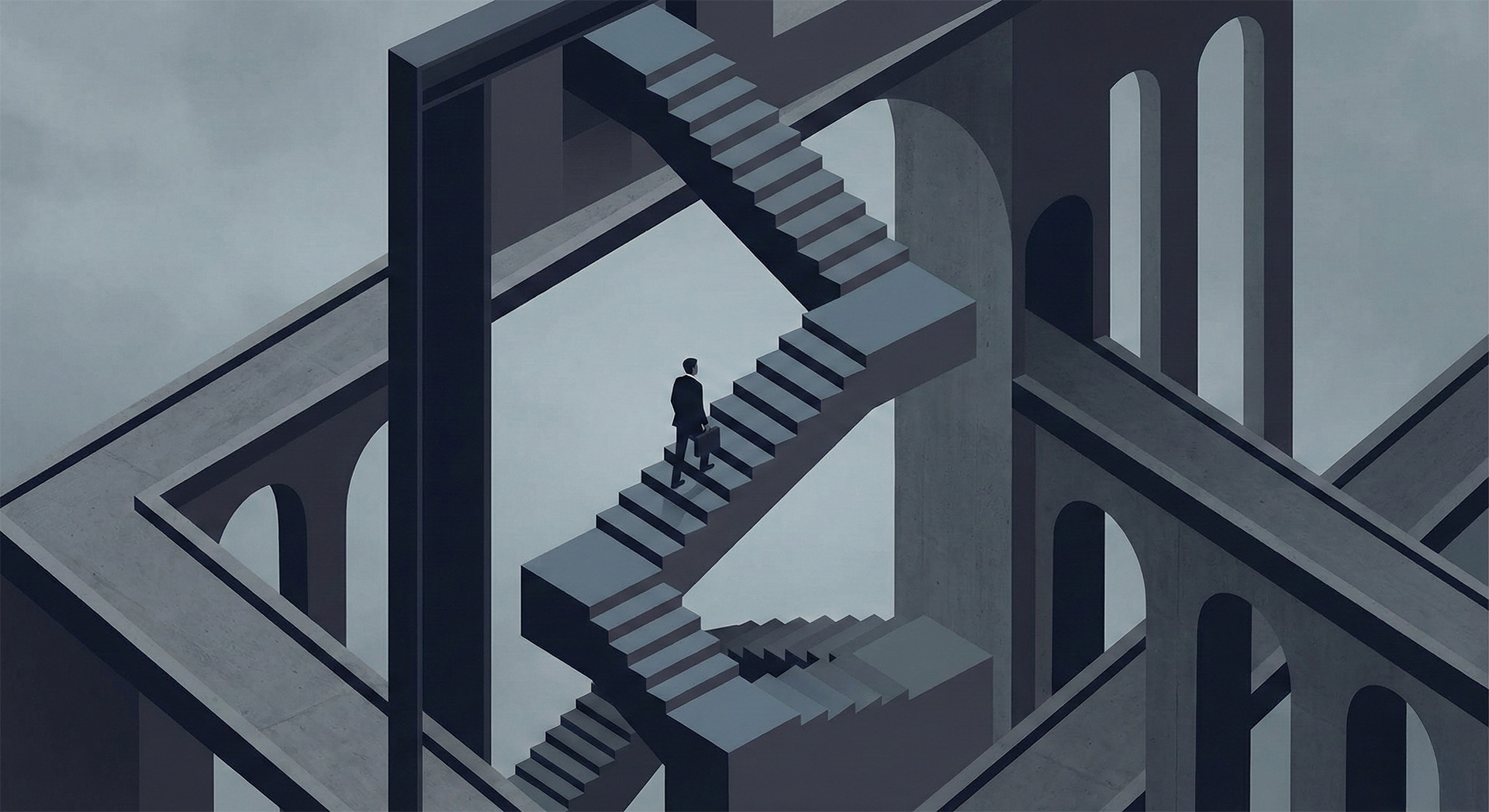
The tax system that punishes work
Posted on: 25 January 2026
There is a paradox millions of people experience without quite being able to name it.
A professional earning £60,000 in London belongs, on paper, to the top 15% of British earners. They should be comfortable. They should be able to save for a deposit, build some security, plan for the future.
In reality, after tax and the cost of living, that professional struggles. Cannot accumulate a house deposit without family help. If they have children, performs constant financial gymnastics between nursery fees and childcare costs. Every unexpected expense becomes a source of anxiety.
And if they look at colleagues earning somewhat less, they notice something odd: those colleagues do not seem much worse off. Sometimes they seem better off.
This is not an impression. It is mathematics.
In Britain, crossing the £100,000 income threshold triggers what financial advisers now openly call "the tax trap." Your personal allowance begins to taper away, creating an effective marginal tax rate of 60% on income between £100,000 and £125,140. But that is merely the beginning.
For a parent with young children, crossing that threshold means losing access to funded childcare hours and tax-free childcare schemes. According to Rathbones, for parents with two children under five, earning just £1 over £100,000 can mean losing childcare support worth almost £20,000 a year.
Twenty thousand pounds. For earning one pound more.
The system is telling you, in terms that could hardly be clearer, that career progression does not pay.
One might assume this is a peculiarly British problem. Perhaps an unintended consequence of the complex interaction between the tax system and the childcare policies introduced over recent years. A technical glitch waiting to be fixed.
It is not.
In Italy, a country with an entirely different political tradition, fiscal philosophy, and administrative culture, the same pattern emerges with remarkable precision. The Italian Parliamentary Budget Office has documented that crossing the €35,000 income threshold by a single euro can cost a worker €1,100 per year in lost benefits. Between €32,000 and €40,000, effective marginal tax rates reach 56%.
Two countries that could hardly be more different in their approach to taxation and welfare produce the identical structural defect. This is not coincidence. It is inevitability.
The mechanism is simple once you see it. Every Western democracy with a layered welfare state and four or five year electoral cycles naturally produces these traps. Not through malice, not through incompetence: through the very structure of incentives facing those who govern.
It works like this. Welfare systems begin with good intentions: protect those who cannot manage alone. Income thresholds concentrate resources on those who genuinely need them. Gradual withdrawal of benefits prevents sudden cliffs. Each individual piece makes sense.
But governments change every few years. Each government adds something: a tax relief here, a benefit there, a threshold somewhere else. Patches upon patches, fixes upon fixes. Every intervention solves a specific problem or satisfies a specific constituency. Nobody ever asks: when all these pieces interact with each other, what happens?
What happens is traps. Gaps. Cliffs. Zones where the mathematics goes haywire and earning more leaves you with less.
This is not conspiracy. This is not a plan. It is simply a system that nobody has ever designed as a system.
In Britain, the consequences are visible to the naked eye. The British Medical Association has documented that pension tax rules are reducing NHS waiting list capacity by almost 10%. Nearly one doctor in four has reduced overtime shifts intended to clear backlogs. Not through laziness: because working more would have made them poorer.
In a health system with waiting lists stretching to months and chronic staff shortages, the tax system is literally removing doctors from hospitals.
London and Milan appear to be different worlds. Different languages, different cultures, different systems. But for a middle-class professional, the problem is remarkably similar.
In London you earn higher salaries, but the cost of living consumes everything. A decent one-bedroom flat in a semi-central area costs £1,500 to £1,800 per month. More than half the net salary from a £60,000 income.
In Milan you earn Italian salaries, roughly 30-40% below the Western European average, but pay European rents, European costs, and taxes designed for a high-welfare state. In return you receive public services that often fail to function, so you end up paying privately as well: healthcare, nurseries, everything the public sector should provide but cannot.
In both cities, the professional earning £60,000 or €60,000 belongs to the top 15% on paper but lives as though they were struggling middle class. The gap with the truly wealthy is not gradual. It is a chasm.
Which brings us to the question everyone should be asking. If the problem is so evident, if everyone can see it, why does nobody fix it?
The answer lies in the incentives of those who might fix it.
Politicians operate on four or five year cycles. A structural fiscal reform produces benefits in ten or fifteen years, well beyond the next election. But it produces immediate costs: someone loses something, and that someone protests immediately. Those who will gain in the future do not yet exist as a political force.
The bureaucrats who administer the system have an interest in maintaining its complexity. Complexity justifies offices, budgets, personnel. A simple system would require fewer administrators.
The professionals who help navigate the system, accountants, tax advisers, financial planners, prosper on complexity. A system an ordinary citizen could understand without assistance would make them considerably less necessary.
Organised groups, trade unions, professional associations, lobbies of every kind, defend every niche that advantages their members with fierce determination. Even when that niche contributes to making the overall system dysfunctional.
And who pays the price? The dispersed mass of taxpayers who have no lobby, no association, no organised voice. Each one faces the problem alone, assuming they are unlucky or do not understand enough.
It is the classic mechanism of collective action: the beneficiaries of every distortion are few and highly motivated to defend it; those harmed are many but dispersed and silent.
Faced with all this, some people think: I shall leave.
And the destination currently most fashionable is Dubai. Zero income tax, gleaming towers, weather that is at least not British winter, and an Instagram narrative of success and freedom that seduces.
But reality is more complicated than the gurus of creative tax planning suggest.
Dubai works, genuinely, for certain specific categories. For those who already have significant capital to invest or generate returns. For those who work remotely for high-value international clients. For those doing business in the Gulf or with the Gulf.
For everyone else, the numbers often do not add up.
The cost of living in Dubai is high. A decent apartment in a liveable area costs £1,700 to £2,500 per month. Health insurance, mandatory because there is nothing public, another £250 to £400 monthly for decent coverage. A car is practically essential. Schools for children are private and cost £8,000 to £20,000 per year each.
If you earn £60,000 a year, which in London felt insufficient, in Dubai you risk finding yourself in the same position or worse. Only more isolated.
Because there is a hidden cost nobody puts in the business plan: isolation. Dubai is a transit city. People arrive, stay a few years, leave. Building genuine relationships, a solid social network, a sense of belonging is difficult. The heat for eight months keeps you sealed in air conditioning. The local culture exists but is separate, not hostile, simply parallel.
And then there is the question of the long term. Dubai does not grant citizenship, does not guarantee permanent residence. You are there as long as you work, as long as you have a visa, as long as the rules do not change. You are not building a foundation. You are renting a place in the world.
Tax emigration works for those who have already won. For the others it is often merely changing scenery while keeping the same problems, plus the loneliness of being a foreigner somewhere you have no roots.
While tax systems remain frozen in their dysfunction, society polarises in increasingly evident ways.
On one side, the working poor multiply: people who work, sometimes even full-time, but cannot make ends meet. Work alone no longer guarantees a dignified life.
On the other, those who do not work but fall into categories protected by welfare manage to stay afloat. They do not live well, but they are not in freefall. And crucially, for many of them starting work would mean losing benefits without earning enough to compensate. The system traps them in inactivity.
In the middle, the professional middle class, historically the economic and social engine of Western democracies, thins year after year. Squeezed between taxes designed for the wealthy, global-city living costs, and public services that do not function.
And at the top? The truly wealthy become ever wealthier. Not through wickedness, not through conspiracy. Simply because above certain thresholds you gain access to structures, advisers, and optimisations that allow you to accumulate rather than be fleeced.
The system that should redistribute ends up concentrating. The system that should incentivise work ends up punishing it. The system that should protect the vulnerable ends up trapping them.
This is not a question of left or right. Not a question of more taxes or fewer taxes, more welfare or less welfare. It is a question of architecture.
We have tax systems built for economies that no longer exist, with patches added for decades without anyone ever looking at the whole picture. Systems that nobody has thought of as systems.
The result is visible to all, even if nobody articulates it: those who work are penalised, those who do not work are disincentivised from starting, those in the middle are ground down, those already at the top accumulate.
It is perhaps the most silent and most costly failure of contemporary Western democracies.
Everyone experiences it. Few understand it. Nobody says it aloud.
And above all, nobody fixes it. Not because it is technically impossible. The solutions are banal and have been known for decades: marginal rates that never exceed 50%, gradual withdrawal of benefits instead of brutal cliffs, integration between tax and welfare systems, sufficient transparency that an ordinary citizen can understand what they pay and what they receive.
But those with the power to implement these solutions have no incentive to do so. The benefits would arrive in ten years, the political costs today. And in politics, today always beats tomorrow.
As long as the incentive structure facing those who govern remains unchanged, the system will remain what it is: a machine that punishes those who work, traps those who do not, and rewards those who already have enough not to play by the rules.
This is not cynicism. It is simply observing how systems function when nobody has designed them to function.