The tariff war nobody can win
Posted on: 2 January 2026
Two economic blocs are shooting themselves in the foot and declaring victory. This isn't a metaphor. It's exactly what's happening between the United States and the European Union. I've seen this pattern at least three times in the past forty years, and it always ends the same way. Badly for everyone. Except those making the decisions.
You pay. They celebrate. Simple.
The United States imposes 25% tariffs on European steel to "protect American industry" and loses 553,000 jobs. The European Union responds with €26 billion in countermeasures to "defend European consumers" and raises prices for those same consumers. Both celebrate their firmness. You go to the supermarket and can't understand why the trolley costs more.
On 1 January 2026 — yesterday — the definitive phase of CBAM came into force — the European Carbon Border Adjustment Mechanism. On paper, it's an environmental tool: anyone importing steel, aluminium, cement or fertilisers into the Union must pay a price equivalent to what European producers pay for CO2 emissions. Levelling the playing field, they say in Brussels. Preventing European industries from being disadvantaged against producers in countries with laxer environmental rules.
The logic makes sense. If European industry pays €80 for every tonne of CO2 emitted and the Chinese or Russian competitor pays nothing, the market is distorted. CBAM corrects this asymmetry. So far, impeccable reasoning.
All perfect, except the timing changes the entire perspective.
CBAM arrives precisely when Europe needs a shield against American tariff policy. It arrives when transatlantic trade relations are at historic lows. It arrives when something is needed that looks environmental but functions as industrial protection. Too many coincidences to be coincidences.
And here emerges the first fact you should know: economic policy instruments have stopped being evaluated for their real effects. They're evaluated for how they appear, for the message they send, for the votes they bring. Economic effectiveness has become secondary to communicative effectiveness.
You care whether they work. They care whether they seem to work.
Let's look at the American numbers, because they're merciless.
The Section 232 tariffs on steel and aluminium were supposed to revive manufacturing. Instead, they increased costs for downstream industries — those using steel and aluminium to produce cars, appliances, machinery. The Peterson Institute calculated that every job "saved" in the steel industry cost $650,000. That's not a typo. Six hundred and fifty thousand dollars for each single job. Your money. Higher prices you pay.
Meanwhile, industries using these materials lost competitiveness. Prices rose. Exports fell. The trade deficit, which the tariffs were supposed to reduce, increased in aggregate terms. Imports from China simply passed through Vietnam and Mexico, changing labels but not substance. The game continues. Only the ticket costs more.
According to the Yale Budget Lab, the American economy will be permanently 0.4% smaller due to 2025 tariffs. That's $110 billion per year evaporating. Every American household pays on average nearly a thousand dollars more for consumer goods. But these costs are invisible, spread across millions of daily transactions. Nobody sees them as a "Trump tax" when paying for groceries. Nobody connects the dots. It's designed that way.
The benefits, on the other hand, are visible and concentrated. The politician announcing "I've put tariffs to protect our workers" appears on the news. The steelworks reopening becomes a symbol of industrial rebirth. The cost spread across 330 million people disappears. The benefit concentrated on a few thousand shines.
This is behavioural economics in action. The costs are yours, dispersed and invisible. The benefits are theirs, concentrated and photogenic.
Europe replicates the same pattern with local variations.
The August 2025 framework agreement between Brussels and Washington was presented as a diplomatic victory. Europe avoided the 30% tariffs Trump was threatening. It obtained a 15% ceiling. Celebrations in Brussels, sighs of relief in the chancelleries.
But let's look at what's inside that agreement. What they didn't tell you on the evening news.
Europe commits to eliminating tariffs on all American industrial goods. Zero. The United States in exchange applies a 15% tariff on almost everything coming from Europe. There's no reciprocity. There's total asymmetry. Europe gives up everything to lose less than it feared. And calls it victory.
On steel and aluminium, American tariffs remain at 50%. Not the previous 25%: fifty per cent. The agreement that "avoided the trade war" didn't even touch the most contested products.
Europe also promised to buy $750 billion in American liquefied natural gas by 2028. Plus $40 billion in AI chips. Plus €600 billion in European investments in American strategic sectors. In exchange for a tariff ceiling that's still triple what we were paying a year ago.
Trade Commissioner Maroš Šefčovič said it was "the best we could get in very difficult circumstances." He was probably right. But that doesn't make it a good deal. It just makes it the least bad available. And guess who pays the difference between "good" and "least bad"?
You.
We in Britain offer an instructive case study of what happens when you leave a system without having built an alternative.
In May 2025, we triumphantly announced being "the first country in the world" to reach a trade deal with the Trump administration. Keir Starmer spoke of a "historic day", of a "renewed special relationship", of the eightieth anniversary of Victory in Europe celebrated with a new transatlantic partnership.
Then you look at the details.
The baseline 10% tariff on almost all British products remains. Untouched. Trump said clearly that 10% is "set" and won't change. On steel and aluminium, American tariffs were at 25%, rose to 50% in June, and remain under negotiation. The "first deal in the world" hasn't resolved British heavy industry's main problem.
In exchange for what? We lowered our tariffs on American products to an average of 1.8%, opening the market to beef, ethanol, agricultural machinery. We promised to maintain "rigorous food standards" on American meat, but negotiations on what that concretely means are still ongoing.
The paradox is structural. We left the European Union in 2020 to "take back control" of our trade policy. Six years later, we must create our own CBAM from scratch (coming into force in 2027, a year after the European one), negotiate separately with every trading partner, and accept conditions we would never have had to accept as EU members.
And we find ourselves crushed between two fronts.
On one side the United States, maintaining the 10% baseline plus sectoral tariffs on steel and cars. On the other the European Union, which in October 2025 announced a 47% cut in duty-free import quotas for steel and a doubling of tariffs to 50% for those exceeding those quotas. The British steel industry has called it "the greatest crisis in the sector's history."
The numbers tell the decline. In the 1970s we produced 26 million tonnes of steel per year. Today we produce four. Port Talbot, the largest British steelworks, closed its last blast furnaces in October 2024, eliminating 2,800 jobs. British Steel at Scunthorpe was nationalised in April 2025 after Chinese owner Jingye refused the public funding offer. The government had to convene Parliament on a Saturday to pass emergency legislation.
And we still have to build our own carbon certificate system, while simultaneously trying to renegotiate access to the European market for the steel products we still manage to export.
Those who voted Leave in 2016 imagined more control, more sovereignty, better trade deals. Those who voted Remain feared isolation. Both were wrong in the way they were right. The problem wasn't in or out of the Union. The problem is the game itself.
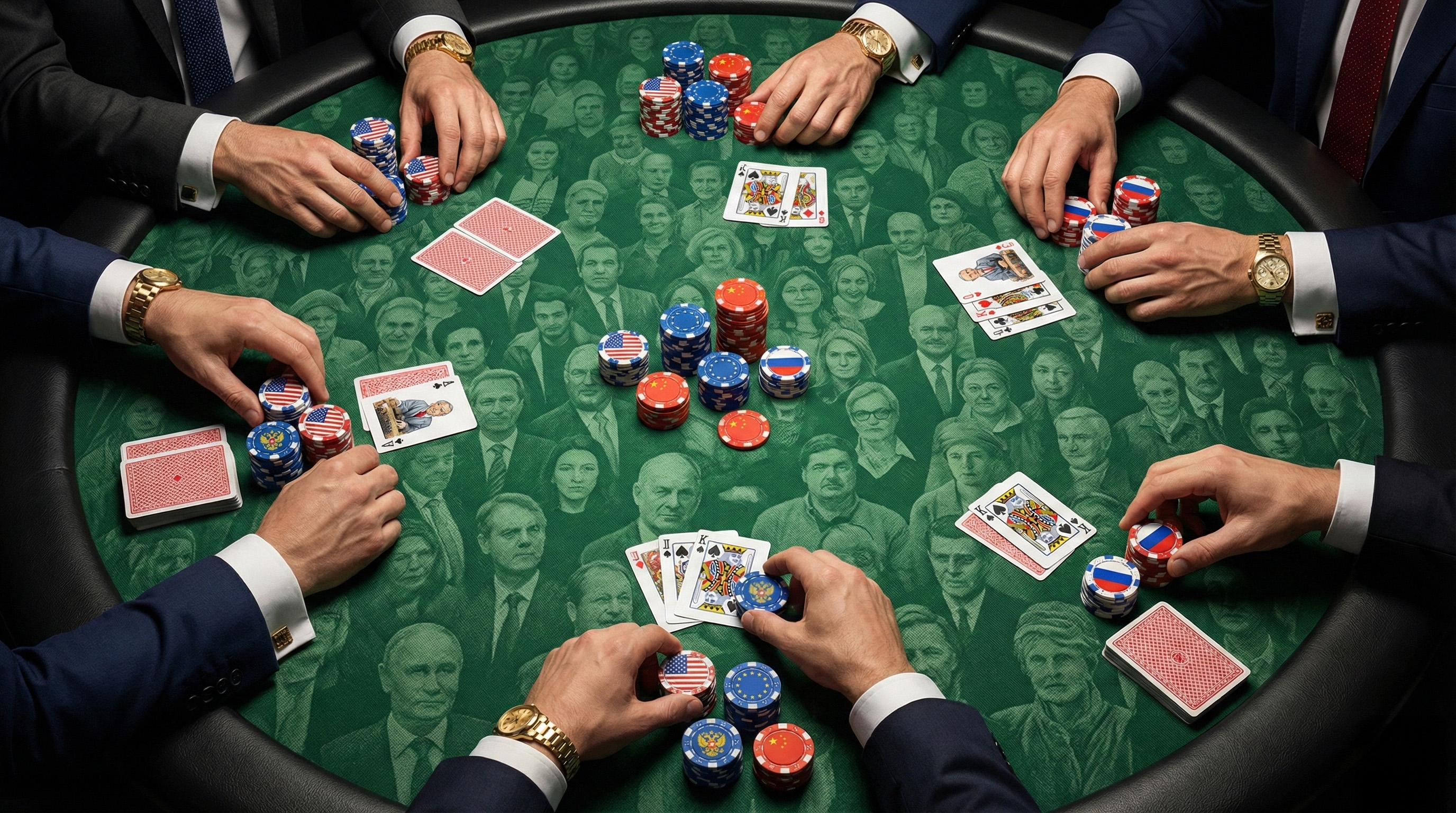
Second fact: when all players are trapped in a negative-sum game, the "winner" is simply whoever loses least. But nobody can admit it, so everyone declares victory while sinking together. You're in the hold. They're on deck toasting.
CBAM fits into this context as a perfect tool for Europe.
It allows raising trade barriers without calling them protectionism. It allows striking imports from countries like Russia, China and India while maintaining an environmental façade. It allows saying "we're defending the planet" while actually defending European heavy industry from foreign competition.
This isn't cynicism. It's realism. Policy instruments always serve multiple objectives simultaneously. The question is: which is primary? And above all: who pays for all the secondary objectives?
Russia understood this perfectly. In May 2025 it filed the first formal complaint to the World Trade Organisation against CBAM, calling it a "discriminatory measure disguised as climate policy." Moscow argues the mechanism violates international trade non-discrimination principles. That it imposes disproportionate bureaucratic burdens on foreign producers. That it protects European industry under green cover.
The European Union refused even to sit at the table for consultations. On 22 May 2025, Brussels declined Russia's request to negotiate, declaring that "such consultations could not be fruitful."
It's an understandable response given the geopolitical situation with Moscow. But it's also revealing. If CBAM were really just a neutral environmental tool, why not defend it on merit? Why refuse dialogue?
Because some of Russia's arguments, however much they come from a bad-faith source, are not without technical foundation. CBAM has grey areas. The rules on default emission values, calculation methods, exemptions for some countries but not others, create interpretive spaces that systematically favour European producers.
And here we arrive at the third fact. The one that explains everything.
2026 is an election year everywhere.
In November, Americans vote in the midterm elections. All 435 House seats, a third of the Senate, 36 governors. History teaches that the president's party loses ground at midterm. Trump knows this and will act accordingly.
In Hungary, Viktor Orbán faces for the first time in fourteen years a credible opponent. Péter Magyar has overtaken him in polls with a pro-European right-wing movement. The outcome is uncertain as it never was before.
In Russia, September brings legislative elections. Usually a formality, but in a post-war context with an economy in difficulty, it could be different.
In Brazil, Lula seeks re-election in October. The future of the Mercosur agreement with Europe depends on that vote.
In Germany, regional elections in five Länder will test new Chancellor Merz's popularity and the far right's strength.
In France, the March municipal elections in Paris and other cities will be a national political barometer.
What does this mean for trade policy?
It means no political leader has incentives to step back. Admitting tariffs don't work would mean admitting an error. Before elections, errors aren't admitted. You double down. You raise the stakes. You find an external enemy to blame if things go wrong.
The electoral cycle is shorter than the economic cycle. Tariff damage shows in three, five, ten years. Elections arrive in six months. The rational politician optimises for the nearest deadline.
While everyone is shooting at each other, there's someone watching from the window with coffee in hand. Nescafé, to be precise.
Switzerland closed its deal with Washington in November 2025. American tariffs on Swiss products dropped from 39% to 15%, with retroactive effect. The 39% was the highest the Trump administration imposed on any developed country. Now it's aligned with the European Union.
But Switzerland's advantage doesn't stop there.
The European CBAM doesn't apply to Switzerland. Annex II of the regulation explicitly exempts it, along with Iceland, Liechtenstein and Norway. The reason is technical but significant: Switzerland has an emissions trading system fully integrated with the European one. Swiss companies already pay a carbon price equivalent to the European one. So no CBAM certificates to buy, no additional bureaucracy, no extra costs.
On one side, access to the American market on the same terms as the European Union. On the other, access to the European market without CBAM barriers. Perfect positioning.
This isn't luck. It's institutional architecture built over thirty years.
Switzerland linked its emissions system to Europe's before CBAM existed. It maintained political neutrality that allows negotiating with everyone without ideological baggage. It diversified its economy into high-value sectors — pharmaceuticals and precision engineering — not heavy commodities vulnerable to trade wars.
When everyone around you is shooting at each other, the only winning strategy is not being in the line of fire. But to not be in the line of fire, you must have built the position twenty years earlier. You can't improvise it when bullets are already flying.
This is why nothing changes depending on who you vote for. It's not a question of left or right, of progressives or conservatives, of Europhiles or sovereigntists. It's a question of structure. The game is rigged at source.
None of them have personal consequences on real economic outcomes. Only on electoral outcomes. And those are measured by completely different criteria. You pay the bill. They collect the votes. It's a perfect system. For them.
It's not a problem of stupid or evil people. It's a problem of institutional architecture. The system rationally rewards behaviour that damages economies. Those who decide don't pay the consequences of their decisions. Costs are externalised onto consumers, taxpayers, future generations. Benefits are internalised in polls, newspaper headlines, parliamentary seats.
It's the total absence of personal consequences. When those who decide never pay for their mistakes, systems degenerate. Always. Inevitably.
And you're there in the middle. Without alternatives. You can vote for whoever you want: the mechanism stays identical. You can be outraged as much as you want: the price of the trolley rises anyway. You can inform yourself, understand, see the game for what it is. But you can't exit it. Not alone.
So what not to do, looking at this landscape?
Don't believe someone will win this trade war. Victory doesn't exist. Only different degrees of defeat exist.
Don't expect economic rationality from decisions made in an electoral context. Rationality is there, but it's political, not economic. They're two different logics optimising for different objectives. Their objectives. Not yours.
Don't underestimate systems' capacity to perpetuate themselves. Once started, a trade war creates consolidated interests in maintaining it. Industries benefiting from protection. Bureaucracies managing the mechanisms. Politicians who've tied their names to the measures. None of them want it to end.
Don't delude yourself that CBAM is just an environmental tool or just a protectionist tool. It's both things simultaneously. And the proportion between the two functions will depend on who uses it and for what purposes.
Don't believe that changing government changes the game. The game is bigger than governments. Governments pass. The game stays.
Don't think that leaving a system frees you from the game. We left the European Union and now play the same game from a weaker position, against more adversaries, with fewer cards in hand.
Don't imagine it's enough to build a good national system to be safe. It takes decades. And you must do it before the game begins. Switzerland didn't have luck. It had strategy. Thirty years of strategy.
What we're observing isn't stupidity. It's an incentive system producing predictably damaging results. It's game theory on a global scale, where every player makes the rational move for themselves and the collective result is a disaster for everyone. Except the players.
Because the players aren't you. You're the table they're playing on.
1 January 2026 isn't the beginning of a new era of sustainable trade. It's another chapter of a story as old as trade itself: governments promising protection to their citizens and ending up impoverishing them, one tariff at a time.
The only novelty is that now we're doing it with carbon certificates instead of import quotas. The mechanism is different. The result will be the same.
And the bill always arrives at the same address.
Yours. Happy 2026.