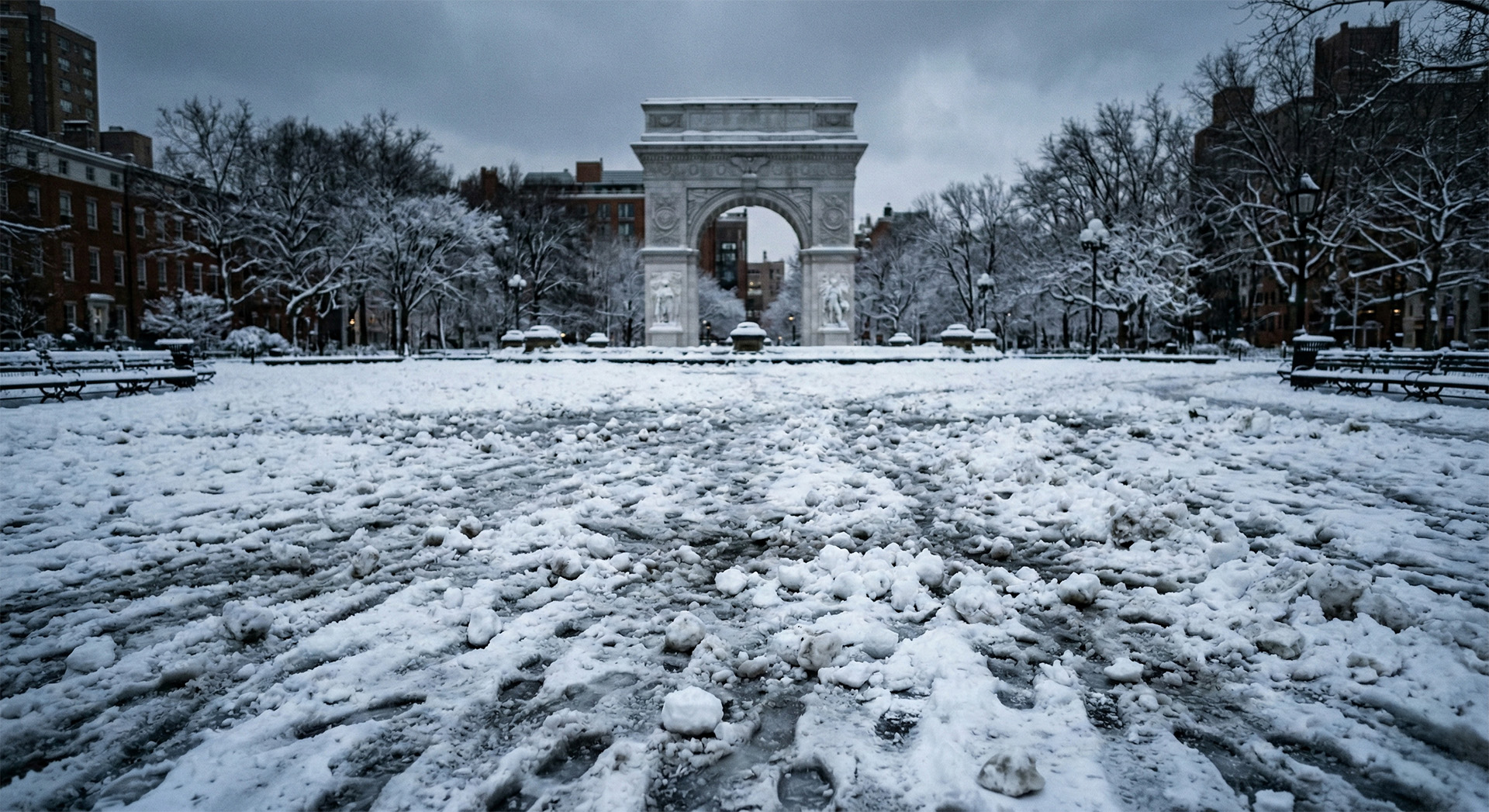
The snowball that caught new york by the throat
Posted on: 27 February 2026
New York hadn't seen a proper blizzard since 2016. Then, on Monday 23 February 2026, the city woke under nearly twenty inches of snow at Central Park, making it the ninth largest snowstorm in the city's recorded history going back to 1869. Flights cancelled, roads shut, schools closed for the first time since 2019. The Blizzard of 2026 paralysed the American northeast as nothing had done in thirty years, with over 600,000 properties losing power and wind gusts hitting 135 kilometres per hour on Long Island.
And at Washington Square Park, someone organised a snowball fight.
The event, born on social media, started the way these things always start: people messing about in the snow, that moment of joyful anarchy that big storms gift to cities. Then the police turned up, called because some people had climbed onto the roof of the park's public toilets. The videos show what happened next: snowballs flying at officers, officers shoving people to the ground, police cars pelted as they left the park. Two officers ended up in hospital with cuts to the face and head.
So far, so unremarkable. The real story begins the following day.
Zohran Mamdani, Mayor of New York for less than two months, addressed the incident at a press conference. His response was: "From the videos I've seen, it looks like a snowball fight." He added, with the timing only a politician in his first executive role can muster: "The only person in our city's workforce who deserves to be hit with a snowball is me." Police Commissioner Jessica Tisch responded the same day on X: "The behaviour depicted is disgraceful, and it is criminal. Our detectives are investigating this matter." The Police Benevolent Association, New York's largest police union, went further: "This was not just a 'snowball fight.' This was an assault, by adults throwing chunks of ice and rocks, that landed two police officers in the hospital with head and face injuries."
On Thursday, police arrested Gusmane Coulibaly, 27, charged with assaulting officers. The district attorney subsequently declined to pursue the felony charge, downgrading the case to obstruction and harassment. Coulibaly was released on supervised conditions. The mayor's office reiterated: we do not believe this situation warrants criminal charges.
To understand what is actually happening here requires some context on who Mamdani is and the city he governs. Born in Kampala in 1991, the son of Columbia University political scientist Mahmood Mamdani and filmmaker Mira Nair, raised between Uganda and New York, a former rapper performing under the name Mr. Cardamom, he only became an American citizen in 2018. A democratic socialist and member of the Democratic Socialists of America, elected to the New York State Assembly in 2020 at twenty-nine, he defeated former governor Andrew Cuomo in the Democratic mayoral primary in June 2025 with 56 per cent of the vote, in what NPR described as "an astonishing upset." He is New York's first Muslim mayor, its first of South Asian heritage, its first born in Africa, and its youngest in over a century. Donald Trump has called him "my little communist."
And now this mayor, on his fifty-eighth day in office, finds himself defining his relationship with the New York police department through a snowball fight.
Anyone familiar with New York politics recognises the mechanism instantly. It is the same script that marked Bill de Blasio's mayoralty. In December 2014, after the police killing of Eric Garner and the protests that followed, de Blasio found hundreds of officers turning their backs on him during the funeral of two police officers murdered in Brooklyn. The relationship between de Blasio and the police never recovered: the PBA treated him as an adversary for all eight years of his tenure, and that permanent conflict eroded his ability to govern on virtually every other front.
The structural mechanism is always the same, and it has nothing to do with snowballs. The police union is not defending two officers with facial cuts. It is testing the boundaries of the new mayor. It is establishing the perimeter within which political power can operate relative to the operational power of the police. The PBA does this with every new mayor, but with a thirty-four-year-old socialist who defeated the Democratic establishment, the test is particularly aggressive because the stakes are correspondingly higher.
For a British reader, this dynamic has a specific resonance. The Police Federation of England and Wales is a powerful body, and the relationship between Home Secretaries and police chiefs has produced its share of public confrontation, from Theresa May's 2014 speech telling the Federation to "stop pretending" reforms were unreasonable, to the long-running tensions between Sadiq Khan's mayoralty and the Metropolitan Police over stop-and-search and institutional racism. But the American version operates on a different scale entirely. The PBA has a lobbying budget, endorses political candidates, purchases advertising space against politicians it considers hostile. It is not a union in the sense that British readers would understand; it is an autonomous power bloc that negotiates its political territory with each change of administration.
The timing of the arrest tells the rest. Police released photographs of suspects, conducted an investigation, arrested Coulibaly, and held a press conference at which a spokesman pointedly noted that the suspect is twenty-seven years old, not a child, directly contradicting Mamdani's description of the participants as "kids." All of this while the mayor was publicly saying that criminal charges were unwarranted. The district attorney subsequently downgraded the charges, effectively vindicating the mayor's position, but by then the media cycle had produced its intended result: Mamdani framed as the mayor who downplays assaults on police.
There is a further detail worth noting. The blizzard arrived during Trump's State of the Union address, in which the president mentioned Mamdani by name to criticise the city's programme paying residents to shovel snow. The intersection is not coincidental in terms of public perception: a socialist mayor, a biblical storm, a police force in revolt, a president on the attack. For Mamdani, the Blizzard of 2026 was already a massive operational test, the first real emergency of his administration. The snowball fight turned it into a political one.
From here, every interaction Mamdani has with public safety will be filtered through this precedent. That is how the mechanism works: the first clash defines the interpretive frame for all subsequent ones. De Blasio never escaped the frame of "the mayor who doesn't back the police," and that frame was built on a single episode, amplified by the union, repeated by the media, crystallised in public memory. If Mamdani falls into the same trap, the Washington Square Park snowball fight becomes his Eric Garner in miniature: not in the gravity of the event, but in the framing mechanism it sets in motion.
The difference, if there is one, lies in the character of the man. Mamdani navigated the press conference with a lightness that de Blasio never possessed: "The only person who deserves a snowball is me" is a line that defuses tension without conceding ground. The following day he adjusted to "a snowball fight that got out of hand," maintaining his substantive position while conceding something in tone. The district attorney's decision to downgrade the charges vindicated him without requiring him to insist. For now, the first round has been played with more skill than his inexperience might suggest.
But the real contest is not this single skirmish. The real contest is whether Mamdani can govern a city where the police operate as an autonomous political actor with its own interests, the most aggressive union in America, and a well-established tradition of conflict with every progressive administration. The snow in New York will melt. The mechanism will not.