The ransom strip reaches Palm Beach
Posted on: 20 July 2026
On 14 July, Coldwell Banker published its mid-year report on the American luxury market and introduced a word: landmaxxing. It describes wealthy buyers acquiring larger properties and neighbouring houses in order to maximise privacy, preserve views and create room for several generations under one perimeter, and it records searches for land up 97% year on year and searches for unique properties up 146%. The Wall Street Journal duly assembled the expected names, Bezos, Ellison and Griffin, and the coverage did what coverage always does with the domestic habits of the very rich, which is to file them under eccentricity. The billionaire who buys the block because he objects to the neighbour's pool.
An English reader should recognise the practice immediately, because English law named it long ago, litigated it and then fixed its price. When two parcels are worth more joined than apart, the surveyor calls the difference marriage value. When one small parcel is the thing that makes a scheme possible, the profession calls it a ransom strip, and in Stokes v Cambridge the court held that the strip commands roughly a third of the uplift it unlocks. That was 1961. What Coldwell Banker has announced as a 2026 trend is a mechanism the Lands Tribunal was already valuing when Harold Macmillan was in Downing Street, which tells you something about the American gift for discovering the old and something rather more interesting about why the mechanism has migrated from the periphery of conveyancing to the centre of the most expensive housing market on earth.
Take the caprice reading first, because it collapses on contact with the arithmetic. Buying the lot next door on a whim would be an expensive whim and a harmless one. Buying it systematically, over years, through intermediaries, keeping the parcels legally separate on the register until the design is complete, is a trade, and trades have a logic that lies not in the aesthetics of the people who practise them but in the structure that makes them pay.
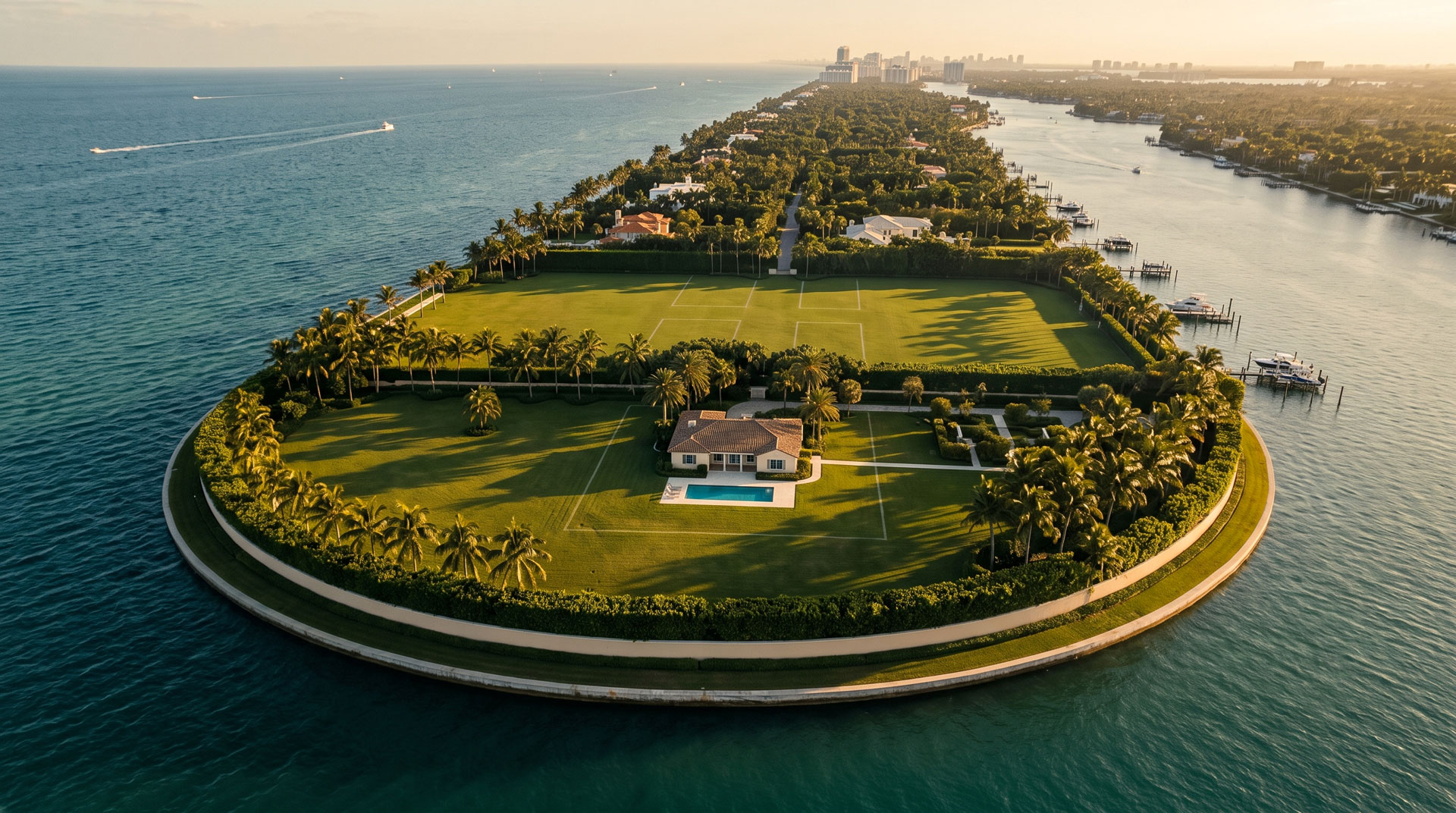
The structure, in Palm Beach, is the zoning. The code is severe: it protects the character of the island, restricts what may be built on any single parcel, and permits the large compound only to an owner who holds enough contiguous parcels to justify it. Whoever drafted that code was trying to prevent the island becoming a terrace of monsters. What the code produced instead is a world in which the only lawful route to scale is to buy your neighbours out. The rule did not prevent concentration. It priced it. A constraint that cannot be evaded is purchased, and the only party who can purchase it is precisely the party the constraint was nominally there to restrain. The planning instrument that protects the neighbourhood manufactures the compound that erases it, not through any failure of drafting but through the plain operation of the mechanism. Ken Griffin's assemblage south of Mar-a-Lago, reported as potentially worth something near a billion dollars, has been passing in pieces through the town's own Architectural Commission. The privacy is the end state. The route to it is public administrative record.
Which brings us to the neighbour, who is the interesting party in all this and the one nobody writes about. The moment the wider design becomes visible, every adjoining owner holds a veto over the whole scheme. His parcel is no longer worth its market value; it is worth some share of the option it releases, and Stokes tells us the English courts think that share is about a third, while the American practice is to fight over it privately and settle nearer to nothing. Hence the shell companies, the intermediaries, the purchase options and the rights of first refusal, all of which exist to fix the price before the seller understands what he is holding. The game is not played against the land, which is inert and going nowhere. It is played against the neighbour's information, and it is won by whoever buys the final parcel before the final parcel knows that it is final. Anyone who has ever built a position quietly in any market at all will recognise the choreography without needing it explained.
The returns are the part that ought to unsettle the eccentricity thesis in the other direction. David and Melissa MacNeil assembled three parcels at Manalapan for ninety-four million dollars over two years, put in a new seawall, asked a hundred and twenty-five million and closed at a hundred and five in April. Eleven million gross across twenty-four months, before carrying costs and before the works. As a financial investment it is indifferent, and the same money in an index would have done better with a tenth of the aggravation. As the purchase of something else it is entirely coherent, because what was bought was never a return. It was the removal of every variable that a man with a hundred and fifty metres of ocean frontage does not otherwise control: what the neighbour builds, who buys when the neighbour sells, how much noise, which windows, which sightline. This is not caprice. It is maximisation. The function being maximised simply is not value; it is the number of other people's decisions that can still reach you.
That is why the thing surfaces now rather than a decade ago, when the rich were already rich and the lots were already finite. The president of Coldwell Banker Affiliates says the useful half of it without quite hearing herself: a luxury house can be built almost anywhere, but land is finite. The novelty is in the first clause. Once the house stops being scarce, because it can be commissioned and reproduced, the differential migrates to whatever cannot be reproduced, and what cannot be reproduced is not land as such but your position relative to whoever stands next to you. In a world where everything can be built to order, the last positional good left is a veto over the conduct of the person adjacent. The report's own data on the wealth divide points the same way: nearly two thirds of the specialists surveyed report a rise in all cash purchases, up from about half a year earlier, and in May the top five per cent of transactions took nearly two thirds of the dollar volume in the single family sector. This is not a market being moved by the price of money. It is a market building defensible positions.
The suffix deserves a line, no more. Maxxing comes from the online forums where young men measure their own jawlines, and it is the vocabulary of inadequacy that proposes to cure itself through discipline. An American brokerage borrows it to describe Jeff Bezos and nobody finds this worth remarking on. The borrowed word says more about 2026 than the report that contains it, because the practice it describes is four centuries old and the English did it on a scale that makes Palm Beach look like a garden dispute. The enclosures consolidated the commons into contiguous holdings with rather more violence and considerably less privacy, and the men who carried them out had the decency to call it by a name that admitted what it was.
Anyone in Britain reading this as an American curiosity should read their own title deeds instead. The mechanism needs no billionaires. It needs two conditions only: a rule that makes contiguity the sole route to scale, and an information gap between the party holding the design and the party holding the parcel. Both have been standard here since before the Tribunal put a number on them. We just never thought to make it sound like a workout regime.