The optimised sunday paradox
Posted on: 11 January 2026
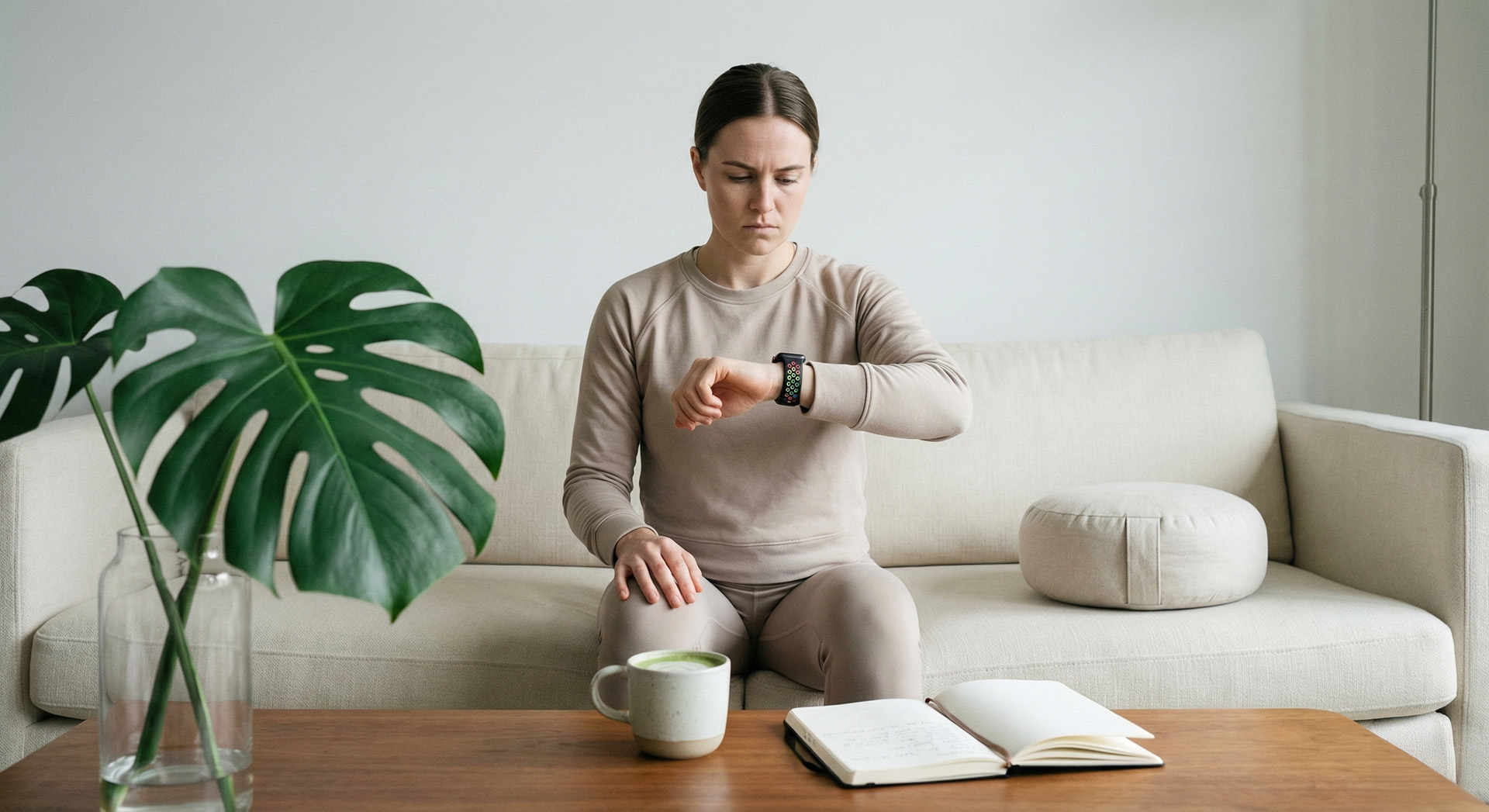
I often find it grotesque watching people optimise their rest. I see it every January, this second week in particular, when resolutions are still fresh enough to hurt but not old enough to be forgotten. The designed Sunday: alarm at seven even though there's no reason to wake at seven, run tracked by GPS even though the body was asking for the sofa, meditation guided by an app that rewards you with badges for breathing correctly. As if breathing were a skill to unlock.
The mechanism fascinates me because it destroys itself by definition. It's like trying to fall asleep by forcing yourself to sleep: the harder you try, the further you get. Rest works exactly the same way. The moment you turn it into a KPI to hit, you've already lost. But people don't get this, or perhaps they get it perfectly well and prefer the anxiety of performance to the alternative, which is being with themselves doing fuck all.
I've seen this pattern manifest in forms that seemed completely different but were the same thing in different clothes. In the nineties, when professional audio was going through the transition from tape to digital, there was an obsession driving everyone: eliminate background noise. Every silence was the enemy, every pause was inefficiency. We filled everything with signal, compressed, normalised, pushed levels to the edge of distortion. The result was records that were technically perfect and musically dead. It took an entire generation to understand what the old engineers had always known: silence isn't the absence of music, it's part of the music. The pause between notes is what gives meaning to the notes.
The contemporary Sunday has the same problem. Empty space is treated as a bug to fix rather than a feature of the system. And so off we go with the list: yoga at nine, healthy brunch at eleven documented for Instagram, afternoon reading the book everyone's reading so you can have your say on Monday, evening of scheduled quality time with whoever's nearby. Every minute colonised by intention, every pause justified by purpose. Rest as work, just in more comfortable clothing.
The point isn't that these activities are wrong. Running is good for you, reading is good for you, even the bloody brunch has its dignity if you actually fancy doing it. The point is the transformation of everything into a credential, into proof to display of a life under control. It's the difference between doing something because you want to and doing something because you should want to. Between pleasure and its certified simulation for the audience.
I've lived long enough to know something that seems obvious but that almost nobody applies to their own life: a machine running constantly at one hundred percent isn't efficient, it's a machine about to break. The margin, the slack, isn't waste but insurance. It's what allows the system to absorb the unexpected without collapsing, to bend without breaking. Remove the margin and you have something that appears to perform better but shatters at the first impact.
The mind works the same way. Good intuitions don't arrive during structured brainstorming sessions with coloured post-its. They arrive in the shower, during an aimless walk, in those moments when the brain is free to wander wherever it likes without anyone asking it to produce output. Neuroscientists have given this state a name, the default mode network, which is the elegant way of saying "when you stop bothering the brain it works better." Filling every moment with intentional activity means switching off exactly the mechanism that produces ideas worth anything.
But underneath there's something uglier, something beyond cognitive efficiency that nobody wants to face. The optimised Sunday is the symptom of a deeper incapacity: being with yourself doing nothing. Contemporary horror vacui isn't fear of external emptiness, it's terror of internal emptiness. Of that silence where you might be forced to hear the thoughts you spend the week avoiding.
Pascal understood this three centuries ago with a precision that's almost unsettling: all of humanity's problems stem from man's inability to sit quietly in a room alone. The formulation is ancient but the mechanism is identical, except that today the room is full of devices designed specifically to prevent you from sitting there. Notifications interrupting every possible silence, apps turning even meditation into a series of achievements to unlock, infinite feeds ready to fill your head the exact moment you risk thinking a thought of your own.
And then there's the social dimension, which is perhaps the most poisonous. The productive Sunday isn't just self-imposed, it's a response to an incentive system that rewards those who perform non-performance best. Those who post their leisure on social media aren't sharing a moment: they're participating in a silent competition over who relaxes better, who has the most balanced life, who's achieved that nirvana of mindful bollocks that allows them to enjoy free time without guilt. It's performance of non-performance. Personal brand work disguised as a break from work. And the saddest thing is that it works: the likes come, the validation comes, so it must be the right thing to do.
The result is a paradox that would be comic if it weren't pathetic: we rest to work better, we meditate to be more productive, we disconnect to reconnect with more energy. Rest becomes functional to production instead of being its opposite, and in becoming functional it loses exactly the quality that made it useful. It's like having sex while thinking about the cardiovascular benefits: technically correct, existentially dead.
I've known them, people who've built things that matter. And almost all of them shared a characteristic that seemed counterintuitive from the outside: they knew how to waste time without anxiety. I'm not talking about laziness, I'm talking about something more subtle. A certain security in their own value that allowed them not to constantly prove something, neither to others nor to themselves. They could stand still because they knew their competence didn't depend on appearing always busy. They didn't need to narrate what they did on Sunday because they didn't give a damn what you thought about their Sunday.
It's a form of authority that's becoming rare. In an environment where visibility has become a proxy for value, where not documenting means not existing, voluntary invisibility requires a confidence few possess. And so Sunday becomes a stage too, rest becomes content too, emptiness gets filled by its own narration. Everything must be seen to exist, everything must be validated to matter.
The way out, if one exists, doesn't pass through another protocol. It's not "here are five steps to really rest," which would just shift the problem up a level, turning the rejection of optimisation into another form of optimisation. The solution, if we can call it that, is more banal and more difficult: stop looking for solutions. Accept that some moments don't need purpose, that some hours needn't produce anything, that existing without proving you exist is not only possible but necessary.
The system that always runs at maximum is the one that breaks first. True for machines, true for organisations, true for people. Those who design know that margin isn't luxury but structural necessity. Those who live could learn the same lesson, but it would require accepting an uncomfortable truth: that doing less doesn't mean being worth less. That emptiness isn't an enemy to fight but a space to inhabit. That not everything needs to be optimised, documented, validated, shared.
This January Sunday, while everyone optimises their rest, the real transgression is perhaps doing nothing. Not the productive nothing, not the nothing that prepares for Monday, not the instagrammable nothing. Pure nothing, the kind that serves no purpose and for that very reason serves everything.
But this, if you know it, you already know. And if you don't, no article can teach you.