The luxury of effort
Posted on: 29 January 2026
Searches for "analog hobbies" have increased 136% over the past six months on Michael's platform, America's largest arts and crafts retail chain. Sales of knitting kits exploded by 1,200% in 2025. US vinyl sales recorded their nineteenth consecutive year of growth, reaching 47.9 million units. In 2020, they surpassed CDs for the first time since the 1980s.
The phenomenon is called "analog lifestyle" and represents something deeper than a passing trend: it's the empirical manifestation of a pattern that repeats with almost mechanical precision every time a technology reaches critical saturation.
A twenty-five-year-old Canadian, Shaughnessy Barker, has installed a landline at home and uses an app that transforms her smartphone into a "dumb phone" when she goes out. She describes herself as an "AI hater to my core" and hosts tech-free craft nights, letter-writing circles, and maintains collections of vinyl and cassettes. The revealing detail lies elsewhere: she promotes all of this on TikTok. "I'm a walking oxymoron," she admits. "I want to get off my phone and I'm making TikToks about it."
This apparent contradiction isn't a bug in the system. It's its most revealing feature.
The mechanism we're observing isn't new. In 1986, Carlo Petrini founded Slow Food as a reaction to fast food: not a denial of modernity, but a response to its excessive acceleration. William Morris's Arts and Crafts movement emerged in the late nineteenth century as an antidote to industrialisation erasing craftsmanship. Every time a technological system reaches saturation point, it spontaneously generates its own antibody.
The pattern is falsifiable: if this were merely nostalgia, we'd see a uniform return to all past technologies. Instead, we observe precise selectivity. No one is returning to fax machines or typewriters for office correspondence. Vinyl is growing, but no one is demanding the return of 8-track tapes. The selection isn't random: the technologies that survive and revive are those offering meaningful friction, where slowing down adds value rather than subtracting it.
Here emerges the first structural insight. In an economy where everything becomes frictionless, where every obstacle is systematically eliminated in the name of efficiency, friction itself becomes a scarce resource. And scarce resources acquire value.
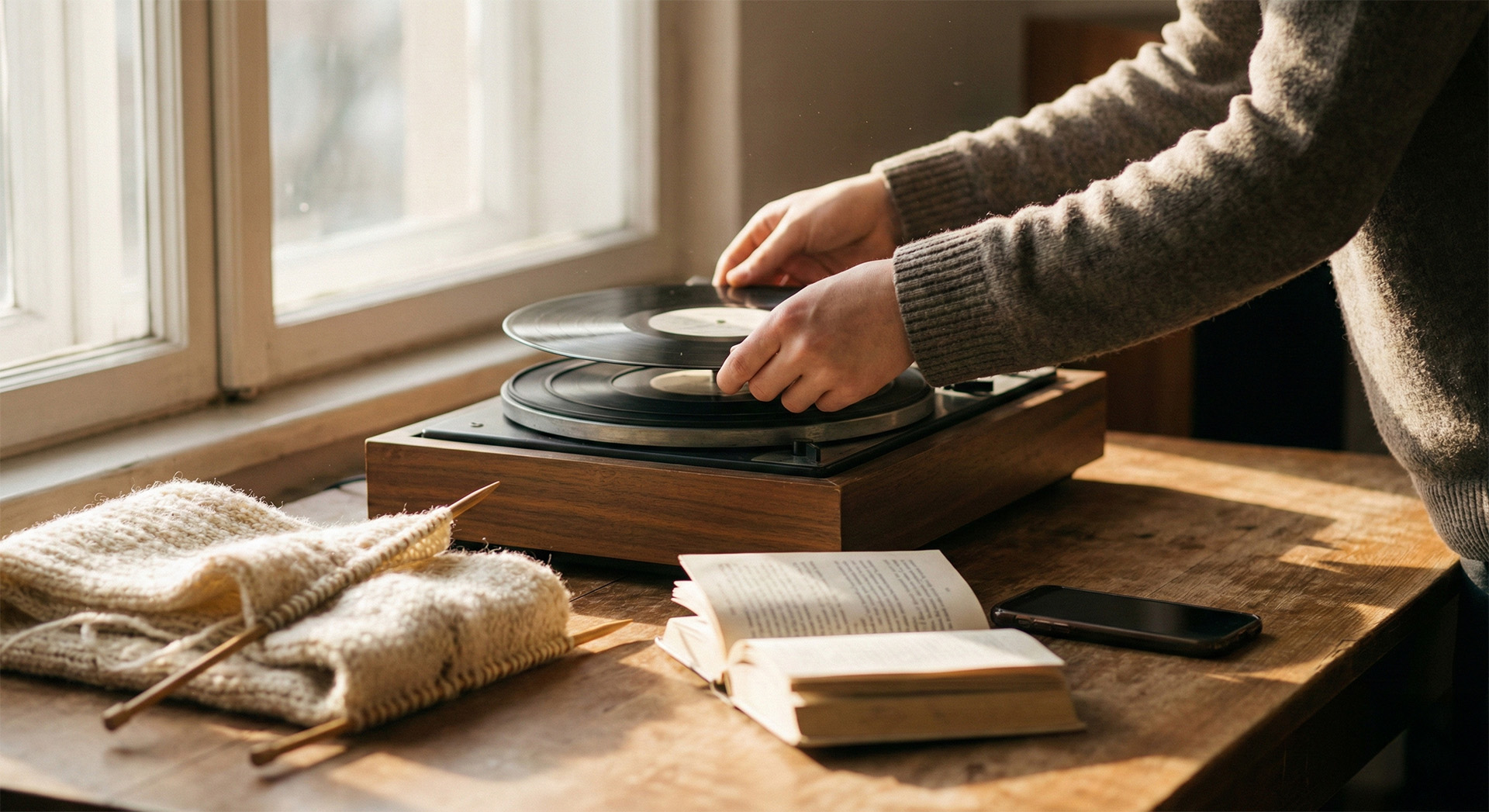
Placing the record on the platter, cleaning it, lowering the stylus: these gestures aren't inefficiencies to eliminate. They're rituals that create presence. When Spotify serves you music through algorithms that anticipate your tastes before you know them yourself, vinyl forces you to choose, to wait, to be present in the act of listening. Friction becomes the product.
Stacey Shively, chief merchandising officer at Michael's, confirms the company is dedicating more store space to knitting materials and recording 86% growth in guided craft kit sales. The projection for 2026 is a further 30-40% increase. The data shows this isn't a niche phenomenon but a market movement of significant scale.
The interesting question isn't why this is happening, but why it's happening now. The answer lies in the specific nature of generative artificial intelligence compared to previous technologies.
The smartphone automated communication. Social media automated socialisation. But generative AI does something qualitatively different: it automates thinking and creation. ChatGPT can write your emails, generate your ideas, produce content that seems like yours. This touches a deeper nerve.
Avriel Epps, an AI researcher at the University of California Riverside, captures the point with surgical precision: "Going analog is not necessarily about cutting myself off from the information on the internet, but it's more so about cutting the internet off from the information about me."
This distinction is crucial. The analog movement of 2026 isn't Luddism. It's not rejection of technology on principle. It's a reclamation of agency in a context where agency is systematically extracted and monetised. When every click feeds an algorithm that knows you better than you know yourself, choosing vinyl over Spotify isn't nostalgia: it's an act of subtraction from the predictive surveillance system.
The market, naturally, has already figured out how to monetise this rebellion too. Michael's sells kits for returning to craftsmanship. Urban Outfitters sells reproduced vintage turntables. Amazon sells "dumb" phones and paper diaries. The capitalist system is perfectly capable of absorbing and commercialising its own critique.
This doesn't invalidate the phenomenon. It makes it more interesting to observe. Every countercultural movement ends up absorbed by the market it criticises, from rock'n'roll to punk to environmentalism. Absorption doesn't mean failure: it means the system recognises real demand and finds a way to satisfy it, even when that demand originates as criticism of the system itself.
Vinyl is the most eloquent example. The global vinyl record market was worth $1.9 billion in 2024, with projections indicating $3.5 billion by 2033. But vinyl coexists with streaming; it doesn't replace it. The same consumers buying vinyl have Spotify subscriptions. The majority of record buyers also use digital platforms. It's not either/or: it's complementarity.
This suggests the analog phenomenon isn't an escape from technology but a negotiation with it. People don't want to go backwards: they want to choose when to slow down. They want moments of deliberate friction in a context of pervasive frictionlessness. Vinyl for contemplative listening at home, Spotify for the morning run. Knitting to unwind in the evening, ChatGPT for the quick draft during the day.
The paradox of an analog movement propagating through TikTok and Instagram isn't therefore a contradiction. It's demonstration that we live in a system where even resistance to the system operates through the system's channels. There is no "outside" the digital network. There's only the possibility of negotiating spaces of autonomy within it.
Luminate's music market data shows 2024 marked the first year two albums exceeded 5 million units sold in the digital consumption era. Taylor Swift dominates the charts in both streaming and vinyl. There's no contradiction: there's segmentation of consumption based on context and intentionality.
The lesson for those observing complex systems is that reactions to dominant systems don't replace them: they complement them. Fast food didn't disappear with Slow Food. Industry didn't return to craftsmanship with Arts and Crafts. But both movements created durable market niches and influenced the mainstream, pushing even McDonald's to offer options perceived as more "authentic."
Generative AI will follow the same pattern. It won't disappear due to the analog movement. But it will have to coexist with growing demand for spaces where cognitive automation is deliberately excluded. We'll probably have "slow thinking" as we've had slow food. Certified "AI-free" zones as we've had certified organic products. Premium pricing on verifiable human creation as we have premium on handmade goods.
The analog movement of 2026 tells us something important about human nature in relation to technology. We're not Luddites by nature, but we're not passive adapters either. We seek an equilibrium that technologies alone cannot find. When acceleration becomes excessive, we create pockets of deceleration. When friction disappears completely, we reinvent it as luxury.
The final irony is that you're probably reading this article on a screen, perhaps after an algorithm suggested the content to you. The system I'm criticising is the same one through which I communicate the criticism. There's no way out of it. There's only a way to negotiate the terms of one's presence within it.
Those buying vinyl and learning to knit aren't fleeing the future. They're negotiating with it, carving out moments of agency in a context where agency is continuously eroded. It's a mechanism of cognitive survival more than ideological rebellion.
The pattern will repeat. Every new technology reaching critical saturation will generate its own antibody. The intensity of the reaction will be proportional to the intensity of perceived invasion. AI, which invades the most intimate territory of all, that of thought and creation, is generating a proportionally intense reaction.
But like all movements criticising the system from within the system, this one too will be absorbed, commercialised and normalised. In five years, we'll probably have premium subscriptions for guaranteed "human-only" experiences and blockchain certifications for content created without AI assistance.
The market always finds a way to sell even the rejection of the market. It's one of the few falsifiable certainties we have.