The inheritance Starmer could not name
Posted on: 23 June 2026
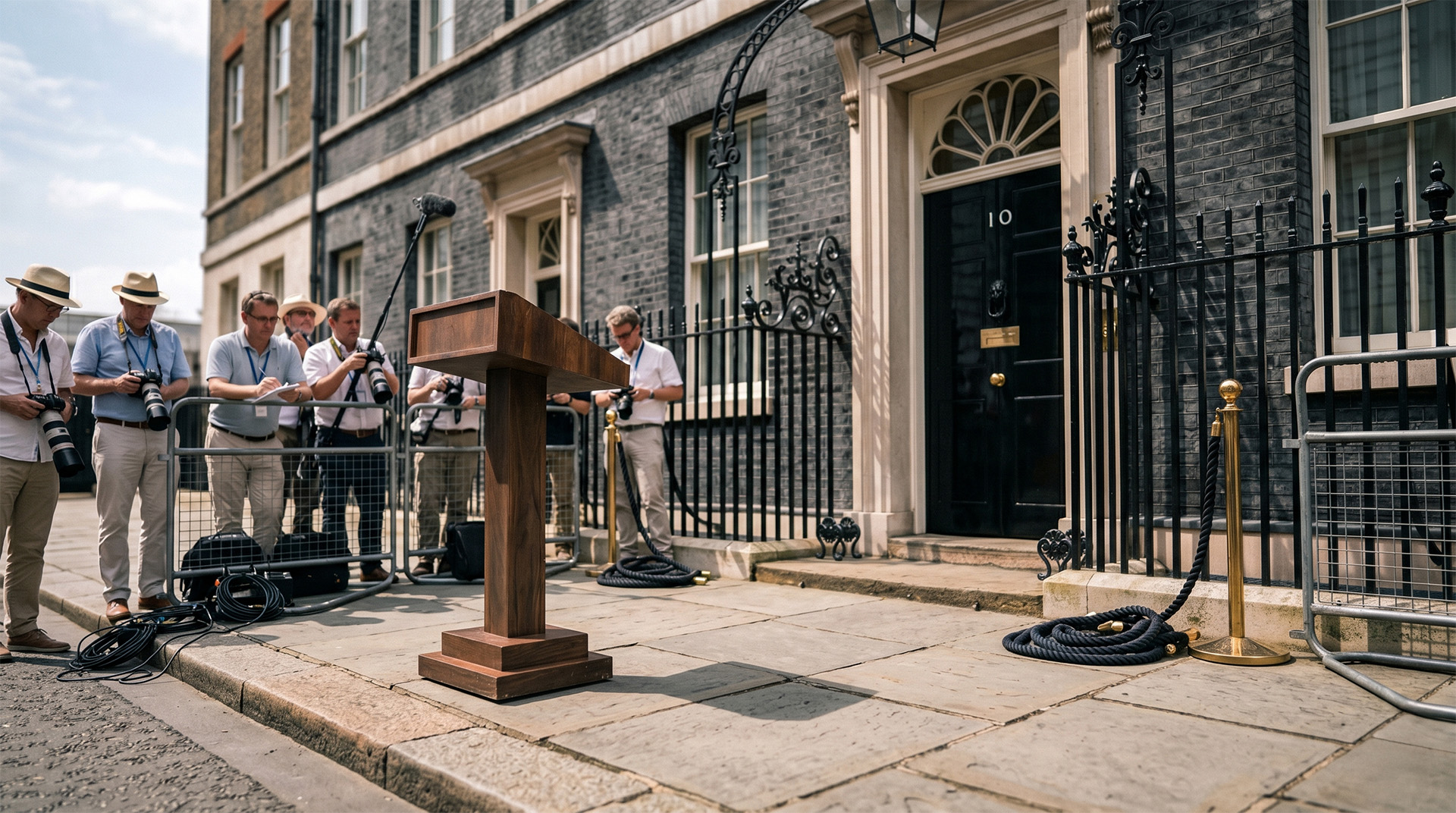
Keir Starmer resigned yesterday outside Number 10, and today marks ten years to the day since the referendum on leaving the European Union. A coincidence of the calendar, nothing more, yet the overlap says something that the outgoing prime minister's statement, muddled as it was, allowed one to glimpse. With Andy Burnham the favourite to succeed him, Britain is preparing for its seventh occupant of Downing Street in a decade. Seven prime ministers in ten years are not a sequence of personal accidents. They are the symptom of something that sits upstream of each of them.
A marker is worth setting down at once. This is not a verdict on the merits of the 2016 choice. Whether leaving was right or wrong is by now a matter for the history books rather than for argument; what interests me is a subtler and more instructive phenomenon, the way a real economic cost can become, over time, politically attributable to no one. It is a problem in the design of responsibility, not a question of which side one stands on.
Begin with the figures that are not in dispute, since that is usually where the conversation runs aground. The Office for Budget Responsibility, the independent body that certifies the public finances, has for years assumed a long-run productivity loss of around 4 per cent against the scenario of remaining, with a 15 per cent fall in the intensity of trade with Europe. That is the official and cautious estimate. The academic studies that use the synthetic control method, reconstructing an imaginary Britain from a basket of comparable countries that lived through the same years, land higher: an output loss of between 6 and 8 per cent by 2025. The precise number remains contested. The direction and the persistence much less so.
This is where a common misreading takes hold, one that appears often even in the serious press, the Financial Times included. The objection runs as follows: the pandemic weighed heavily, and so did the war in Ukraine with its train of energy costs, so the fault cannot lie with leaving alone. True enough. Except that the synthetic control is built precisely to strip those factors out. Set Britain against a basket of economies that took the same pandemic and the same energy shock full in the face, and what remains is not the pandemic. It is what is left once the pandemic has been subtracted. The multiplicity of shocks does not show that leaving counted for less. It is the very mechanism through which a real cost became unrecognisable.
Leaving never produced a visible crash, no Black Monday, no chart dropping at a right angle. It did something more insidious. It lowered the ceiling, slowly, cumulatively. Matching the G7 average for growth, as the Institute for Government observes, is no catastrophe; yet even half of that 8 per cent, spread across a decade, amounts to more than a trillion pounds of forgone opportunity. On paper the country has more or less held its ground, and that is exactly what makes the bill impossible to present to anyone. A loss that shows up as an accumulation of small and seemingly unrelated disappointments has no culprit. It has only a melancholy set of accounts.
And here is the part that both camps prefer to overlook. The same diffuseness that stops critics pinning down the damage stops supporters displaying the gain. The benefits of recovered autonomy, the freedom to regulate differently and to strike one's own trade deals, exist in principle, but they too are diffuse and deferred, measurable only against an imaginary Europe in which the country had stayed. Deniability does not protect one narrative. It protects them all. That is why the argument, ten years on, does not close: not for want of data, but because the data refuse to be attributed.
There remains the question that ties the anniversary to the revolving door of Downing Street. I am not claiming that leaving accounts on its own for seven departures. There were personal scandals and a pandemic, and the fiscal misadventure of Liz Truss cost fewer than fifty days in office; none of it had anything to do with Europe. Yet beneath those episodes runs a common pressure. Each prime minister inherits a symptom they own but cannot name, since to name it is to reopen the wound of 2016, and cannot cure, since the cause sits upstream of them. They govern the consequence of a decision they did not take and cannot undo. Under those conditions the average tenure shortens of its own accord.
Burnham will enter Downing Street with the same ceiling above his head. The difference is that now, ten years on from the vote, no one can tell him with any certainty how low it hangs, nor whose fault it is that it does.