The immune system of global capitalism
Posted on: 27 January 2026
Yesterday we looked at the signals: gold above $5,100, Swiss franc at 2011 highs, Chinese generals purged. All symptoms of the same silent referendum. But there is one piece of that puzzle worth flipping over, because when you look at it properly it tells a story few people know and that is unique in its kind. Switzerland.
Eight and a half million people. 0.1% of the world's population. A handkerchief of land wedged between the Alps. Yet when the remaining 99.9% wake up in panic, when billionaires cannot sleep, when family offices desperately search for somewhere to stash their money before it evaporates, everyone runs in the same direction. And this is not a recent story. It did not start with Lehman Brothers in 2008, nor with the tech bubble in 2000. It started one hundred and ten years ago. And it has never stopped since.
Before 1914 the Swiss franc was considered a weak currency. A satellite of the French franc, a currency nobody considered particularly solid. Then came the First World War. While Europe slaughtered itself and currencies collapsed one after another, Switzerland did something simple: it maintained the gold standard. It stayed anchored to gold while everyone else printed paper to finance the carnage. The German mark went from one loaf of bread for one mark to one loaf for 750 million marks. The Swiss franc stayed where it was.
That was the moment the myth was born. Or rather, the reality.
During the Second World War Switzerland accumulated gold by trading raw materials with Germany. At the end of the conflict, when the Americans built the new monetary order at Bretton Woods, Switzerland said no. It refused to peg the franc to the dollar like everyone else. It stayed outside the system, independent, anchored to its own rules. When Bretton Woods collapsed in 1971, the franc strengthened again. Oil crises of the 1970s: the franc strengthened. In 1978 the Swiss National Bank had to impose its first cap in history, a ceiling on the exchange rate against the German mark, because the appreciation was strangling the economy. It worked for a while. Then it stopped working.
One hundred and ten years. Five generations. Two world wars. The end of the gold standard. The end of Bretton Woods. Every single crisis of modern capitalism. And every time the same dynamic: the world gets scared, capital flees to Switzerland, the franc strengthens, Switzerland pays the bill.
Today's numbers are obscene if you look at them properly. The Swiss National Bank has a balance sheet of over one trillion francs. 130% of the country's GDP. The US Federal Reserve, which prints the world's reserve currency, sits at around 30%. The SNB is, in proportion, the most exposed central bank on the planet relative to the economy it is supposed to serve. And almost all of that balance sheet is denominated in foreign currencies. Euros, dollars, sterling, global equities. Assets that lose value every time the franc strengthens.
And the franc strengthens every time the world is afraid. For one hundred and ten years.
In 2022 the SNB lost 132 billion francs. The largest loss in its history. Not because of bad speculation or reckless investments. Simply because its currency appreciated. Those euros and dollars on its books are worth less when you convert them back into francs. It is the only central bank in the world that is systematically punished for the trust the world places in it. Think about that. You are punished because you are reliable. You lose money because everyone trusts you. It is a trap with no exit that has lasted a century.
The SNB has tried to defend itself. For decades it bought foreign currencies by the bucketload, trying to keep the franc weak so as not to kill exporters. It worked, more or less, until it stopped working. In 1978 it put a cap against the mark. In September 2011, with the euro plunging during the sovereign debt crisis, it drew another line in the sand: 1.20 francs per euro, not a centime more. "We will defend this floor with the utmost determination and unlimited resources." For three years they succeeded, accumulating hundreds of billions in reserves they did not want.
Then came 15 January 2015. The day traders still call Frankenschock. The ECB had just announced quantitative easing. The SNB realised that defending that level would mean buying euros forever while Draghi printed them forever. They raised the white flag. Within minutes the franc appreciated by 30%. Brokers went bust. Hedge funds were wiped out. The Swiss market fell 10% in a single session. The economy entered deflation for months.
The lesson nobody ever learns: not even a central bank with unlimited resources can fight indefinitely against the aggregate will of eight billion people seeking a safe place. You can slow them down. You cannot stop them. And the more you try, the more you accumulate risks that eventually explode.
Today the vice is even tighter. The franc has touched 0.78 against the dollar, levels not seen since 2011. It has appreciated 9.5% since the start of the year while everyone else prayed it would not. The SNB would like to intervene but Trump threatens tariffs against "currency manipulators". Switzerland has already ended up on the US Treasury's blacklist once before. Intervening means risking a trade war with your main partner. Not intervening means deflation, industry on its knees, pensioners watching their returns evaporate.
One hundred and ten years trapped by their own success. Generations of stability, prudence, neutrality have built a reputation that now functions like a black hole: it attracts everything, lets nothing escape. You cannot dismantle that reputation even if you wanted to; it is the foundation of everything. But you cannot prevent it from crushing you every time the rest of the world decides to be afraid.
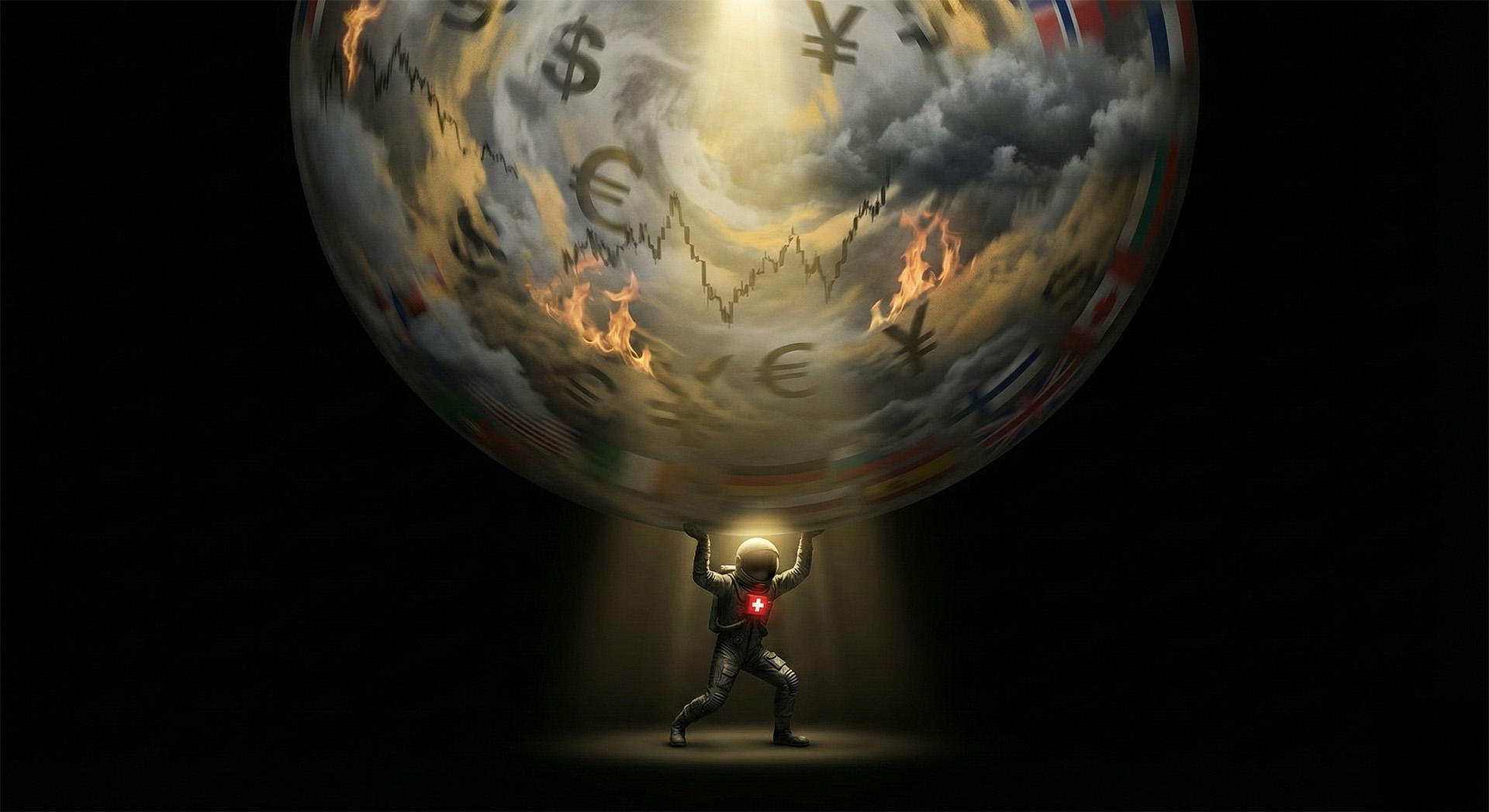
This is why I call it the immune system of global capitalism. For one hundred and ten years it has absorbed the shocks. Neutralised the panic. When capital does not know where to go, it goes there instead of wandering destructively and amplifying chaos. The franc is the anchor when all other anchors come loose from the seabed. It is the refuge when all other refuges reveal cracks. It was during the Weimar hyperinflation. It was during the Second World War. It was when Nixon closed the gold window. It was during the oil crises. It is now.
But here is the part nobody says.
An immune system can fall ill. Autoimmune diseases exist precisely because defence mechanisms turn against the body. And there is something worse: an immune system that is too efficient can keep alive an organism that should die. Or at least transform.
Switzerland is the painkiller that allows global capitalism not to face its structural problems. For one hundred and ten years. Every time pressure rises, capital has an escape valve. The franc appreciates, Switzerland pays the bill, the pressure releases, the system survives another round without changing anything. Without that valve the pressure would have nowhere to go. Gold is not liquid enough to absorb those volumes. The yen has Japan behind it with its 260% debt to GDP. The dollar is often the problem people are fleeing from, not the solution.
Without Switzerland, perhaps the system would have already collapsed. During Weimar. During the war. During Nixon. During 2008. Or perhaps, and this is the interesting part, it would have been forced to reform. To cure its dysfunctions instead of anaesthetising them. To build institutions that work instead of leaning on eight million Alpine people who never asked to bear the weight of eight billion people for five consecutive generations.
This is the final paradox. Switzerland is keeping alive a patient that does not know it is terminal. For one hundred and ten years. Every crisis avoided is a reform postponed. Every panic absorbed is an incentive to change nothing. The immune system works so well that the body no longer feels the symptoms. And when you do not feel the symptoms you do not go to the doctor. Until one day you do not feel them because it is too late.
This week the franc hit historic highs. Gold too. Central banks are accumulating yellow metal as if they know something they are not saying. In Beijing Xi is dismantling his own army out of fear. Everyone is preparing for something nobody names.
And Switzerland? It will keep doing what it has done for one hundred and ten years. Absorb. Pay. Hold. It has no alternative.
But the real question is another. What happens when the painkiller stops working? What happens when the valve cannot hold the pressure anymore? What happens when the immune system fails after a century of overload?
The immune system never lies. If it reacts, there is a reason. But if it reacts too well for too long, perhaps it is hiding a disease nobody wants to see.
And that disease, sooner or later, presents the bill. To everyone. Including the 0.1% who thought they were safe. And the 1% who thought someone would cover their backs forever.
One hundred and ten years is a long time. But nothing lasts forever. Not even Switzerland.
Some say the only way out would be to join the European Union. Dissolve the franc into the euro. Stop being the valve. But that door does not lead to freedom. It leads to hell. For everyone. Because the day the painkiller disappears, the next crisis will have nowhere to discharge. And perhaps, without knowing it, this is precisely what keeps Switzerland out. Not pride. Necessity. Everyone's necessity.