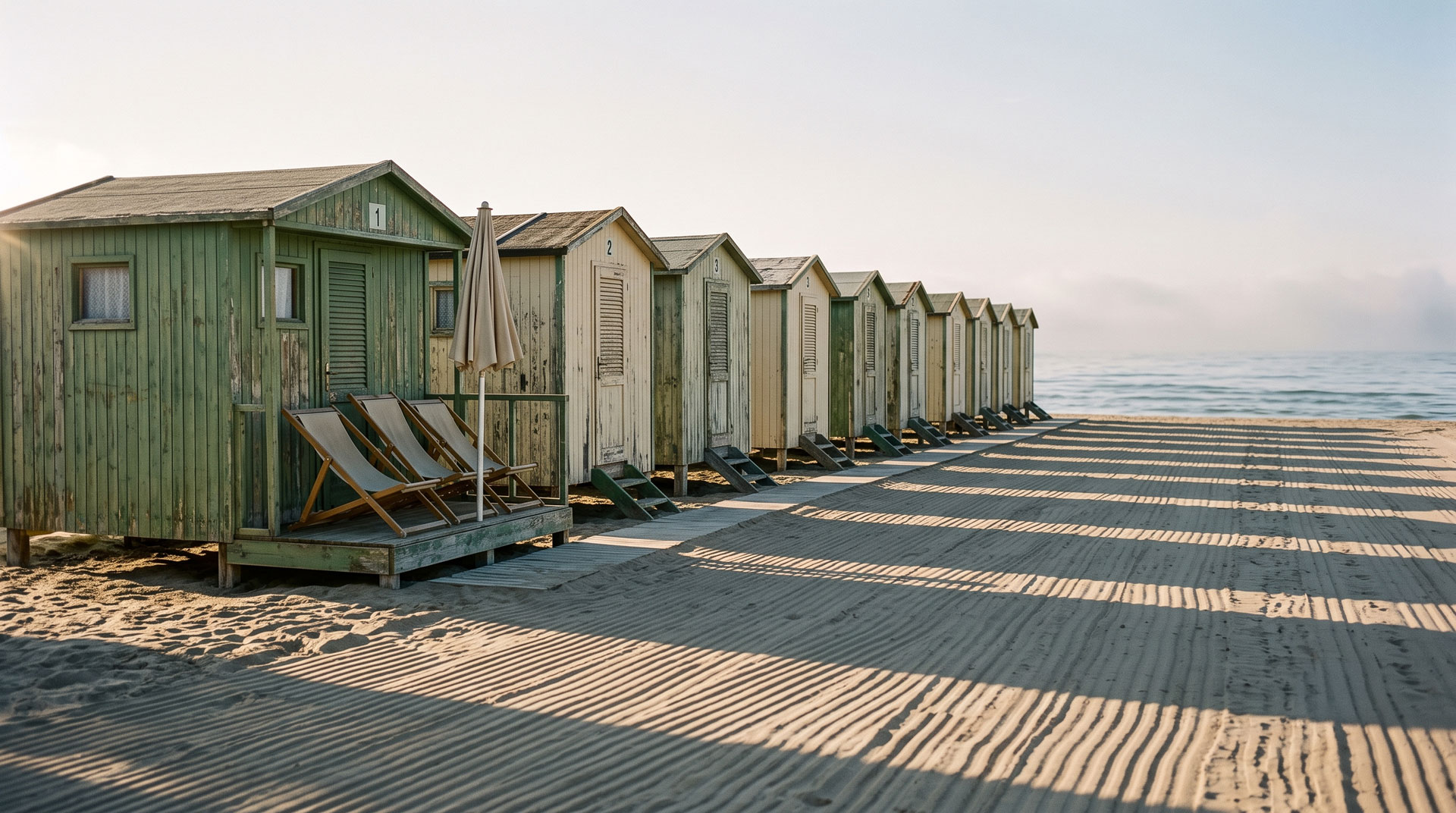
The front row is not for sale
Posted on: 13 August 2026
In the summer of 2024 Bournemouth, Christchurch and Poole Council reopened the waiting lists for its beach huts for the first time in seven years. The lists had been closed in 2017, and they had been closed not because demand had collapsed but because it had not: the council could no longer administer the queue it had created. When they reopened, each list was capped at five hundred applications and a place on it cost fifty pounds, which buys nothing except the right to wait. There are 2,732 huts along the Bournemouth and Poole seafront. At Branksome Chine and Canford Cliffs the council put the waiting time at eight years.
Eight years for a wooden shed with no plumbing.
The arithmetic underneath is simpler than the queue suggests. Back in 2012, when the Borough of Poole was still a separate authority, it published the figures while consulting on a change of policy: 962 huts let on an annual licence, 339 names on a closed waiting list, and somewhere between forty and sixty huts coming free in any given year. A licence renewed each year by a tenant who has no reason to stop renewing is, in economic terms, an option with no expiry, and the stock only turns over when somebody dies or moves away or finally admits the children have grown up. Everything else about the system follows from that single design choice, and none of it has anything to do with price.
What makes Poole worth returning to is what the council tried to do about it. The proposal was modest and entirely reasonable: replace the rolling annual licence with fixed leases of five and ten years, so that huts would circulate and the list would shorten. It went out to public consultation. Existing tenants objected, in numbers and in temper, and by October 2012 the cabinet had dropped it. The queue was left exactly as it was, which is to say the incumbents successfully defended a right they had never been granted in the first place, only accumulated.
A few miles east along the same bay the opposite regime operates, and the comparison is the closest thing to a controlled experiment this subject allows. At Mudeford Sandbank, in what was then Christchurch, there is no waiting list at all, because the 344 huts on the spit are bought and sold on the open market. Prices went from a few thousand pounds in the 1980s to a hut listed at £575,000 in 2021, for roughly a hundred and fifty square feet of timber reachable only by ferry or by a long walk. Same coastline, same weather, same shed. Where the queue allocates, the money price stays symbolic and the waiting becomes the real currency. Where money allocates, the price rises until it has finished doing the rationing that the queue used to do.
Neither system is fairer than the other, and it is worth resisting the temptation to make that the point. What they differ in is who is allowed to catch up. The Mudeford hut is available to anyone who arrives tomorrow with the cheque, and the fact that the cheque is enormous does not change the structure: it is purchasable. The Branksome Chine licence is not available tomorrow at any price, because the only way to have it in 2026 was to have joined the list in 2018 and to have kept renewing since. Money buys a great many things quickly. It has never found a way to buy having already been there.
This is why the seaside version of the argument travels so badly when people try to make it about wealth. The signal carried by the front row is not that its holder is rich, since plenty of richer people are standing behind it, but that its holder is continuous. It marks somebody who did not interrupt. And it is unusually resistant to imitation precisely because the counterfeiting technology that works on everything else, which is simply spending more, does nothing here at all.
The pattern is not confined to beaches, and the largest instance of it in Britain sits at Heathrow. Take-off and landing slots at a congested airport are allocated historically: an airline that used its slots sufficiently in the previous equivalent season keeps them in the next one, which is why the arrangement is universally known as grandfather rights. New entrants get whatever the pool coughs up, which at Heathrow is close to nothing. The consequence is well documented and slightly absurd, in that for years the practical route to a serious presence at the airport was not to apply for slots but to buy an airline that already held them, as IAG did with bmi in 2012. Nobody designed this as a barrier. It emerged from a rule about continuity of use, and it has proved more durable than most rules designed to be barriers.
Reform tends to arrive at the wrong storey of the building. It regulates who holds the title rather than who holds the position, and the two are not the same asset. A council can put its seafront concession out to competitive tender, and an airport can be told to run its terminals on a more transparent basis, without either action disturbing the queue underneath by a single place. The scarcity was never in the licence. It was in the accumulated order of arrival, and the accumulated order of arrival belongs to nobody and cannot be tendered.
I have watched this happen at close range in a different industry. When film distribution went digital, the working assumption across the business was that removing the print would open up access to screens, because the print was the thing that cost money, weighed something and had to be physically shipped. The print duly disappeared. Access did not open up, because the actual constriction had been a floor higher all along, in the booking relationship between distributor and exhibitor, and whoever had that relationship still had the screen while whoever merely had the file had nothing at all. The technology solved the visible problem with great efficiency. The visible problem was not the problem.
A small point about the huts themselves, which does not advance the argument and I am aware of it. The numbering almost never tracks desirability. Hut one is frequently in the worst position, next to the steps and the bins, and the best plot on a given stretch often carries some unremarkable number in the middle which then, in certain families, hardens into something close to a surname. People say the twelve the way they would say the cottage. Nobody explains why it is the twelve.
The person who turns up in August, having taken a decision to spend properly on the summer, and asks about the front row, receives a courteous and final answer which contains more information about his social position than he realises he has been given. He is not short of money. He is short of thirty years, and thirty years were something to have started spending in 1996.
If the councils that reopened their lists in 2024 end up shortening them by moving to fixed-term leases, and do so without the incumbents defeating the proposal as they did in Poole, then this reading is wrong and the renewal right was weaker than it looked. I do not expect it. The people who defend that right understand exactly what it is worth, which is considerably more than the licence fee suggests, and considerably more than they will ever say out loud.