The cost of other people s decisions
Posted on: 3 March 2026
Three days into open war in the Middle East and the dominant commentary remains fixated on the wrong question: is Khamenei really dead? The more uncomfortable question, almost entirely absent from public debate, is simpler and more consequential: who actually pays for what comes next? Because the answer is not who signed the order.
The parallel most analysts have reached for is Venezuela under Maduro, where removing the leadership accelerated the collapse of the system. It is a tempting comparison but it conceals a structural difference that matters enormously. Maduro ran a personalistic regime held together by loyalty to a single figure. The Islamic Revolutionary Guard Corps is something else entirely: an institution with its own economic interests worth tens of billions, real estate, businesses, oil revenues, a security apparatus with forty-five years of experience surviving external pressure. When Maduro falls, the system falls with him. When Khamenei falls, the IRGC already knows who to call. The loyalty was never to the man. It was to the institution that feeds them. Cutting the head off an institution is not the same as cutting the head off a man.
None of this makes the attack irrational. It makes the declared rationale incomplete.
From late 2025 into early 2026, Iran had been shaken by a new wave of protests triggered by the collapse of the rial and the rising cost of essentials, protests that gradually shifted from economic grievance to direct political challenge to the leadership. Washington read this internal vulnerability as a rare window of opportunity. But the real incentive behind Trump's decision was not regional security. It was presidential legacy. The Iranian nuclear file is the one dossier no American president has closed in forty-five years. Reagan failed, Clinton failed, Obama produced the JCPOA which Trump himself dismantled in his first term and Biden made no progress. The convergence of internal protests, Iran's naval presence in the Gulf reduced to zero and Geneva talks freshly collapsed offered a window that looked unrepeatable. Trump has since declared the operation is going "better than expected" and that "we planned four weeks, we destroyed the leadership in one hour." That is not a victory statement. It is a description of an operation that succeeded tactically and now does not know what to do with that success. There was no plan B.
This is the narrative everyone is following. The mechanism nobody is watching is elsewhere.
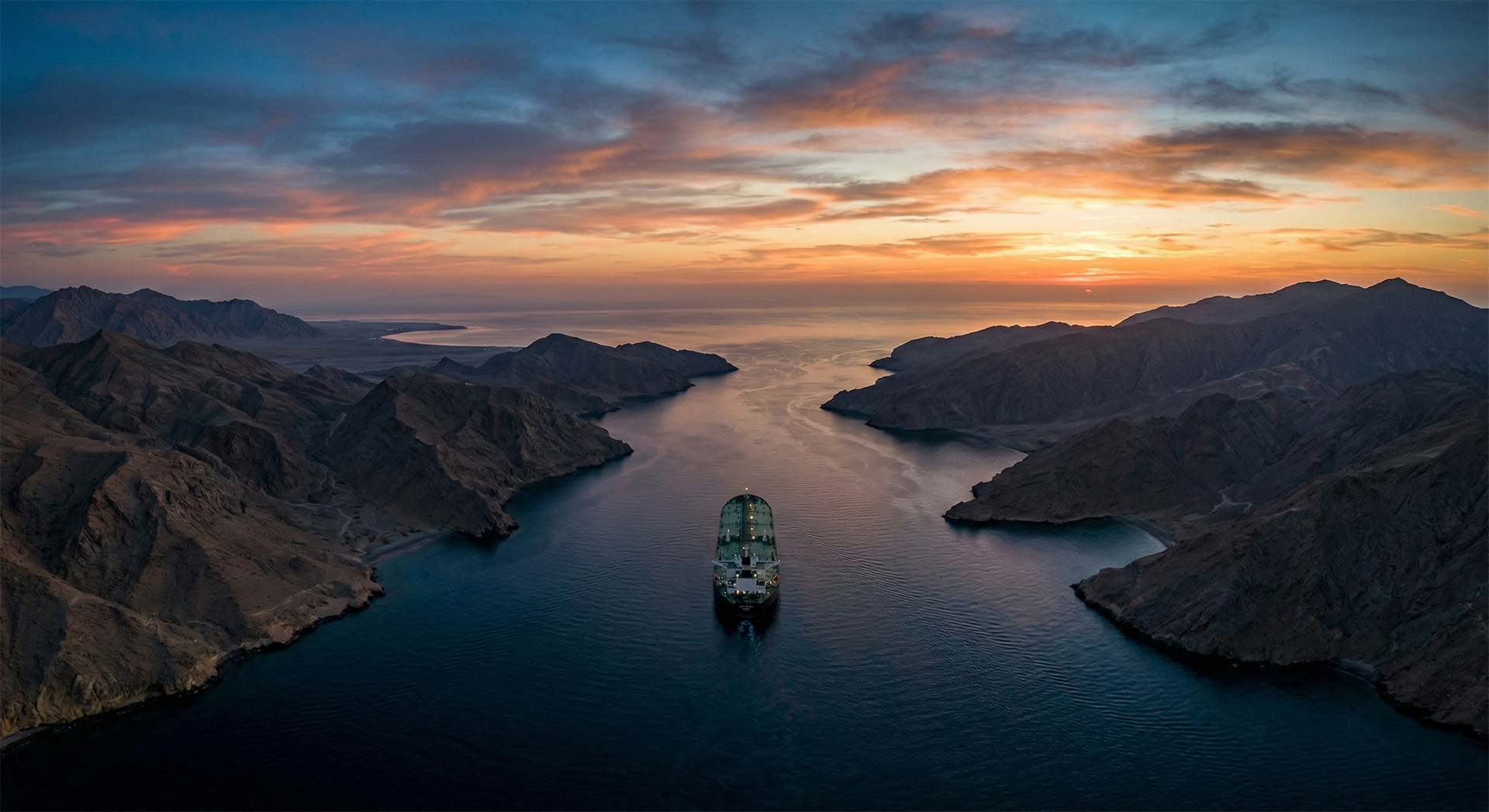
The Strait of Hormuz is a corridor of water approximately 34 kilometres wide at its narrowest point between Iran and Oman. Through it passes roughly one third of all seaborne oil traded globally, what the US Energy Information Administration has described as one of the world's most critical energy chokepoints. The IRGC declared it closed at the end of the third day of conflict. US Central Command insists no formal blockade exists and no vessel has been stopped by military force. But the distinction between "closed" and "too dangerous to navigate" is entirely irrelevant to energy markets, which price on perceived risk not legal definitions. An oil tanker hit by IRGC drones is already burning in the strait. No official declaration is needed. That photograph is sufficient.
Here is the point that is missing from the debate. The United States has been substantially energy self-sufficient since 2020. The oil moving through Hormuz does not go to Houston. It goes to Rotterdam, Genoa, Shanghai and Tokyo. The instability of the strait hits Europe and China in a structurally different way from how it hits Washington. This is not a matter of degree. It is a difference of category. America can absorb weeks of Hormuz disruption with manageable domestic consequences. Europe cannot. China, which sources a significant share of its oil imports through that route, cannot either.
The European Commission has already begun monitoring transport disruption risks around the strait and the Red Sea. That is the institutional signal that the problem is considered real. The Italian foreign minister's public observation that "the US and Israel decided independently" is the most revealing statement to emerge from the European side in these three days — not for its diplomatic bluntness but for the precision with which it describes the underlying structure: Europe bears the costs of a decision in which it had no voice. That is worth sitting with for a moment.
China watches all of this with an attention that is not neutrality. Beijing has a direct interest in rapid de-escalation because every week of Hormuz instability is a real energy cost on its own economy. But it also holds a structurally more powerful countervailing interest: it is currently the only actor capable of mediating credibly with all parties. Neither Europe nor Russia has that leverage. The longer the crisis runs, the greater China's negotiating weight in any diplomatic solution. Beijing has every incentive to let things burn long enough to make itself indispensable. Each day of conflict consuming American resources and attention is also a day of greater operational freedom in the Indo-Pacific, obtained without any action on China's part.
Russia does the most intelligent thing available to it: nothing. Every week of Middle Eastern crisis tests America's capacity to manage two fronts simultaneously, consuming military resources and political attention that would otherwise bear on Moscow's position in Ukraine. The Kremlin does not need to move. It simply needs to wait.
Back to Iran, because the mechanism closes there. The regime has forty-five years of practice turning external pressure into internal cohesion. The foreign threat is the most powerful adhesive a system of this kind possesses: it redirects domestic discontent toward a common enemy and legitimises the repressive apparatus as an instrument of national defence. The protests of December and January, which had visibly weakened the regime in Washington's assessment, risk becoming the fuel of its reconstitution if any leadership figure can credibly construct the narrative that Iran resisted. The IRGC will support that figure — not out of affection but because institutional continuity protects their economic interests. The regime did not depend on Khamenei. It depends on the institution. And the institution is intact.
Iran's attacks on American bases in Qatar, Bahrain, Kuwait and the Emirates were not irrational. They followed from a structural constraint: the regime must demonstrate to its internal constituents that the system responds to aggression, and it must attempt to fracture the regional coalition quietly forming around the Abraham Accords by forcing Gulf states to choose between hosting American bases and absorbing the costs of that choice on their own soil. It is a move determined by structure, not strategy.
The picture that emerges is this: a decision taken in Washington for reasons of presidential legacy, whose energy costs fall primarily on Europe and China, whose effect on the Iranian regime may prove the opposite of what was declared and whose diplomatic resolution, if it comes at all, will almost certainly pass through Beijing. Washington has opened a game in which it controls fewer variables than the rhetoric suggests.
The cost of other people's decisions is a well-established feature of the international order. What is less often acknowledged is that the distribution of those costs is not random. It follows the structure of who decides and who depends. In this case the structure is unusually clear.
America decided. The bill goes elsewhere. That was always going to be the case.