Six hundred million (perhaps) for a rulebook
Posted on: 14 September 2026
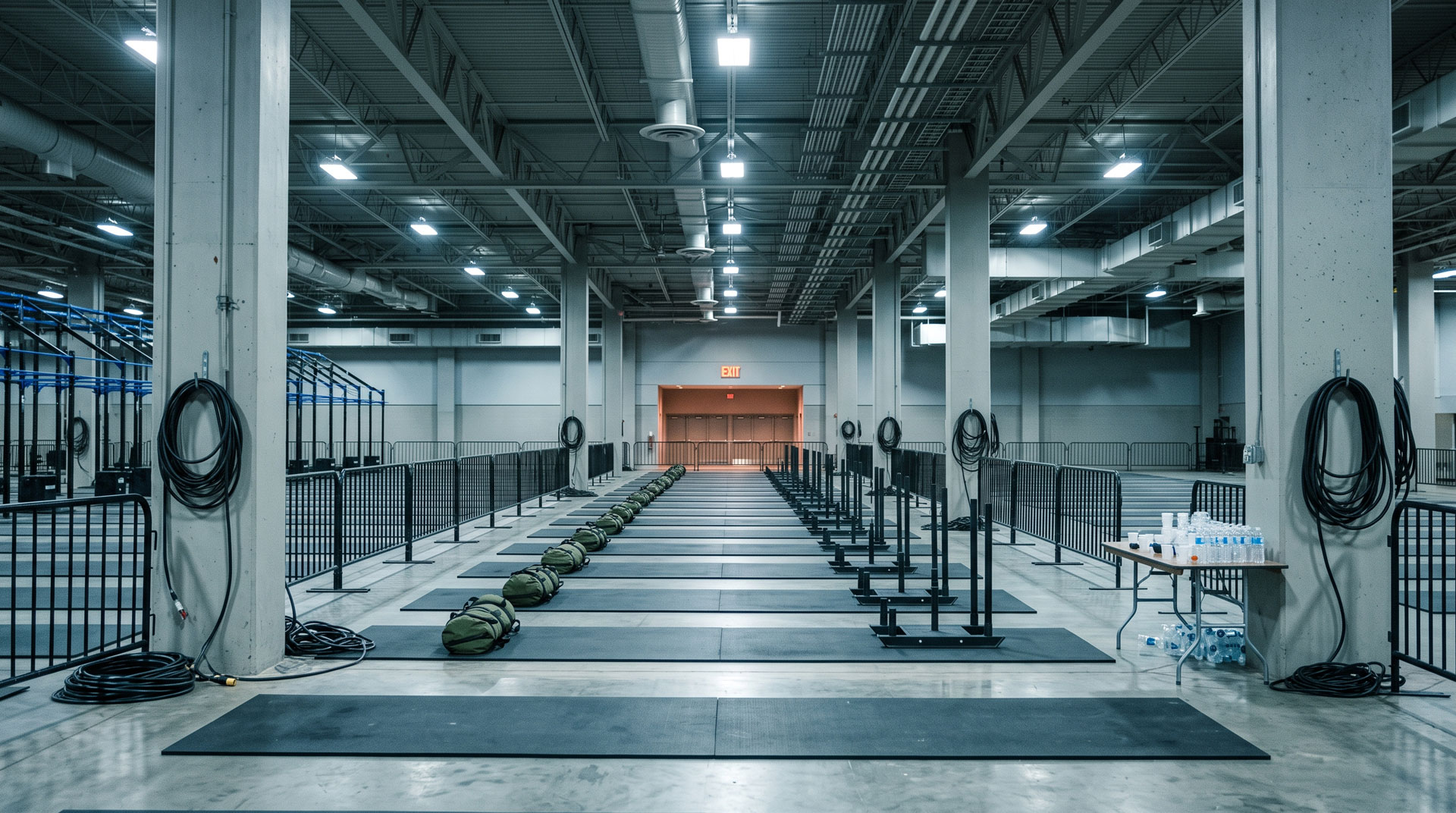
No facility was sold and no warehouse either, given that Hyrox runs an indoor race made of eight kilometres of running alternating with eight work stations, held inside exhibition halls hired for the weekend, with the equipment used in competition supplied by the technical sponsors. What Infront sold on 8 September to a consortium led by L Catterton, alongside founders Christian Toetzke and Moritz Fürste and WndrCo of Jeffrey Katzenberg, is essentially a calendar, a rulebook, a world ranking and a list of email addresses. Neither side has disclosed terms, while Bloomberg, two days before the announcement, reported a valuation of around six hundred million euros. The figure is not the point in any case, because for a private equity deal it is not a large one.
The rough arithmetic runs as follows. In June the trade press credited Hyrox with roughly 140 million dollars of revenue from around 650,000 participants, while Infront's sale announcement claims over a hundred events and more than 1.4 million participants across the 2025/26 season. The two measures are not comparable and nobody has published the reconciliation, which on its own tells you how immature the reporting in this sector still is.
The cost structure deserves attention because it is the part a gym operator recognises immediately and a consumer analyst tends to look at last. A Hyrox event needs judges at every station, registration staff, transition marshals and people putting the sandbags back in place between heats, and that work is covered in large part by volunteers managed through Rosterfy, which is the same rostering platform half the marathon world uses. The interesting part is the currency they are paid in, because a full shift of around eight hours in the Benelux is worth a free entry to a Hyrox race within twelve months, while in the United States it is worth points redeemable against tickets and merchandise.
The cost of the race workforce is therefore settled in a good the organiser prints itself, whose marginal cost stays close to zero for as long as that heat is not sold out, while whoever collects it then turns up at a race paying for travel, a hotel and a shirt. I have seen a good many business models in my life and few have that circular elegance.
Which brings me to the part that kept me awake longer than the rest, because nobody owns eight kilometres of running alternating with eight stations. There is no patent and no copyright stopping anyone from staging the identical thing tomorrow under a different name, since the registrable intellectual property here is the trade mark, the logo and perhaps the graphic design of the leaderboard, while the format itself is air. Anyone with a contact at an exhibition centre, an equipment supplier and a timing system can build the event, and over the past three years a fair few have. The functional fitness circuit has been proving the point for years, given that nobody has ever been able to stop anybody else from running their own.
Whoever pays at this level knows perfectly well the format is not defensible, so that is not what they are buying.
The reference model is Ironman, and it holds up precisely because it shows where the real barrier sits. Nobody owns the 226 kilometre distance and nobody has ever tried to, whereas what Ironman owns is the fact that to get to Kona you have to qualify at an Ironman race and that your time counts only inside that ranking system. The barrier is not legal but social, because it consists of having convinced a few million people that the only clock that counts is theirs, a result built over twenty years that cannot be copied with a hired hall.
Hyrox has built the same thing in nine, which is why the 2027 world championships in Hong Kong, the first outside Europe and North America, matter more than any commercial agreement announced this week. The world championship is the apex of the pyramid that makes paying the entry fee at the base worth doing.
From here you can also see why this particular buyer. L Catterton is the largest consumer focused private equity firm in the world, backed by LVMH and the Arnault family, with a playbook that has been public for years. Anyone saying Louis Vuitton has bought Hyrox is being careless. In February 2021 L Catterton acquired, together with Financière Agache, a majority of Birkenstock at a valuation of around four billion euros, without changing the product, which is a German sandal designed in the nineteenth century. It raised prices, reorganised distribution, pushed the direct channel and took the company to the New York Stock Exchange in October 2023 at 46 dollars a share.
That debut is worth recalling accurately, because the story has since been tidied up. The stock opened at 41 dollars and closed its first day at 40.20, down twelve and a half per cent, one of the worst starts of the year for a large American listing. The playbook worked anyway, simply more slowly than the prospectus suggested, so much so that in the secondary offering that followed L Catterton sold fourteen million shares at 54 dollars, taking 756 million.
Applied to Hyrox, that playbook reads itself. There is the entry fee, which in the United States already reaches 185 dollars and has plenty of headroom given the queue for places. The real structural advantage, though, is geographic, and it is best understood from London.
A record 1,133,813 people applied to the ballot for the 2026 London Marathon against roughly 17,000 ballot places, which is a one and a half per cent chance. That scarcity is genuine and it is also completely fixed, because it is set by the width of the road from Greenwich to Westminster, by the Metropolitan Police, by the boroughs the route crosses and by forty five years of relationships with all of them. London Marathon Events could not manufacture more of it if it wanted to. Hyrox needs an exhibition hall for two days, which means its supply is a procurement decision rather than a civic negotiation. Geography, in this model, can be bought with money, and Bloomberg reports Asian coinvestors under consideration.
Then there is the side of the table the company sits on in relation to brands, which is the piece usually read backwards. The natural objection to a deal like this is that turning a sports event into a global apparel and equipment brand has historically been a graveyard, which is true, except that Hyrox does not have to. Adidas bought Reebok in 2006 for 3.1 billion euros and sold it in August 2021 to Authentic Brands Group for up to 2.1, which is a billion lost over fifteen years to own a sports brand, manufacture it, distribute it and carry its stock. Authentic Brands, which bought that brand, manufactures almost nothing, because it licenses and collects royalties, on the model of the intermediary that lives off the right to put a name on somebody else's goods.
Hyrox already sits on that side, given that Puma, Red Bull and Amazon pay to be associated with the race rather than the other way round, with no inventory and margin entirely on the right. Which also explains why WndrCo is in the consortium, the vehicle of Jeffrey Katzenberg and Sujay Jaswa, which has never had anything to do with gyms. That is content and rights money.
Three things are worth watching over the next eighteen months and none of them will appear in an announcement.
The first is the fee affiliated gyms pay to be recognised as training clubs on the circuit, since that channel currently delivers entrants at almost no acquisition cost and is the real distribution asset in the deal. If the fee starts rising or splitting into tiers, the fund has decided to monetise the channel instead of feeding it. Anyone who knows the recent history of this sector knows that a gym's cost of leaving is nil, because there is no proprietary equipment to dispose of and no certification to redo.
The second is the ratio between the number of races per market and repeat participation per athlete, because easy growth in these models comes from adding dates and works only until the dates outrun the density of the local communities that fill them. Tough Mudder went into Chapter 11 in 2020 on exactly that curve.
The third is whether a genuine broadcast contract with a mainstream outlet appears within a year and a half, because without one the six hundred million stays an events organiser's multiple paid as a media property's multiple.
Between one source's 650,000 participants and the other's 1.4 million there is a full order of magnitude. Whoever paid six hundred million has the reconciliation and we do not, though the Birkenstock debut, for that matter, is now remembered as an unqualified success.