Same cost of living different rights
Posted on: 8 January 2026
There is something structurally different between a train driver who goes on strike and a copywriter who does the same. It is not a difference of merit, of effort, of legitimacy of grievances. It is a difference of architecture: the first controls a flow node, the second does not. And in an economy where time is the scarcest resource of all, whoever can hold other people's time hostage holds the only negotiating currency that still works.
The UK spent two years, from 2022 to 2024, in what became the largest rail dispute since 1989. Forty thousand workers walked out over wages, redundancies, and working practices. The RMT and ASLEF became household names. Mick Lynch became something close to a folk hero. The dispute ultimately resulted in victory for the unions, with improved pay deals concluded region by region. Meanwhile, the gig economy has quietly grown to 1.7 million workers, with 52% earning less than the minimum wage, and precisely zero leverage to negotiate anything at all.
This is not an anomaly. It is how the system works. The rail workers are not stronger because they are more organised or more combative. They are stronger because they sit on a chokepoint. They control what game theory calls a "focal point": a node everyone must pass through and no one can easily bypass. The medieval tollkeeper on the bridge knew this principle well. Dockworkers of every era did too. Whoever controls the obligatory passage can demand a toll, whether in money or in political attention.
The problem emerges when you look at the other half of the labour market. Britain suffered from wage stagnation after 2008, a period the TUC estimates has left the average worker over £14,000 a year worse off than if pre-crisis wage trends had continued. Real wages fell by 4.5% in April 2022, the sharpest drop since records began in 2001. The Joseph Rowntree Foundation reports that disposable incomes for the bottom 40% of households have flatlined since 2023, with no improvement in sight. This erosion affects everyone: the train driver and the freelancer, the signaller and the Deliveroo rider. But only some have the tools to respond collectively. The others suffer in silence, atomised, without a node to block.
A fracture thus emerges that cuts across the old categories. It is no longer capital versus labour, nor bosses versus workers. It is flow workers versus value workers: the former control the system's arteries, the latter produce content that runs through those arteries but cannot interrupt its passage. Both pay impossible rents in London and the South East. Both see the cost of living rise faster than their earnings. Both are technically "exploited" by any metric you care to apply. But only the former can turn distress into political pressure.
This asymmetry produces a side effect that undermines the very foundations of class solidarity. The stranded user, the one who loses their connection or stands frozen on the platform, is often themselves a poorly paid worker. They see the train driver not as a fellow sufferer fighting for common rights, but as a privileged figure who can afford the luxury of blackmail. "If I don't show up to work I get sacked. They can shut down the country and no one touches them." Resentment flows horizontally, not vertically. Anger discharges onto the flow worker instead of onto the system that produced the general impoverishment. It is a war among the poor, fought in railway stations and airport terminals, while those who actually benefited from the wage erosion watch from a distance.
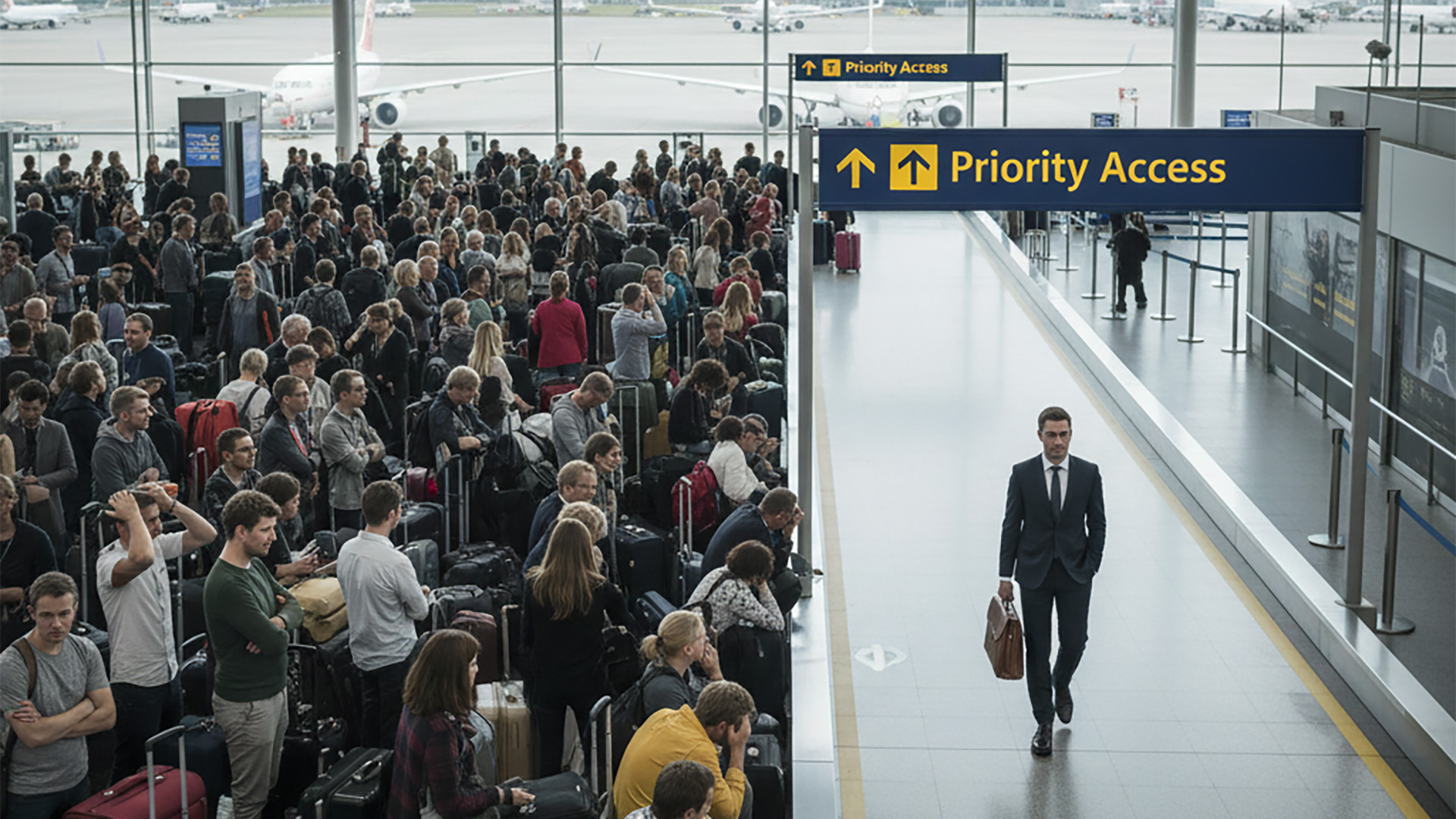
Speaking of watching from a distance: there is a mechanism that makes this dynamic even more stable, and therefore harder to break. It is called the Fast Track, and in its apparent banality it tells us much about the structure of contemporary power. For those unfamiliar: it is a service that lets you skip the queues at airport security. It costs little, relatively speaking: a supplement on the ticket, access through premium credit cards, corporate subscriptions. Nothing prohibitive for those who travel for high-level business, for managers, for consultants, for anyone whose time is valuable enough to justify the expense.
The Fast Track is the privatisation of the exit route. When the system jams, those who can pay bypass the jam. Those who cannot, remain in the queue. The political effect is subtle but decisive: the decision-making classes, those who could exert pressure to structurally resolve the conflict, no longer experience the discomfort firsthand. The executive who needs to catch a flight for a board meeting passes through the priority lane. The commuter who needs to get to the office stays stuck. The former has no incentive to intervene; indeed, the persistence of conflict justifies the existence of premium services they can afford. The latter has all the rage in the world but no channel to express it except against those who blocked the system, that is, other workers.
This mechanism of separating experiences is what maintains the stalemate. The conflict does not resolve because those who could resolve it do not pay its costs, and those who pay its costs do not have the power to resolve it. Flow workers obtain partial concessions, enough to keep the system functioning but insufficient to genuinely improve structural conditions. Value workers obtain nothing, because they have nothing to threaten. Users develop growing hostility toward any form of protest that touches them directly, reinforcing the position of those who would restrict the right to strike. The circle closes.
There is a question this scenario poses that deserves to be stated explicitly: what does it mean when public service becomes a permanent battlefield? Britain built its transport system on the assumption that certain services were guaranteed by the state as part of the social contract. The citizen pays taxes; the state provides infrastructure that works. But if that infrastructure is constantly interrupted, if those who run it use it as a negotiating lever, if those who can afford it bypass it through private services, the contract has effectively broken. Not formally, not legally; structurally.
The government responds with minimum service legislation, the tool that obliges workers to guarantee essential services even during strikes. But minimum service laws are a plaster on a systemic wound. They do not resolve the conflict; they temporarily contain it, preventing it from reaching intolerable levels. Every time they are used, they reinforce the narrative that transport workers are a protected category requiring discipline from above, further fuelling horizontal resentment. And meanwhile the underlying problem, the erosion of purchasing power that affects everyone, remains intact.
What we are observing is not a British anomaly, nor a defect in the system that should be corrected. It is the normal functioning of an economy where power has concentrated at chokepoints and where the political response has been to further fragment those who were already weak. Value workers, those who do not control nodes, have been progressively atomised: zero-hour contracts, gig economy platforms, freelance arrangements. A record 1.35 million people now hold second jobs. The more dispersed they are, the less they can coordinate. The less they can coordinate, the less they matter in the negotiations that determine the distribution of national income.
The train driver who strikes is using the only tool the system has left them. The copywriter who cannot strike, or rather can but no one notices, is suffering the consequences of a structure that has rendered them invisible. Neither is wrong to perceive the injustice of their condition. But the system places them in competition rather than alliance, and this is perhaps its most effective feature from the perspective of those who benefit from the status quo.
The 2022-2024 rail strikes represented an attempt to rebuild cross-category solidarity: the conflict is not between those who can block and those who cannot, but between those who work and those who extract rents from others' labour. It is a harder narrative to sustain in an era where rents are diffuse and opaque, where the enemy has no recognisable face, where exploitation passes through pricing algorithms and housing costs rather than through the factory owner. But it is the only narrative that could prevent conflict from continuing to discharge horizontally.
January 2026 begins much as the previous year ended: with bus drivers on strike in Cambridge, with cinema workers walking out in Glasgow, with the legacy of two years of rail disruption still fresh in memory. The pattern repeats because the structure that produces it remains intact. And structures do not change until someone changes them. The problem is figuring out who still has the capacity to do so, when those who could have no interest, and those who have the interest have no capacity.