Punishment without a target
Posted on: 31 May 2026
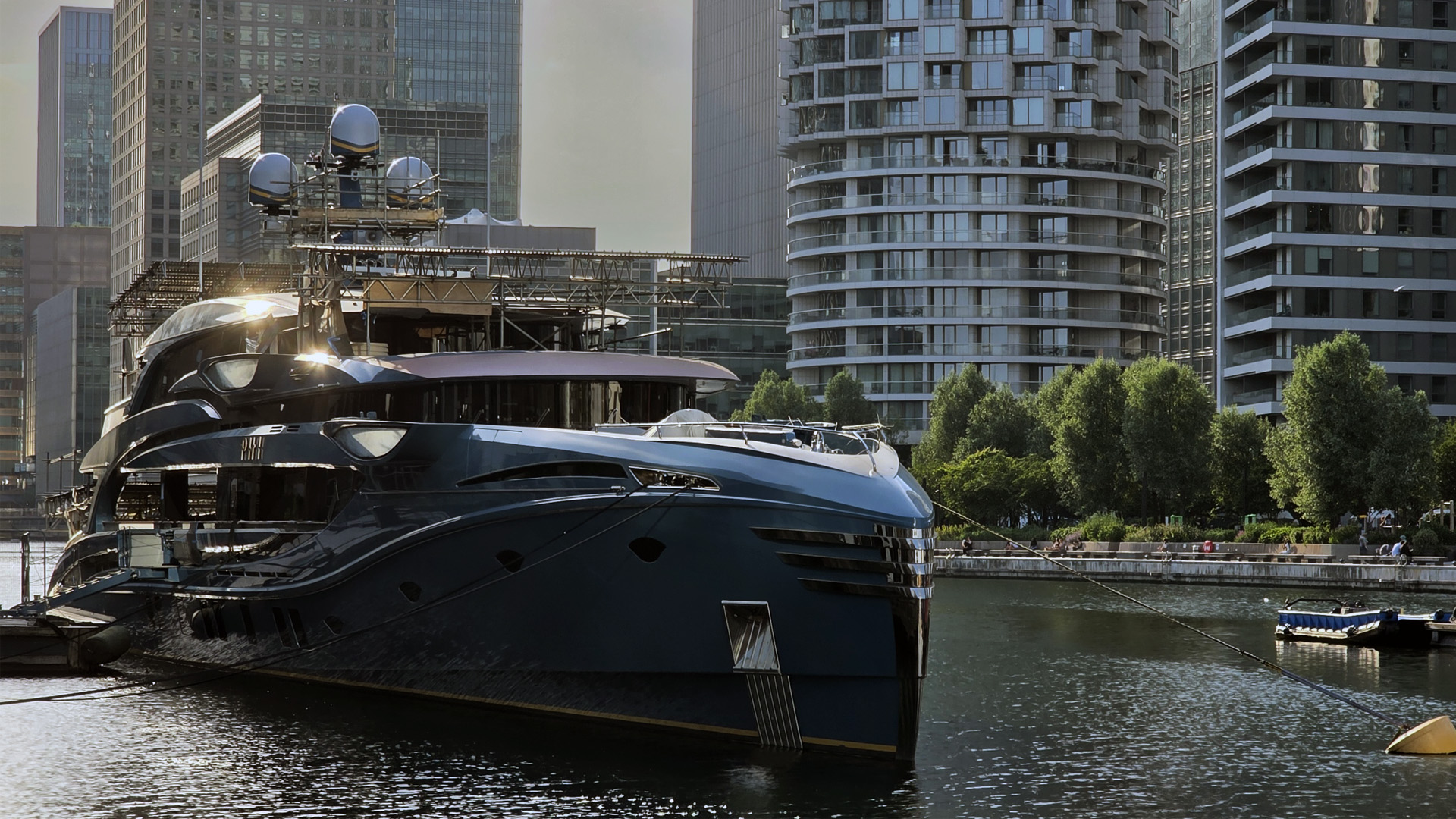
I saw her again yesterday, from Wood Wharf, walking home through Jubilee Park, with the low sun catching her light-blue hull and the iconic towers standing behind her, and the Phi is still there, where she has sat for more than three years, and from a distance she still looks like the most beautiful thing on the water. Then you come closer and you see the scaffolding rigged on the upper deck, the covers lashed down, the air of something going nowhere. She looks like a stalled building site, not a ship. A building site eleven metres short of fifty-nine in length, the longest superyacht ever built under five hundred gross tonnes, a piece of Dutch engineering now collecting rust and gull droppings in front of the offices of the City.
The seizure dates to 28 March 2022, a few weeks after the invasion of Ukraine. The man who stopped her was Grant Shapps, then the British Transport Secretary, who turned up on the quay with a phone held out and running live, and announced that he had turned an icon of Russian wealth into a stark warning to Putin and his circle. The first detention of a superyacht in British waters; the composition was perfect, the skyline behind and the gleaming hull in front, with the minister talking to camera. That was precisely the point, even if at the time nobody saw it.
Because the owner, a Russian property developer who lives in Russia and is called Sergei Naumenko, was not and is not on any sanctions list. I do not say this out of any sympathy for him; it was the English courts themselves that put it on the record, the Court of Appeal having found it improper to describe him as connected to Putin, as Shapps had done from the quay. The yacht was held all the same, on a different and more slippery footing, namely that a Russian wealthy enough to own such a thing must surely, in some fashion, have benefited from the regime; the precise claim collapsed and in its place came one that can neither be proven nor disproven, which is exactly how institutions go on defending a gesture once the gesture's original reason has stopped holding.
And it is here that the story stops being an item of news and becomes something more interesting, because it was never a confiscation. The state never took ownership of the Phi and never put her up for auction; it did not want her value, it wanted her visible. A confiscation usually has an ending: you sell, you redistribute, you close the file, which is what Gibraltar did with another Russian yacht, the Axioma, brought under the hammer in 2022. Here, no; here there was never any terminal state in view, because the object was useful whole and stationary, in the South Dock, not liquidated.
So what was she detained for? I have asked myself that every time I have walked past her, looking for an instrumental logic, an effect on the world, and I have not found one, because there is none. There is a logic, but it is of another kind, an expressive one, and expression is measured entirely in the instant of the act, not in its consequences; the gesture was already complete the moment Shapps's livestream ended, and everything that came afterwards, the three years, the courts up to the Supreme Court, the rust, the crew still aboard, simply did not enter into the calculation, because it lay outside the frame. You optimise for the photograph, and you stop the clock on the photograph. It reminds me of certain Instagram influencers, but that is another story.
Meanwhile somebody pays, and it is not who you might think, no. Naumenko pays, going on paying the yacht's crew, settling the mooring fees and covering the maintenance, through the licences that govern frozen assets. The judge said it almost with relief, that being deprived of a luxury asset does not significantly affect how he lives, nor can it be suggested that he cannot afford the cost of keeping her; translated, the penalty is proportionate because he is rich enough to pay for it himself. Except that, while he pays for it, the boat dies anyway. The Phi is now uninsured and out of class, weathered to the point that she will probably never leave that quay under her own power again. The man pays to keep alive a thing that is meanwhile ceasing to exist.
And here is the knot, the thing that angers me more than the politics; this is a punishment without a recipient, and you should think about it, really, because the blow does not reach Putin, who would not so much as notice the secondary yacht of some private individual, it does not touch the owner, declared solvent enough by the court itself not to feel it, and not a pound of value reaches anyone, because the state takes in nothing. So who serves the sentence? The object serves it. The only thing in the whole affair actually doing time is a boat, which carries no blame and was never a party to anything.
Her beauty and her elegance, by this point, are not a sentimental detail but the very instrument that lets you see the thing for what it is. You need feel no sympathy for the Russian, who is opaque and rich enough to be unsympathetic by design, and it is exactly for that reason that the rotting hull carries you where a partisan argument never could. The arrow missed the man, never even grazed the enemy, and struck the statue. The statue remains, damaged, beneath the windows of people who walk to work in the morning and have all but stopped looking at her.
You might think this was the isolated error of a single minister in a moment of heat, but it was not, and a simple fact shows why: the government that seized the Phi is not the same one that defended her all the way to the Supreme Court in 2025, and yet the incoming government did not free her, it defended the detention and won unanimously. The faces change and the colours change, the boat stays where it is. Because no incoming government wants to go down in history as the one that let the Russian's yacht sail, the Russian who was Putin's friend and was not really anything of the sort; the incentive is identical for whoever holds the keys, which is why the trap has no party, it has only a direction, towards the bottom of the South Dock, for everyone.
Shapps's livestream, seen today, was an act of irreversible commitment, meant to make any retreat impossible, to plant a flag, and it worked rather too well, because that flag now binds the people who planted it and their successors more tightly than it binds Russia. A threat you can no longer withdraw becomes a cost to you, not to your adversary. There is even a tail still open: the Supreme Court left unresolved the question of whether the whole operation was an unlawful interference, and it is through that half-open door that a claim for damages might one day come, paid in the end by those who never decided on any sanctions at all, the British taxpayers, who pay enough tax to be entitled to a little fury when they work out where their money ends up.
The point is not Russia, and it is not the parties either, but that there exists a category of state action that mistakes visibility for effectiveness and stays indifferent to what it destroys while it poses for the picture. The Phi is the limiting case, because she struck nothing and saved nothing, she merely took a beautiful thing and left it to die slowly in the middle of the water, to remind us how strong we were. I looked at her a moment longer, yesterday, before heading home, and I cannot quite hold back a small catch in the throat at such a waste of beauty; the gulls, for their part, could not care less who was right.