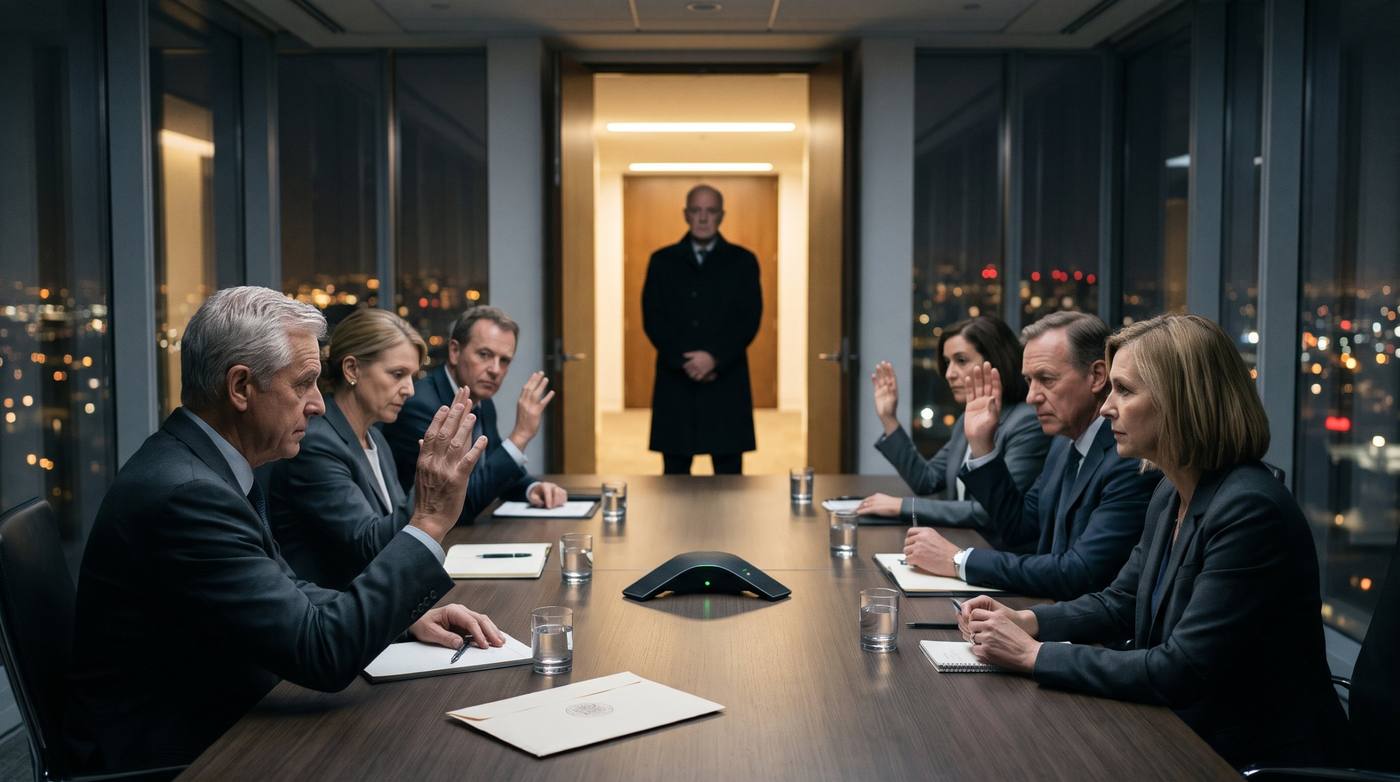
On 1 December 1992 Sir Adrian Cadbury, then chairman of Cadbury Schweppes, signed the report of a committee set up the year before by the London Stock Exchange, together with the accountancy profession, after a run of corporate scandals in which British boards had failed to notice what their own companies were doing. Its best-remembered recommendation was also the plainest, that the job of chairing the board should be separated from the job of running the company, or failing that that there should be a strong independent element on the board. The logic was simple enough. A board exists to be able to say no to the person in charge, and it struggles to do so when that person is chairing the meeting. The report also warned that if companies did not comply, legislation and external regulation would probably be sought, which made self-discipline the price of keeping the state out of the boardroom. By 2007 almost nine in ten listed British companies had split the two roles, against little more than half in the United States.
A few months after the report came out, three engineers in California founded Nvidia. One of them, Jensen Huang, ran it as chief executive for the next thirty-three years without the company ever having a chair. That changed on 12 November, when Huang resigned and Harvey Jones, a director since 1993 and a former chief executive of Synopsys, the company whose software is used to design chips, became the first chair in Nvidia's history. On 17 November, opening Nvidia's first earnings call without its founder, Jones read a single sentence, according to which the board had unanimously accepted the resignation and did not intend to reinstate Huang. On Monday 23 November the same board, again unanimously, reinstated him with immediate effect. In its filing with the Securities and Exchange Commission, the American markets regulator, the board says it is satisfied with Huang's candour and that it received input from senior levels of the United States government, on the basis of which it sees no risk to national security. A few lines further down the same document states that the internal investigation entrusted to independent directors and outside counsel will run to completion.
Nothing new about Huang emerged between those two statements. He had stepped down after reports of extramarital relationships, among them one with Alice Huang, no relation, a former executive of Megaspeed, a Singapore data centre company under investigation by the US Commerce Department on suspicion of moving Nvidia chips into China. According to the New York Times she had been in contact with Chinese intelligence for more than a year, while Reuters reported that Huang had misrepresented the nature of the relationship to senior Nvidia executives. What changed was who was doing the talking. On Sunday Donald Trump wrote on his social network that he hoped Nvidia would rehire Huang, and on Monday morning he told CNBC that he had spoken to the board directly and indirectly, that the directors had asked him for assurance on national security and that he had given it. Huang, the president said, had done nothing wrong and should be considered exonerated.
Whom a chief executive sleeps with is a matter for him and his family, at least until the other person turns out to work for a customer suspected of diverting the most closely watched product on the planet to China. The market did not punish an affair. It priced the possibility that the founder had become a way in, which is also why the word carrying the weight in the board's statement is candour, since the board's problem was never the relationship but the account it had been given of it.
That word has been used before, in the opposite direction. On Friday 17 November 2023 the board of OpenAI, the company behind ChatGPT, fired its co-founder and chief executive Sam Altman on the grounds that he had not been consistently candid in his communications with the directors. Within days nearly all of its roughly 770 employees had signed a letter threatening to leave, many of them ready to follow him to Microsoft, OpenAI's largest investor, and by the night of 21 November Altman was back. That too was a rapid reversal under pressure, so anyone who argues that a departed chief executive should never return has at least one recent precedent to contend with.
The resemblance ends there. At OpenAI the pressure came from people with something of their own to lose, employees prepared to walk out alongside an investor that had put in billions, and the board that had said no paid for its decision. Of the directors who voted to remove Altman only Adam D'Angelo stayed, while the others made way for Bret Taylor, a former co-chief executive of Salesforce, and Larry Summers, Treasury secretary under Bill Clinton. At Nvidia the board that said no is the board that said yes, nobody has left the room and Jones remains chair.
At Nvidia the pressure came from a head of state whose financial disclosures show between $13m and $62m in the company's shares, which rose by more than 30 per cent on Monday. He is the same president who in December 2025 allowed Nvidia to sell its H200 chips to approved customers in China in return for 25 per cent of the revenue going to the US government, so access to the very market at the centre of the investigation also runs through him. Meanwhile his Treasury secretary, Scott Bessent, says the administration still has no answers about a culture of noncompliance inside Nvidia, while John Cornyn, a Republican senator from Texas, has asked on what basis anyone can rule out a risk to national security. Elizabeth Warren, the Democratic senator expected to lead the Senate Banking Committee from next year, wants to know what the government's input actually contained, so the same question is now coming from both sides of the chamber.
Cadbury's settlement rested on a trade, in which boards would discipline themselves through independent chairs and non-executive directors able to say no, so that the state would not have to do it for them. What happened at Nvidia turns that bargain inside out. The state did walk into the boardroom, but to overrule its judgement rather than to enforce it, and the directors then wrote the fact into a regulatory filing. By stating in black and white that the reinstatement rests on input from the government, they have turned a political assurance into one of the grounds on which they claim to be acting in shareholders' interests. In the same filing they announce a committee of independent directors for national security and export control, along with a search for a chief compliance officer, sensible measures that arrive on the very day the most important decision in that area was taken somewhere else. An assurance of that kind holds only until the person who gave it changes his mind, so Huang returns with a protection that is also a leash. A chief executive put back in place by a president can be removed by the same president, or by the next one, and every director on that board will now have to ask how the White House will react before asking what is good for the company.
I have nothing against Huang, and on industrial grounds his return is probably the right decision, as the market made clear without any ambiguity. What I cannot accept is the way it was done. Anyone determined to protect him at all costs could have kept the whole affair in the dark from the start, although a secret of that kind would have left him open to blackmail by those who already knew the story. Nvidia ended up with the worst of both worlds instead, a public scandal followed by a rescue whose terms nobody knows, and so paid the price of transparency without collecting any of its benefits.
One question remains that the filing does not answer. On 1 December, thirty-four years to the day after Cadbury signed his report, Huang is due to be questioned behind closed doors by three House committees, while the board's own investigation is not yet complete. What will that board do if its own lawyers reach conclusions that differ from the assurance it received from the White House?