No ctrl z
Posted on: 10 February 2026
There is a shop on the corner of Tower Street in Covent Garden called Choosing Keeping. It has been there since 2012, the very year smartphones were devouring the last pockets of analogue resistance. It sells Japanese silkscreen papers, Tuscan watercolours, hand-turned nib holders, inks of every conceivable hue. Walk in for the first time and the instinct is to assume you have stumbled into a museum, a leftover from an era that no longer exists. And yet 142,000 people follow its Instagram account, young adults represent a growing share of its clientele, and the shop does not merely survive but thrives. Something does not quite fit the narrative we had taken for granted, the one about digitalisation being inevitable and irreversible.
The numbers deserve attention. The Pinterest Predicts 2026 report, based on search behaviour across a platform where Gen Z accounts for 42% of users, records a 110% rise in searches for snail mail, 105% for decorative stamps, 45% for handwritten letters, and 35% for pen pals. A quarter of users under thirty say they have rediscovered letter writing. This is not a marginal aesthetic affectation: Etsy reports a 40% increase in analogue-themed shops, and the phenomenon was identified as a leading cultural trend in VML's Future 100 Report for 2025. The global fountain pen market, which any sensible analyst would have declared dead a decade ago, is growing steadily and now stands at roughly one billion dollars, with young adults among the fastest-expanding segments.
Here is where the paradox gets genuinely interesting. According to a study from the University of Stavanger, approximately 40% of Gen Z struggle with basic handwriting skills. This is the same generation now actively seeking to reacquire that ability. It is not nostalgia: nostalgia requires a memory. For many of these twenty-somethings, handwriting is not something they lost; it is something they never truly possessed. They are discovering, not rediscovering. And that changes the nature of the phenomenon entirely.
To understand what is happening, one needs to look where trend journalists do not tend to look, which is inside the brain. A study published in Frontiers in Psychology by researchers Van der Weel and Van der Meer at the Norwegian University of Science and Technology monitored the brain activity of 36 university students as they wrote by hand and as they typed on a keyboard. The results are unequivocal: handwriting activates a vastly broader and more interconnected cerebral network, simultaneously engaging motor, visual, sensory, and memory-related regions. Typing, by comparison, produces more passive, more restricted cognitive engagement. As Van der Meer explains, when you write the letter "A" by hand your body lives a completely different experience from writing "B"; when you type, the same repetitive finger movement occurs regardless of what you are writing. A 2025 systematic review published in the journal Life confirms the picture: handwriting activates broader brain networks involved in motor, sensory, and cognitive processing, while typing produces more limited neural engagement.
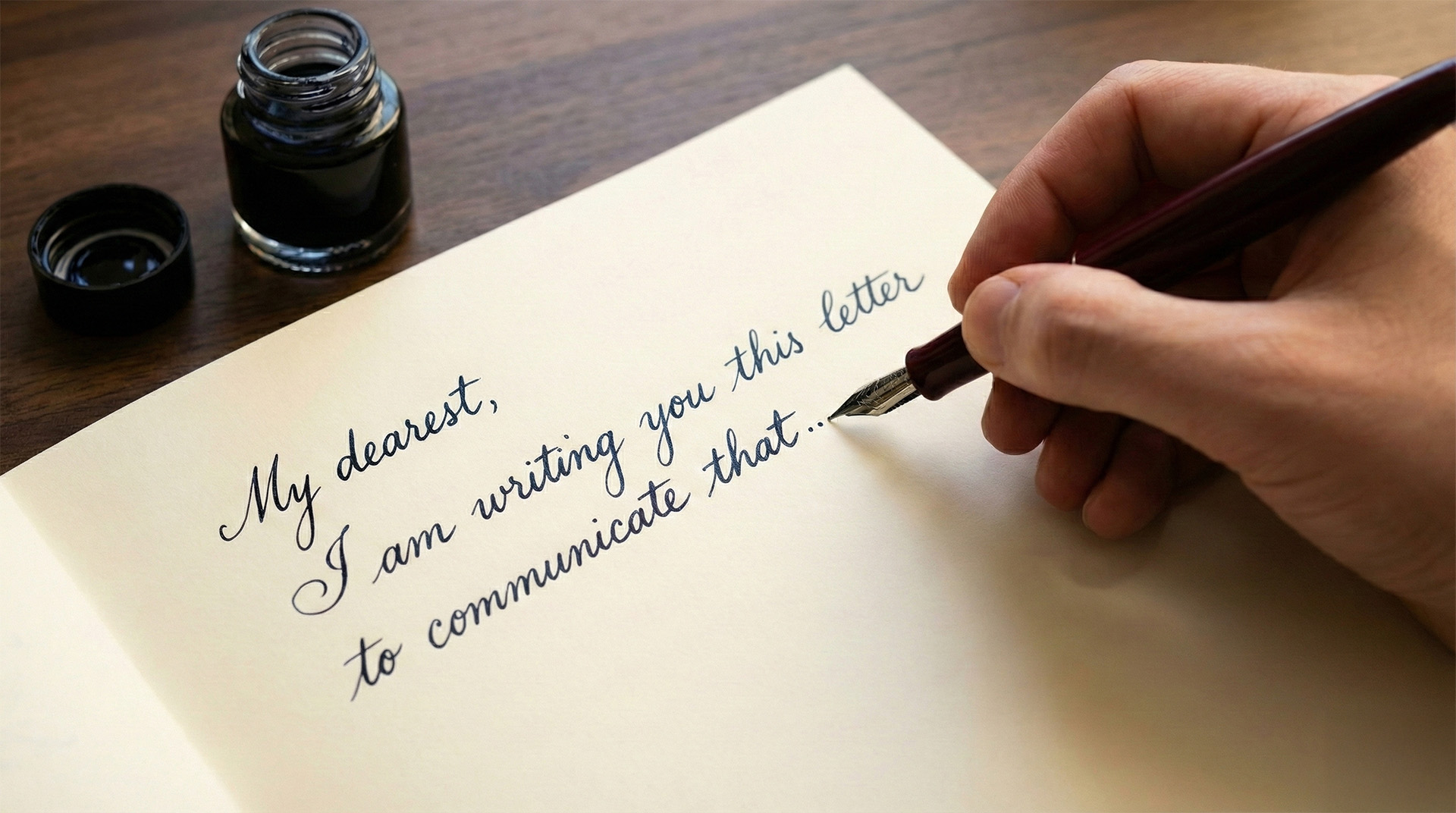
Anyone who uses a proper piston-fill fountain pen, a Pelikan Souverän or a Pilot Custom 823 chosen with genuine knowledge, rather than the £700 Montblanc that first-generation money flashes about without knowing what nib is fitted, understands an experience these studies are only now beginning to explain scientifically. There is something in the act of filling the reservoir, in waiting for the ink to flow, in the calibrated pressure of nib on paper, that forces thought to slow down until it coincides with the movement of the hand. The absence of ctrl+Z is not a limitation: it is a design constraint that improves the quality of the output. If you cannot easily delete, you must think before you write. The sentence must form in the mind before it reaches the page. It is a principle any systems designer recognises immediately: the right constraints produce superior results.
This is the mechanism that the dominant digital detox narrative fails to capture. It is not about stepping away from screens to feel better, as though it were a matter of hygiene. It is a cognitive recalibration that occurs through the deliberate reintroduction of friction. The entire digital ecosystem is engineered to eliminate friction: writing is instantaneous, deleting is instantaneous, sending is instantaneous. But friction, in cognitive processing, serves a precise function. It compels deeper elaboration. It forces more careful word selection. It imposes a temporal sequence the brain uses to consolidate memory and comprehension.
The pattern becomes recognisable when you look elsewhere. When music streaming reached saturation, vinyl returned; not as a replacement, but as a cognitive and sensory complement. Nobody listens to a record on vinyl for convenience; they listen because the ritual of selection, of placement, of waiting for the stylus to touch the groove, creates a listening experience that streaming by definition cannot produce. The same mechanism is operating today with pen and paper relative to digital writing. And it is no coincidence that both revivals coincide with the moment of peak saturation of their respective replacement technology. Streaming saturated with infinite algorithm-generated playlists; digital writing is saturating now, with artificial intelligence generating text on command. The easier, cheaper, and more ubiquitous digital text becomes, the more handwritten text gains value through scarcity and intentionality.
A Boston Globe article from January 2026 documents how entire communities are forming around these analogue rituals. There are typewriter clubs like Type Pals, Instagram communities like the Wax Seal Guild, analogue printing fairs, cafés where you pay by the hour to write letters in silence with typewriters and fountain pens provided. Wax seals, which for centuries guaranteed the authenticity and privacy of correspondence, are enjoying a second life as a meditative and creative practice. Fortune reports that communities dedicated to calligraphy and sealing wax thrive on Instagram and TikTok, and that the phenomenon cuts across age groups. As a twenty-eight-year-old Canadian founder of a mail club with thousands of subscribers puts it: "The girls are going analogue in 2026."
What strikes you, observing the phenomenon from a systems design perspective, is that this is not a rejection of technology. It is precisely the opposite: a sophisticated deployment of older technology as a tool for cognitive enhancement. People who write letters by hand in 2026 often photograph them for Instagram, use TikTok to learn calligraphy techniques, and purchase inks and papers through e-commerce platforms. The digital is not being abandoned; it is being repositioned. It moves from total environment to one tool among many. And the analogue, from leftover of the past, becomes premium technology for deep thought.
There is a broader lesson here, for anyone who designs systems or makes strategic decisions. Every time a technology completely eliminates friction from a process, over time it produces two effects: it democratises access to the baseline level of that process, and simultaneously creates demand for a high-friction version of the same process, aimed at those who seek superior quality. Email made written communication instantaneous and free for everyone; and precisely for that reason, a handwritten letter penned with a fountain pen on quality paper has become a signal of personal investment impossible to replicate digitally. The more easily ChatGPT generates a thousand words in three seconds, the more weight a hundred words written slowly by hand on a single sheet carry.
If this pattern holds, and history suggests it holds rather well, what we are observing is not a passing fad but the beginning of a permanent reconfiguration of the relationship between speed and depth, between friction and thought, between hand and mind. The attention economy had wagered everything on speed. The next phase may well reward those who know how to slow down deliberately, because in a world where everyone can write fast, knowing how to think slowly becomes the real competitive advantage.
Which brings us back to that corner shop in Covent Garden, which in 2012 looked like an anachronism and in 2026 looks like a prophecy. The founders of Choosing Keeping explained the name this way: they wanted customers to be "considerate and discerning in their choices, and to honour and care for their purchases for years to come, thus choosing and keeping." In an era that optimises everything for rapid consumption and immediate disposal, choosing carefully and keeping intentionally is not nostalgia. It is the most radical form of cognitive resistance available. And perhaps the most pleasurable one too.