Moscow and the economy that now needs the war
Posted on: 15 June 2026
Last week I sat in on a discussion the Ticino Chamber of Commerce had titled, with a certain candour, "The New Logics of Power". Tuesday afternoon, at Villa Principe Leopoldo above Lugano, a room of business owners and executives gathered to hear a handful of specialists reason about geopolitics and about what these scenarios mean for anyone who actually has to keep a company running. The conversation was led by Marcello Foa, alongside people who follow defence and international security closely for a living.
I came away with a sensation that often takes hold of me on these occasions, namely that the talk is almost always about intentions, about who wants what and about which move this or that leader has in mind, because that is the natural way in which we read power, as though it were always the product of a will, and yet while I listened one case kept coming back to me that has little to do with intentions and that says more, precisely for that reason, than any number of declarations. A case in which what gives the orders is not whoever decides, but whatever has been built.
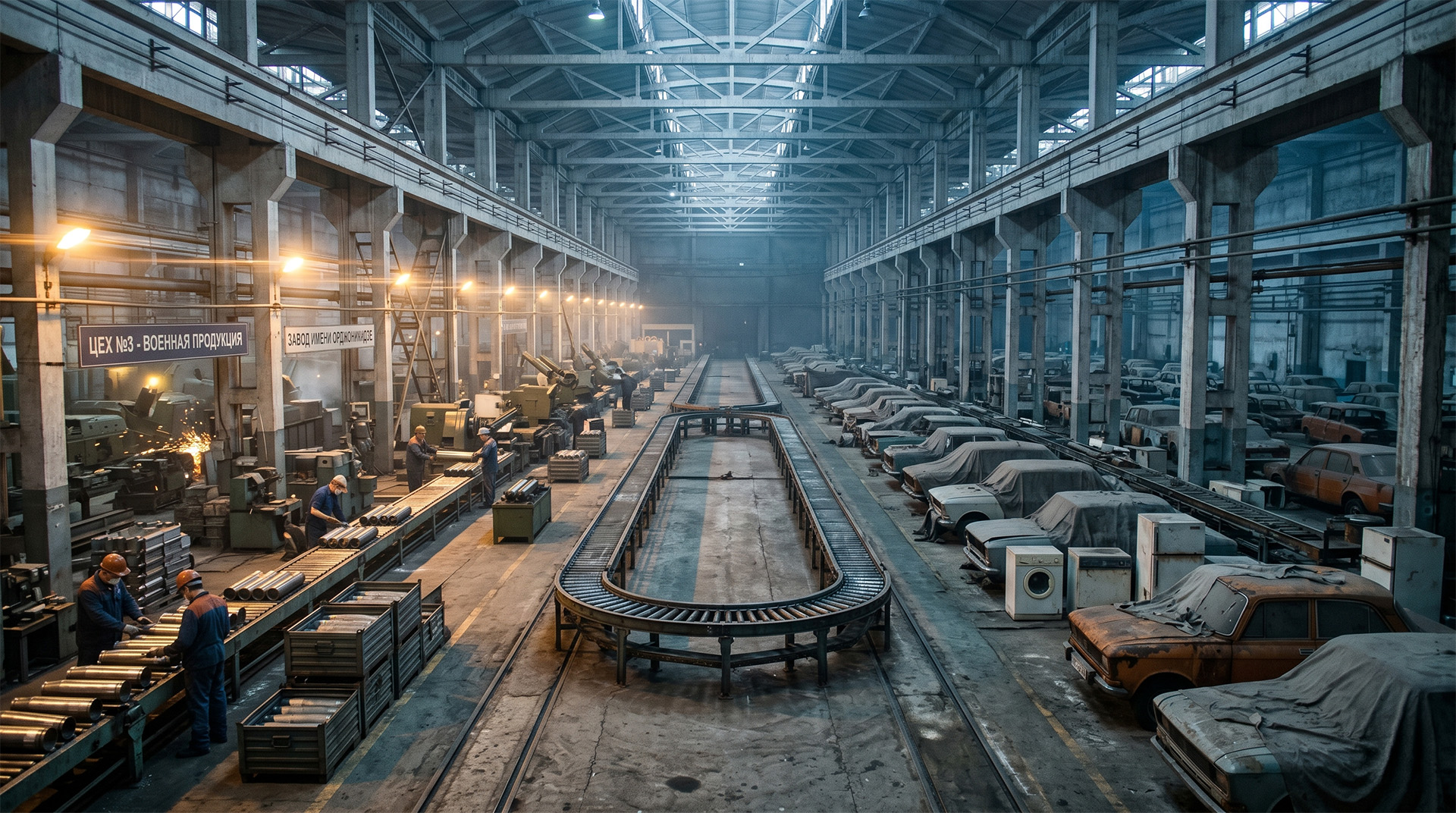
There is a figure that circulates little because it makes nobody quarrel, and it is precisely the one that weighs most heavily when the subject is Russia. In 2026 the country's production of civilian cars stayed nailed to its 2021 levels, while in the first months of the same year cement and bricks fell by between ten and twenty-five per cent. This is not the profile of an economy struggling under sanctions, but that of an economy that has stopped building houses in order to build something else.
Recorded Future lined the figures up again a few days ago, and the picture is not one of siege but rather one of reconversion: the share of the workforce employed in the military sector has risen from 3.9 to 5.1 per cent between 2021 and today, with roughly half a million jobs added to the defence industry while the overall pool stayed put at around seventy-six million. Put in brutal terms, it means that every worker who has entered a factory to produce munitions is a worker subtracted from something else. In those factories the wage runs to twice that of colleagues in the civilian sector, and inside Russia there are those who have already called it what it is: a new social contract.
Here the reporting ends and the interesting mechanism begins. An economy that restructures itself around a single activity does not come back at zero cost, because every reconverted factory, every doubled wage, turns into a political constraint before it is an industrial one. I have seen it on an infinitely smaller scale in firms that had built everything around a single client or a single revenue line: as long as the flow holds they look rock solid, but the day they ought to diversify they discover they cannot, because dismantling the machine costs more than continuing to feed it. The difference is that there a company goes under, whereas here we are talking about five per cent of the workforce of a nuclear power.
This is what makes the Russian case different from the usual sanctions-versus-resilience reading. Sanctions explain the strain, they do not explain the direction. The collapse of the civilian side is not the collateral damage of the embargo, but the result of an allocative choice in which capital and workers go where the war needs them and are missing where peace would need them. If it were only a matter of sanctions we would see an economy contracting uniformly, yet what we see instead is an economy that grows on one side while it hollows out on the other; that asymmetry is the signature of the lock-in.
At this point the question stops being whether Russia can win and becomes one of those questions nobody wants to ask: what does an economy do when peace becomes more dangerous than war? A genuine demobilisation would mean steering three and a half million people back towards a civilian sector that has by now been compressed, and halving wages that have bought the loyalty of entire industrial regions, and certainly no Russian planner has any interest in discovering what happens in that passage, which is why the terms of a peace, even a reasonable one, are treated by Moscow as a threat and not as an opportunity.
This is not the first time Russia has found itself against this wall, and that ought to be more unsettling than it is. In the 1980s the Soviet Union devoted to its military-industrial complex a share of output that no peacetime economy could sustain, and when Gorbachev tried to reconvert it, the famous konversiya, he found that factories designed to make tanks did not know how to make saucepans and that defence engineers could not be retooled in a single season, but above all he found that an entire ecosystem built around the weapon defended itself against its own reconversion. That resistance was one of the threads that led to the collapse, so the point is not that history repeats itself, but that the mechanism is the same, today in a version far more conscious of itself.
There is, however, a second plane that it would be dishonest to ignore. For more than a year the Secretary General of NATO has been repeating that Russia turns out more munitions in a few months than the whole alliance produces in a year, while other reports have it running out of breath, throttled by interest rates and by the shortage of Western microelectronics. Two opposing accounts of the same object, and the temptation is to ask which one is true. The right question, to my mind, is a different one: who has an interest in which figure.
It has to be said that the frightening number is useful. It serves a European rearmament that needs a threat which will not slow down, defence budgets that find their justification precisely in the size of the adversary, and the inflated figure is not necessarily false, but it comes from those who have to use that figure to obtain something. And here the mirror opens: the Russian economy needs the war in order not to collapse, Western defence planning needs that economy to look unstoppable in order to fund itself. The war of statistics does not contradict the Russian lock-in, it is its reflection on the other bank of the front.
Care is needed, though, not to fall into the comfortable symmetry, the kind that makes everyone seem the same and absolves them all together. The two sides of the mirror do not carry the same weight. Moscow has restructured the real economy, it has changed the material life of millions of people; the West, far more modestly, has retouched the account of the threat, and it is plain that redesigning the production of a country is one thing and choosing which number to put before a press conference is another. Whoever confuses the two orders of magnitude is not doing analysis, he is doing cynicism. And cynicism is laziness dressed up as lucidity.
What remains is the real knot, the one neither narrative wants to look in the face. An economy built around war does not need to want war in order to need it, no plan is required, no malice: the structure is enough. The incentives push in the same direction even when no one, at the top, is conspiring to arrive there, which is why forecasts that fix on Putin's intentions almost always strike the wrong target. Intentions change, but the machine, once built, has an inertia that intentions are not enough to stop.
What keeps me awake is not how long this configuration can last but that its exit is unknown. A war ends with a treaty, but a war economy, in order to end, needs to know what to do with itself the day after. And that day, in Moscow, no one has yet written.