H&M closes stores while Zara optimises its network
Posted on: 23 September 2026
When H&M said in April that it would close 160 stores during the year and open 80 new ones, the Italian press turned it within days into a requiem for fast fashion, with the Rome store on via Tuscolana cast as the physical proof. At the end of July Inditex ran 5,444 stores against 5,528 a year earlier, an exercise its own statement called optimisation of the commercial network, a phrase the same press reproduced without feeling any need to translate it into crisis. The operation is identical, except that the market had already decided which story belonged to which company and the figures were read accordingly.
The ten per cent drop that accompanied those closures also needs handling with care, since it is measured in Swedish kronor. First-quarter revenue went from 55.3 to 49.6 billion kronor, yet in local currencies the half year closed down one per cent, because the rest was done by a strong krona that in the second quarter alone took almost three points off reported sales. On the day of those results the shares fell eight per cent in Stockholm on an outlook judged too cautious, even though operating profit had risen 26 per cent.
The real distance between the two companies shows up in constant-currency sales, given that Inditex grew 9.2 per cent between February and July and opened the autumn at plus nine, while H&M was flat over March to May, facing the same European shoppers and the same freight costs inflated by the Middle East. Inside that flat number sits a Western Europe down three per cent, with Germany and the United Kingdom held back by falling confidence, alongside a Southern Europe up five, which makes it hard to blame the cycle when the direct competitor, which takes two thirds of its sales in Europe, is growing close to double digits.
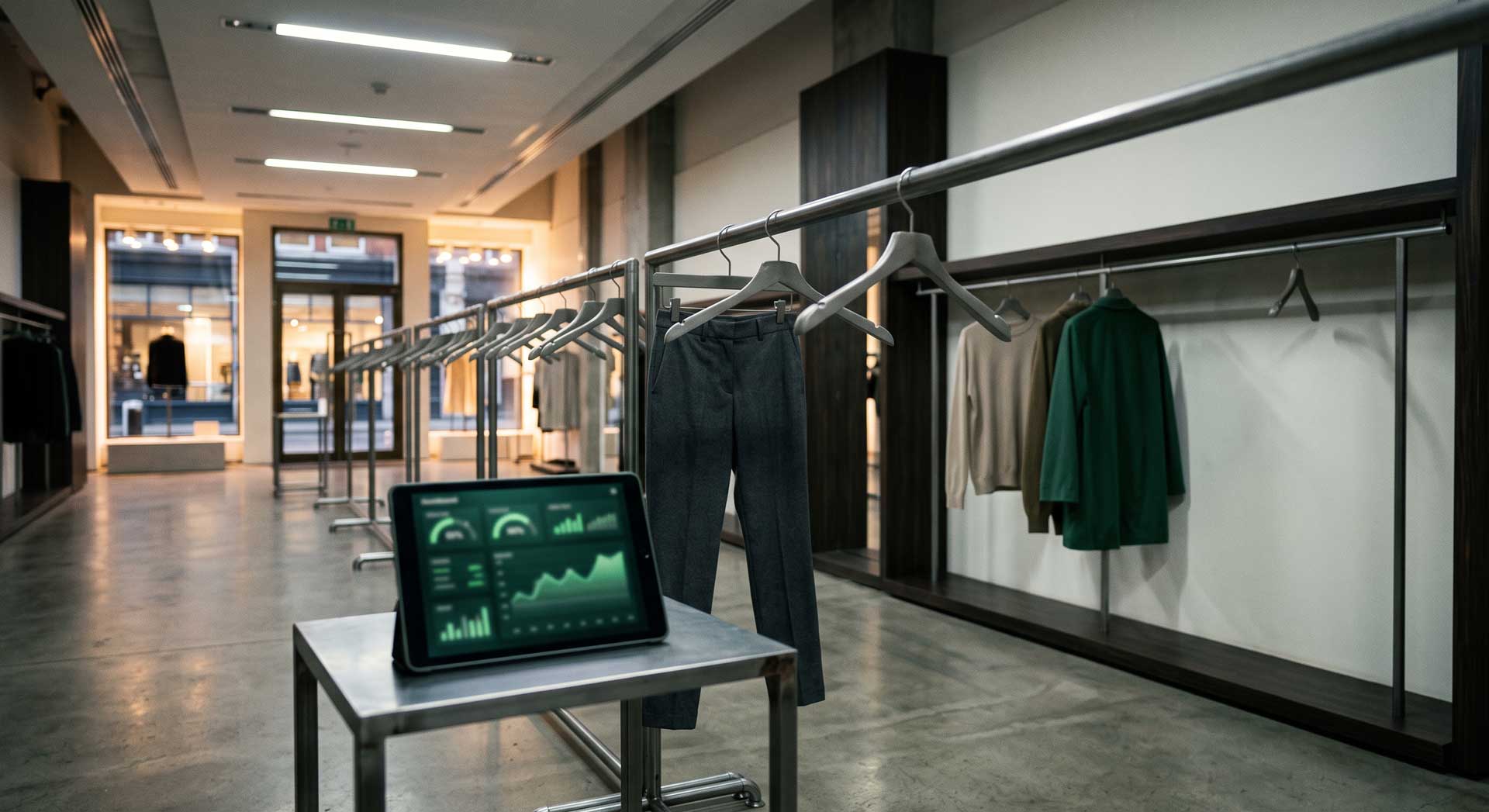
In June Daniel Ervér, chief executive since January 2024, said something that has stayed with me, admitting that tighter stock management had in some cases cost the company the ability to meet demand in full. Inventory was down ten per cent to 34.9 billion kronor and the operating margin excluding restructuring had risen to 12 per cent from 10.4, so the dashboard read green throughout while womenswear, which is precisely the part that had been driving the recovery in earlier quarters, stalled on gaps in the assortment.
I have watched this happen in companies far smaller than this one, where a sound indicator gets chosen, it gets tied to management targets and the organisation learns with great diligence to improve the indicator. The customer who walks in looking for her size and does not find it appears in no line of the dashboard until she stops coming back, at which point she appears as a sales decline with nobody able to trace her back to the decision that produced her.
Zara solves the same problem upstream, because it produces close to its markets and in small batches, which lets it run low stock without leaving empty rails since it can reorder quickly whatever actually sells. H&M cut its inventory without first shortening the reaction time of its own supply chain, which amounts to applying a competitor's metric to a machine built to work another way.
H&M knows this, having already said it will slow the reduction in inventory to avoid further gaps and that in the second half of the year it will replace its management systems, starting with the ERP, with the stated aim of matching supply and demand more closely. It has also stripped out layers of management in a restructuring costing 679 million kronor so that individual markets can decide for themselves and faster, which is as good as admitting that part of the delay sat in the distance between whoever reads the number and whoever has the power to act on it.
On Thursday at eight the nine-month figures land and I will be reading local-currency sales alongside inventory as a share of turnover, which stood at 15.8 per cent in May against a long-term target of 12 to 14. If stock rises and sales pick up, the problem was availability and the crisis story can be filed away, yet if stock rises and sales stay flat the papers were right for the wrong reasons.