Geneva barricades itself for a party that is not its own
Posted on: 12 June 2026
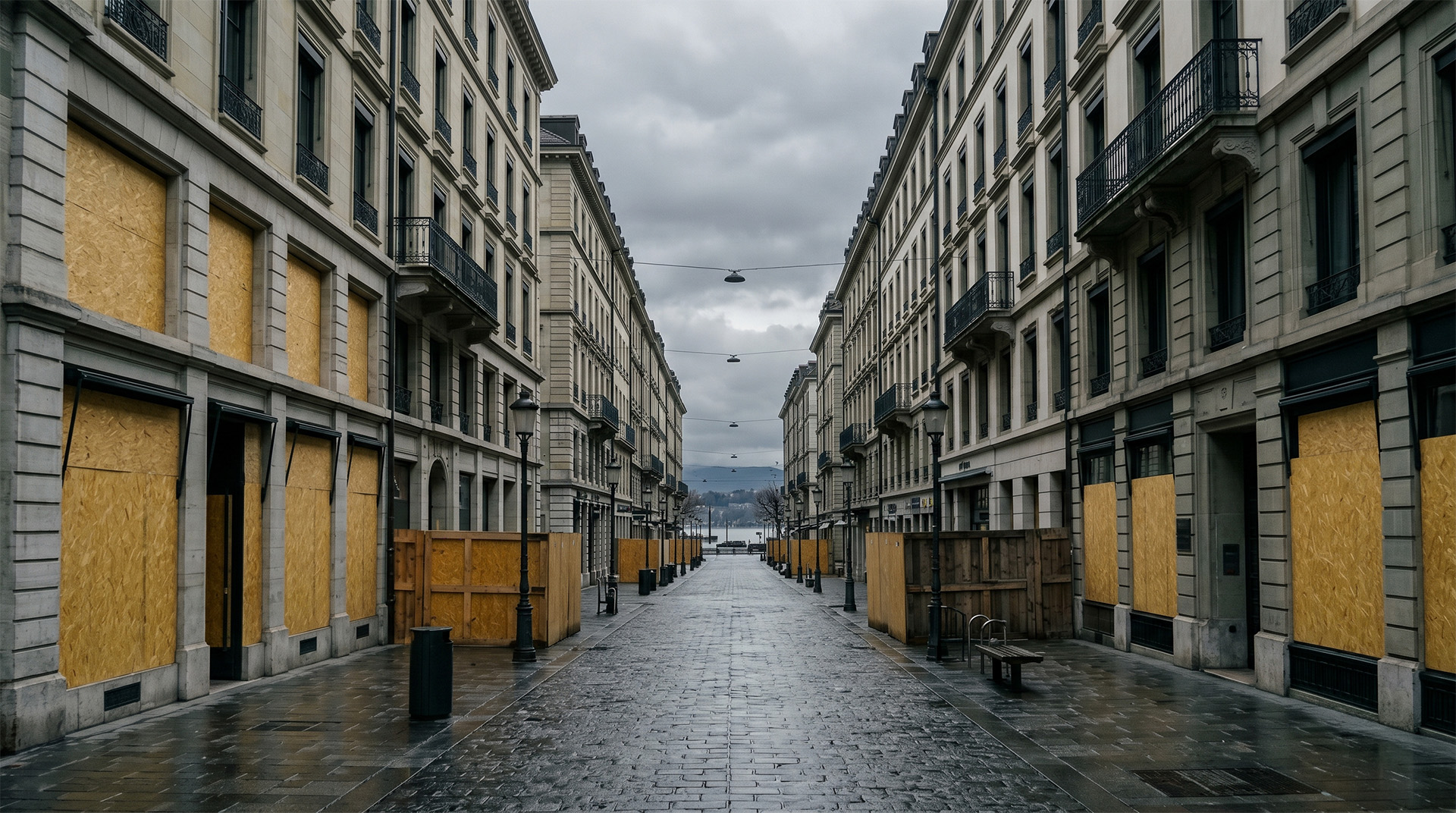
I was due on the Rue du Rhône that Monday, in Geneva; not for work, I may as well admit, but to shop, precisely the customer those windows exist for. An unremarkable afternoon, the sort that anyone who has lived in Switzerland long enough takes for granted in a country where things work. It did not happen. Postponed to Thursday, through no mishap of mine, but because that part of the city had sealed itself more tightly than any other: border controls reintroduced, crossings closed, public transport on a reduced timetable, the windows of the maisons and the banks already clad in the same yellow plywood as in 2003. The luxury shopper, shut out of the luxury. The moneyed quarter barricades first, and it does so for a summit, the G7, that is not being held in Geneva, nor indeed anywhere in Switzerland.
This year's G7 convenes in Évian, on the French shore of Lake Geneva, from 15 to 17 June. Seven kilometres of water separate the conference hall from the city that pays for it. Switzerland is not a member of the G7, was not invited and does not sit at the table; and yet it closes its borders, deploys more than 2,000 troops, covers 80 per cent of the security costs of the cantons of Geneva, Vaud and Valais and imposes restrictions on the airspace over the lake. The President of the Confederation, Guy Parmelin, will greet the heads of state on the tarmac at Geneva airport, Donald Trump among them, before handing them to a convoy or a helicopter bound for France. Master of the lobby, not of the room.
There is a comfortable way to tell this story, the register of logistical irritation, in which the overbearing neighbour throws the party and leaves you the mess. But what interests me is less the irritation than what the position reveals. That Switzerland should find itself there, playing doorman and escort to an event that is not its own, is not explained by this year's calendar; it is explained by the model on which the country has built two centuries of prosperity.
Switzerland has sold the world one thing in particular: neutral ground, less an ideology than a piece of infrastructure. Geneva is where the powers talk when they cannot talk at home. The Red Cross, the League of Nations, the UN, the discreet diplomatic channel, the strongbox too: the implicit message has always been the same, bring your business here, the ground is solid and no one is playing against you. It is an offer that has made the country rich and necessary. What tends to be forgotten is that whoever supplies the ground does not decide what the ground is for; that is decided by whoever uses it. It is a predicament a British audience has had recent cause to recognise: furnishing the room is not the same as holding a seat in it.
Évian is exactly that: France using the Swiss platform, the airport, the security, the airspace, the lake as a backdrop, without granting Switzerland a place in the room. The service is rendered and the supplier is kept outside the door. It is not an anomaly of this particular June, but rather the ordinary working of the trade, when the party not seated at the table is you.
And here is the detail that says everything. Parmelin wrote to Macron a letter meant to remain private, in which, by what has leaked of it, he poured out his displeasure at the organisation of the summit and at the costs offloaded onto the Confederation. The letter found its way into the pages of Le Canard enchaîné. In public the president offers a dependable "we will be ready"; in private he sends his French counterpart the bill along with the resentment. It is the posture of the host who knows himself to be, in the end, the hired help: smiling on the tarmac and grumbling in the correspondence.
Honesty requires me to dismantle my own reading here, because it is too seductive to be trusted unexamined. One might object that there is no demotion at all, merely geography: the nearest international airport to Évian is Geneva's, and anyone staging anything thereabouts will use that hub, which says nothing about Switzerland's standing. One might add that the 80 per cent and the 2,000 soldiers are no tribute paid to someone else's party but the defence of one's own territory against an unwanted spillover: Switzerland is not paying for the G7, it is paying to protect itself from it. And one might finally observe that Parmelin on the tarmac, far from playing the footman, is the plain proof that the world cannot hold its summit without Swiss ground; indispensability, then, rather than subordination.
These are serious objections, and largely true. What they fail to explain is why we have seen this scene before, identical, 23 years ago. In 2003 the G8 met in the same Évian hotel and Geneva became a battlefield: the black bloc tore through the Rues-Basses, the commercial heart of the lower town, shop windows went in and premises were looted; the damage ran into the millions. The city has carried the trauma ever since, and the political debate has never quite metabolised it. That is the precise reason the Geneva cantonal government asked Bern to seal the borders before the first march had even formed. The fear of 2003 dictates the fortification of 2026.
There is a detail that escapes the outside observer. It is not the whole city that barricades first but its richest artery: the Rue du Rhône, the watchmaking maisons and the banking quarter, armouring themselves although the authorised march is not even routed past them. They are not defending against a present threat; they are defending against a memory. Shops board up everywhere, of course, and Bond Street does the same before a demonstration; the gesture on its own proves nothing. What makes Geneva's case worth pausing over is the symmetry. The shopfront that is the most visible proof of what the Swiss model produces, the luxury and the wealth that accumulate where the ground is safe, is also the first surface that model must armour when the bill for its own openness comes due. Not because the protester has any quarrel with Geneva, but because the Rue du Rhône is the legible face of a global order convening at Évian, and the dissent discharges itself onto the nearest available symbol. The bank that pays for the hoarding of the shop beneath it is, quite literally, protecting its own window. Same shore and same neighbour absorbing the shock; the same city paying, as before, for a table at which it does not sit. When a role repeats at a quarter-century's distance, the same actors in the same positions, it ceases to be coincidence and becomes structure.
And here is the knot the objections, however sound, do not untie. Indispensability and subordination are not opposite conditions but the two faces of the same coin. Whoever sells neutral ground gets in return a position at once immensely powerful and immensely fragile. Powerful, because without that ground certain things do not happen: the world needs a place to meet in safety, and that place pays. Fragile, because the leverage it confers is the supplier's, not the principal's. The supplier can always refuse; but to refuse, here, is to surrender the very thing that makes you valuable. So Switzerland says yes, renders the service, absorbs the costs and entrusts its displeasure to a letter it hoped would stay sealed. This is not the weakness of those who govern, to my mind, but the physiology of the trade the country has chosen to ply in the world.
My postponed afternoon on the Rue du Rhône is the smallest unit of all this: an ordinary purchase, not made, because the city closed itself, beginning with that street, to receive guests who are not even its own. Multiply that single missed errand by an entire region and by three days and you have the price the model presents, punctually, at the till: borders sealed, soldiers on the lake, traffic diverted, business deferred. It is paid by those who live here, not by those seated at Évian. It is the kind of cost that never makes the communiqués, because to admit it would be to admit that openness as a service always has a master, and that the master, the weekend of the G7, does not sit in Bern but in Paris.