Fear as architecture
Posted on: 6 April 2026
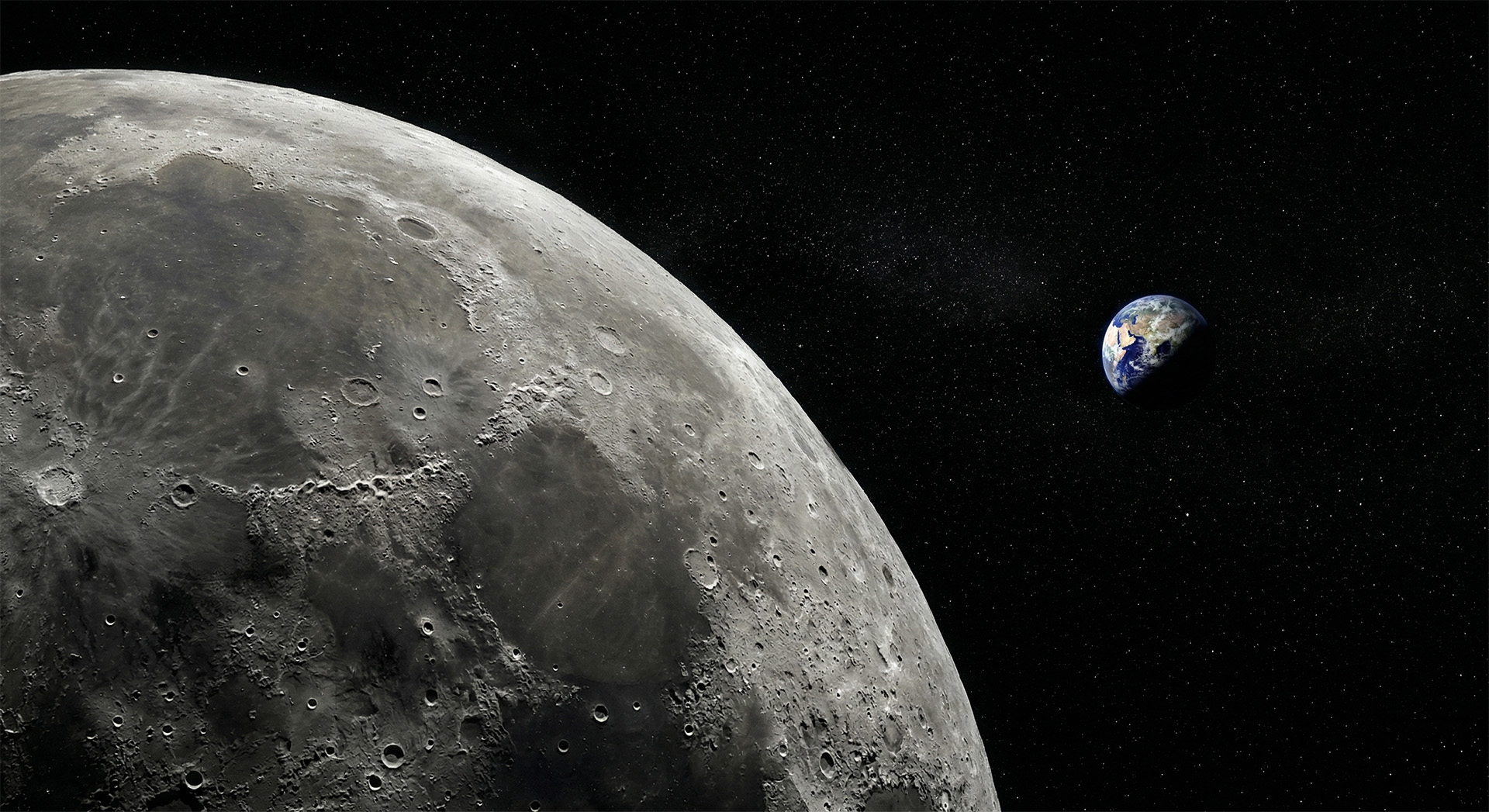
This week, four astronauts flew around the Moon. The first crewed mission beyond Earth orbit since 1972, when Harold Wilson was still a year away from returning to Downing Street and the miners' strike hadn't yet brought down a government. Reid Wiseman, Victor Glover, Christina Koch and Jeremy Hansen, aboard Orion, travelled further from Earth than any human being since Apollo 17. They made their lunar flyby yesterday. Today they are on their way home.
Barely anyone noticed.
Not because the story was suppressed. Not because some editor decided it wasn't worth the front page. It disappeared in a far more interesting way: it was simply outweighed by everything else. The Iran war is in its sixth week. Every day brings updates, downed pilots, drones over Dubai, infrastructure strikes, declarations from Washington at odd hours of the night. The cycle never stops, and the human brain, confronted with a choice between danger and wonder, will always choose danger. It was built that way.
The observation that war crowds out other news is not particularly illuminating. What is worth examining is something less obvious: nobody chose for it to go this way.
Contemporary media organisations are not editorial teams deciding what matters. They are attention-capture systems optimised for a single metric: time spent on platform. Programmatic advertising, social distribution, push notifications, real-time click data — all of it remunerates one category of content with a precision no twentieth-century Fleet Street editor could have imagined. The content that wins, consistently, is whatever triggers the threat response. Fear, urgency, imminent danger. Not because journalists have become cynical or lazy, but because the incentive architecture pushes them there without anyone having explicitly decided it should.
The result is structural terror. Unplanned, unorchestrated. Generated automatically by a market architecture applied to human attention.
While Iran dominates every available column, South Korea has been through a constitutional crisis of a severity it has not seen since its democratic transition. A president impeached, a country in institutional stasis for months, a new government that must now rebuild its alliance with Washington at precisely the moment Washington is looking only at the Persian Gulf. South Korea is the fourth-largest economy in Asia. It produces close to a fifth of the world's advanced logic chips. It shares a live border with a nuclear state. This is not peripheral news. Yet ask any reasonably well-informed person what they know about Korean politics over the past year and the answer will almost certainly trail off somewhere around the martial law declaration.
Zelensky has vanished. Not from Ukraine, but from the attention economy entirely. Trump displaced him in the most literal sense: he absorbed all the oxygen of the geopolitical narrative, first with tariffs, then with Iran. The war in Ukraine continues — as a conflict, as a humanitarian catastrophe, as an unresolved diplomatic problem of considerable consequence. It simply no longer exists as news. That distinction matters more than it might appear. A conflict that ceases to be visible also ceases to generate political pressure. It stops weighing on negotiations. It stops costing anything to the people who allow it to continue.
There is a mechanism here that deserves a clinical look.
Political actors who have understood how the attention architecture functions possess a tool of power with no real historical precedent. Censorship is unnecessary. Controlling the press is unnecessary. Saturating the field is enough. Produce sufficient noise, sufficient urgency, sufficient high-voltage content, and everything else slides away on its own. Saturation is more effective than suppression because it leaves no trace, generates no opposition and cannot be accused of anything. It is simply the market working as designed.
I recognised this pattern in a different register in the nineties, when the internet was beginning to reorganise the creative industries I was working in. The assumption at the time — widely held and genuinely believed — was that multiplying the channels would necessarily produce more pluralism. More voices, more distributed attention, a more complex public conversation. The opposite happened. Multiplication concentrated the power of attention capture in the hands of whoever could produce the most visceral, most urgent, most biologically irresistible content. That is not a moral judgement. It is a description of what happens when the physics of attention are organised as a market.
The structural terror this produces bears no resemblance to the terror we know from history. It has no ministry, no declared ideology, no propaganda apparatus in the traditional sense. What it has is subtler: a persistent sensation that the world is always on fire everywhere, that each day brings a new crisis too urgent to ignore, that there is no point following South Korea because something more pressing will arrive tomorrow. The cumulative effect is cognitive helplessness. I cannot keep up. I do not understand enough. Better to focus on whatever is immediately in front of me.
That helplessness is not an accidental side effect. It is functional.
A cognitively overloaded and frightened public does not build complex models of reality. It reacts. It rewards simple narratives, legible enemies, immediate solutions. This is the ideal ground for certain kinds of politics, certain kinds of leadership, certain kinds of consent. I have no evidence that anyone designed this outcome deliberately, and I do not need it. The mechanism operates independently of intention. Systems produce structural consequences that extend well beyond the individual choices of the people running them.
Artemis II will splash down off San Diego in the next few days. Four human beings saw Earth from a distance no one had seen it from in half a century. They photographed the far side of the Moon, watched the solar corona during an eclipse observed from space, called the International Space Station the way you might call a colleague across town. On a different week, this would have been the kind of thing that makes you briefly aware of belonging to the same species as everyone else.
Instead, we were watching the drones over Dubai.
No one is to blame. The system is functioning exactly as it was built to function. Which may be the most unsettling part of all.