Everyone is optimising the same biscuit
Posted on: 10 July 2026
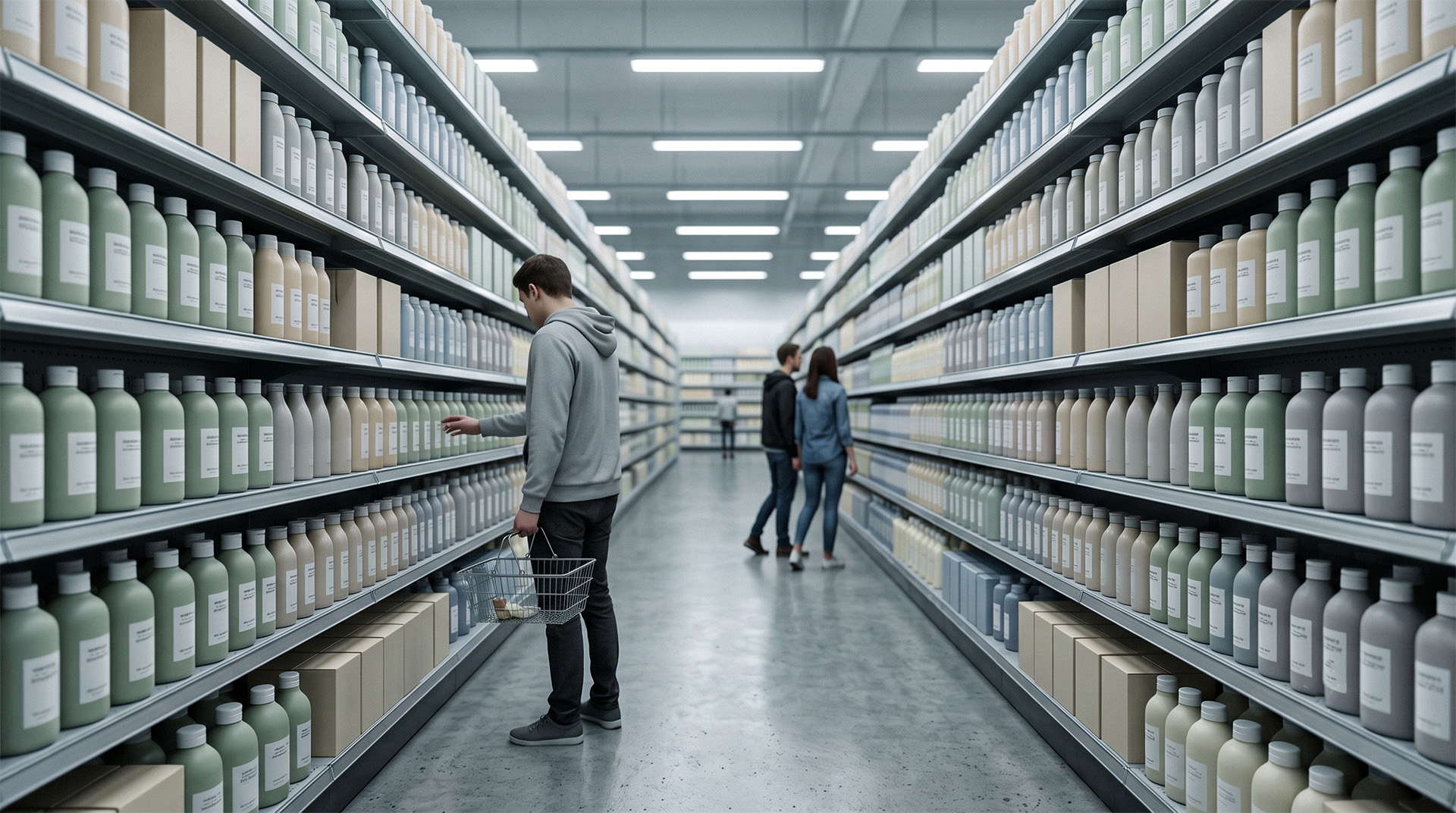
Walk down any British supermarket aisle and the own label product now sits beside the brand it imitates looking almost indistinguishable, the same silhouette of bottle, the same on pack claims, a few pence cheaper. That kind of convergence used to take years of patient reverse engineering. What the consumer goods industry told us at a summit in Vienna in late June is that it has found a way to make the underlying work far faster, and it has chosen to call this innovation. L'Oréal says it can now formulate four times more quickly than before and has repurposed molecules first developed for skincare into a collagen shampoo that adds lift. Mondelez, the owner of Cadbury and Toblerone, says an in house tool generates recipes that a human expert then judges, and that sixty per cent of its new biscuit formulas scored better on the measures the company tracks, from nutrition to cost. These are good numbers. They are also, every one of them, claims made by the people who paid for the tools, delivered in the one venue built for saying that the money worked. Nobody at that podium stands up to announce that they wasted a fortune.
It is worth starting with the objection that appears to dismantle the whole thing. If artificial intelligence drives costs up, as everyone keeps saying, why are these companies using it to improve their products. The contradiction dissolves the moment you separate two things that public discussion keeps fused. The AI that raises costs is the generative kind served at scale, the data centres, the energy, the price of every query to a model running for millions of users. It is not the AI that L'Oréal and Mondelez are describing, which is predictive and simulation software confined to the laboratory, closer to computational chemistry than to a chatbot. That variety does not raise the cost of the shampoo, it lowers the cost and the time of finding its formula. The saving sits in the funnel of experimentation, not in the cost of goods sold, two very different lines on a balance sheet narrated as if they were one.
This is where the story about speed begins to show its flank, because in fast moving consumer goods the bottleneck was never formulation. The binding constraint is demand, or more precisely the space on the shelf and the attention of a shopper who already faces more choices than they can process. Formulating four times faster means accelerating the input that was already abundant while the scarce one stays exactly where it was. You do not produce more sales, you produce more variants, and the proliferation of lines in this sector is a value destroyer understood for decades, because it multiplies complexity and cannibalises itself, forcing the retailer to decide what to delist to make room for you. Any buyer at Tesco or Aldi will tell you that shelf space, not recipe count, is the thing in short supply.
L'Oréal makes the point almost too neatly. The group filed seven hundred and twenty five patents in 2025 and built an entire programme, its beauty stimulus plan, around the idea that the way out of a slowdown is to innovate more and faster. In the same year group growth decelerated, with the final quarter running at plus 1.5 per cent against plus 4.5 the year before. A company pressing the accelerator on formulation precisely as demand slows is telling you where it believes the problem lives. It is looking where the light is better, in the laboratory it can control, rather than where the problem actually sits, in a consumer desire that no simulation designs.
Then there is a second effect, slower and more insidious, which concerns what happens once the tool belongs to everyone. Models that optimise a recipe work on measurable parameters, what an ingredient costs, how it weighs on the nutritional profile or the environmental footprint. They optimise what can be counted, as they must, because a machine cannot chase what has no metric. Yet in food, and in cosmetics still more, the reason a person reaches for one product over the near identical rival lives precisely in what is not counted, the taste that lingers and the promise a brand has spent thirty years building, that irrational distinctiveness which was always the moat. When every competitor trains similar tools on similar data to optimise the same parameters, the outputs move toward each other. It is nothing more than Goodhart's law seen on the factory floor, the moment a measure becomes the target it stops saying what it used to say. The biscuit wins on the dashboard and loses on the reason you bought it. Haleon can optimise a toothpaste to score well on every quantifiable axis and still find that what sold Sensodyne was a claim about sensitivity that no formula sheet contains.
That the giants should move first is not incidental and rewards a careful reading, because this kind of AI pays off most for whoever owns what is needed to train it, decades of formulations and consumer tests held as proprietary data, plus the capacity to spend at fixed cost on building or buying the models. It is an incumbent's weapon, not a challenger's, because a small player has no molecular library on which to run the prediction. The paradox arrives at the end of the argument. The same instrument that hands the large player an advantage of scale, once all the large players adopt it, turns that advantage into a shared treadmill on which everyone runs harder to stay in place. What promised differentiation delivers, at the level of the whole sector, its opposite.
The test of all this I leave open, because it is honest to. If within a few quarters the firms that embraced this speed first show gains in share that come from the product rather than from advertising spend, then I have been chasing a ghost and faster formulation really was an edge. There is a more fragile point still in the argument, which I hold for what it is, a hypothesis and not a verdict. I am assuming that the optimum on the dashboard does not coincide with the optimum on the shelf, when it is perfectly possible that optimised products simply sell better, that the shopper genuinely wants the biscuit that costs less and feeds more. We will tell the two apart only by watching where the market share goes, not where the press releases go. For now the one certain thing is that the industry has learned to produce, faster than ever, the answer to a question nobody was yet asking.