The pudding you didn't have
Posted on: 29 October 2026
Every British drinker knows the man who is always just leaving when it comes to his round. He has had three pints bought for him, he glances at his watch as the fourth glass empties, and he is out of the door before anyone has to say anything. Nobody ever does say anything, which is precisely the point, because the round is one of the few institutions in this country that runs entirely on unwritten credit. No one keeps a ledger, no one asks for a receipt, and yet everyone at the table knows to the drink who has paid and who has not. The man who slips away is not short of money. He has misunderstood what was being exchanged.
The state, for once, understood it rather well. During the First World War, under the Defence of the Realm Act, the government brought in what became known as the "no treating" orders, which made it an offence to buy a drink for anyone else and required every drink to be paid for by the person who drank it, with up to six months in prison for breaking the rule. The concern was munitions output and drunkenness among servicemen, and the reasoning was sound, because officials had grasped something that economists would take another ninety years to measure. When drinks are bought for the group rather than for oneself, everybody drinks more. The orders faded away soon after the war, and the round came back as if nothing had happened, since a habit that old does not die of a regulation.
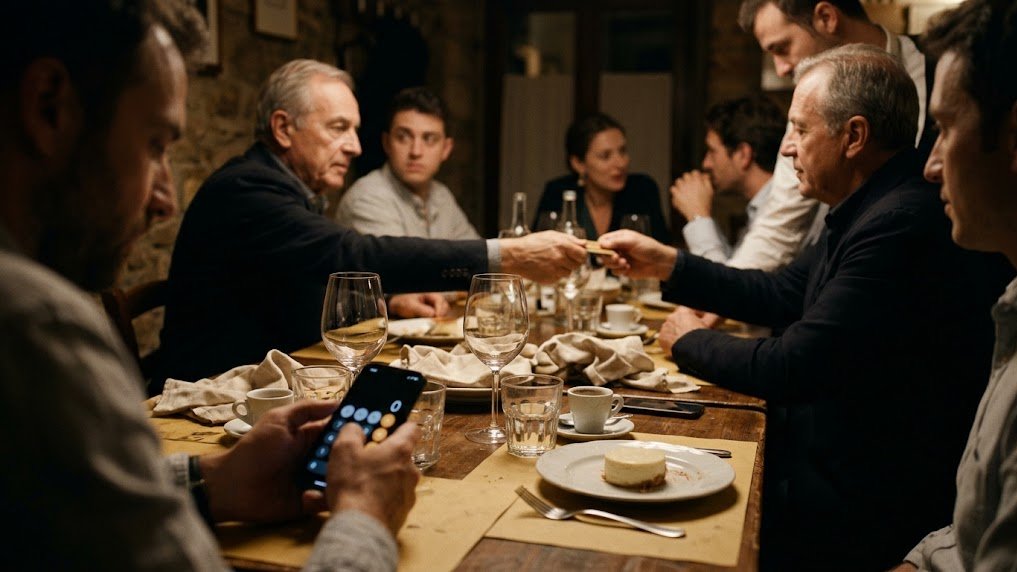
The restaurant has no such institution, which is why the end of a dinner so often goes wrong. The bill arrives on its little saucer, somebody turns it towards himself and before the waiter has even stepped away he has opened the calculator on his phone. Then comes the sentence, always the same with small variations: "I didn't actually have the pudding." Sometimes it is the wine he doesn't drink, or the starter he only tasted. From that moment the dinner is over, even if the coffee has not yet arrived, because figures and roundings start circulating around the table while someone stares into the middle distance waiting for it to pass.
When it happens I usually pick up the bill and pay for everyone. I know the gesture invites an unflattering reading, that of the man who produces his card to make the accountant feel small in front of the others, and I do not rule out that a particularly touchy guest might take it exactly that way. The reason is simpler, though. What I am paying for at that point is a decent end to the evening. I am not buying anyone's gratitude, I am buying the end of the scene.
The fact is that counting at the table is vulgar, for a reason that has nothing to do with the sum involved. The table is one of the few places where, for a couple of hours, the accounting between people is suspended, which is why we invite friends to dinner rather than to the office. Whoever opens the calculator puts the till back among the glasses and turns friends into counterparties, and whether the difference is six pounds or sixty makes no difference at all, because the message gets through either way.
It would be convenient to dismiss the accountant as a skinflint, but he has a point, and somebody has measured it. In 2004 Uri Gneezy, an Israeli economist who has spent his career studying how the way we pay changes the way we behave, published with Ernan Haruvy and Hadas Yafe a study in the Economic Journal based on an experiment in a restaurant in Haifa. Groups of six strangers were invited to dinner under different rules for the bill. Those paying for themselves ordered on average 37 shekels' worth of food, those splitting the bill equally went up to 51, and those who knew the experimenter would pay for everything reached 82. When a bill is split six ways, each diner pays only a sixth of whatever extra he orders, so he orders more, and in the end whoever ate little ends up subsidising whoever had the lobster. The accountant, in other words, has economic theory on his side, and so, a century ago, did the wartime licensing authorities.
He has it, however, at a table of strangers. Gneezy deliberately sat together people who had never met and would never meet again, precisely in order to remove the social consequences, since his aim was to use the restaurant as a laboratory rather than to describe dinner among friends. Among people who will see each other again the game changes. The man who orders the lobster at everyone else's expense pays for it later in reputation, much as the man who skips his round does, while the man who counts the pennies pays as well, in a different currency.
That currency was described better than anyone by Marcel Mauss, the French anthropologist who was the nephew and pupil of Émile Durkheim, the man who more or less founded sociology in France. In "The Gift", published in 1925, Mauss compared the customs of peoples as far apart as Melanesia and the north-west coast of North America and found the same pattern everywhere: whoever receives a gift is obliged to return it, and until he does he remains bound to the giver. The debt is what holds people together. I pay tonight and you pay next time, or nothing happens for a year and then one day a favour arrives that nobody asked for. The account stays open, and the friendship stays open with it. The pub round is Mauss with a bar towel, a chain of small debts that is never quite settled because settling it would end the evening.
Whoever splits the bill to the penny the moment it arrives performs the opposite operation. He settles everything in front of witnesses and says, without realising it, that nothing remains outstanding between us, which is another way of saying that we need not see each other again. The line about the pudding nearly always comes from someone who cares a great deal about appearing fair. And fair he certainly is, in the way an invoice is fair.
Every language, incidentally, blames the habit on a neighbour. The English go Dutch, Italians pay "alla romana", as though the Romans had anything to do with it, and in parts of Latin America one pays "a la americana". Nobody, it seems, wants the custom to be their own.
Mauss also saw the dark side of the gift, which is why this is not meant as a eulogy for the man who always pays. Among the Kwakwaka'wakw of British Columbia, known in his day as the Kwakiutl, the potlatch was a feast at which a chief distributed or destroyed wealth, blankets and copper plates among them, in order to leave a rival unable to reciprocate. A gift that cannot be returned humiliates the person who receives it, because it leaves him in debt for ever. The Canadian government banned the potlatch in 1885 and the ban stayed in force until 1951. There are people in restaurants who pay for everyone in the same spirit, and the others at the table usually notice.
So the dividing line does not run between those who have money and those who do not. It runs between those who count at the table and those who did their sums before sitting down. If I cannot afford a dinner I do not go, because accepting the invitation means accepting that tonight the bill might fall to me, all of it. It should not always fall to the same person, and it is better that it does not, since whoever pays every time ends up depriving the others of the chance to reciprocate with a bottle the next time or an invitation to their own home. But the possibility of paying for everything has to be accepted beforehand, when you say yes to the invitation, not discovered when the bill arrives.
Splitting the total equally, for that matter, without discussion, is often the most civilised solution there is. A curry house full of twenty-year-olds living on student loans is no place for grand gestures, while the total divided by eight is an elegant way of not counting. The target is the ritual of the calculator with the pudding deducted, which is the precise moment at which dinner stops being dinner.
What remains to be said is what the person who does not count actually gains, because he does gain something, and this is exactly where one has to be careful. If you pay thinking that a small loss tonight will earn you a great deal more in a few years, you are merely an accountant with a longer horizon, and the person sitting opposite will notice sooner or later. The return does come, I have seen it come many times, but it comes afterwards, as the consequence of a gesture that was not looking for it. People remember for years who did not count at the table, even when they can no longer recall where the dinner was or what they ate.