China: The sixty billion the Treasury did not put in
Posted on: 9 September 2026
While Monday's headlines were reporting that China is pumping 54 billion dollars into its state banks and insurers, it is worth doing the addition before reading the commentary. Agricultural Bank of China is raising up to 160 billion yuan through a private placement of A shares, ICBC up to 100, the Export-Import Bank of China receives 30 billion directly. On the insurance side, China Life takes 35 billion, PICC up to 15, Sinosure 10, China Taiping 7, China Re 3. The total declared by the eight companies in their Shanghai exchange filings and carried by Xinhua is 360 billion yuan, around 53.6 billion dollars.
The Ministry of Finance is subscribing for 130 billion of Agricultural Bank's placement and 70 billion of ICBC's. Add the other items, all of which sit directly with the ministry, and the Treasury's share comes to exactly 300 billion, which is exactly the special bond figure announced on Monday morning and exactly what Li Qiang's government work report had promised in March. Sixty billion is left uncovered.
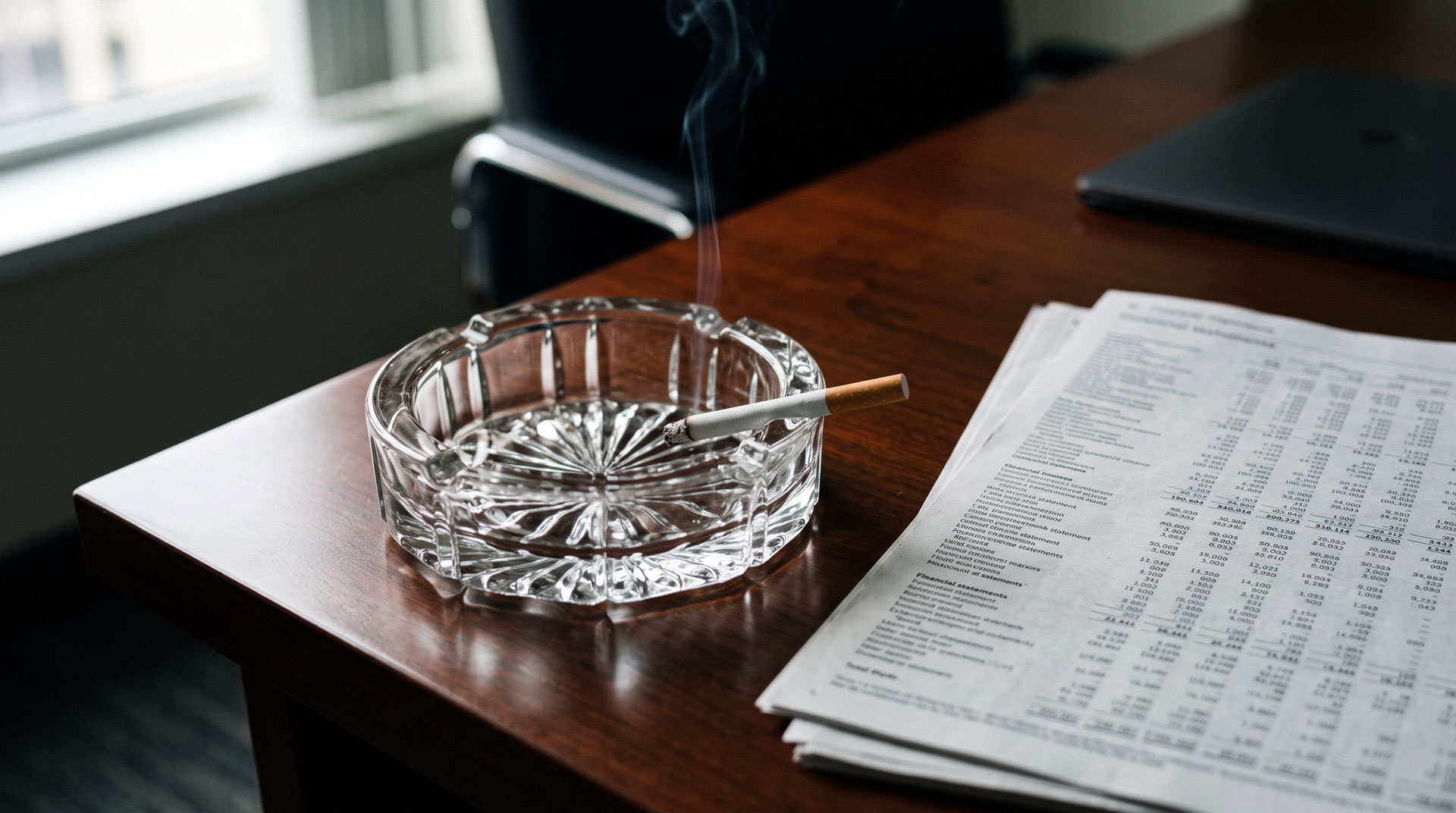
Those sixty billion are coming from China National Tobacco Corporation and its subsidiaries, which appear alongside the ministry in the Agricultural Bank and ICBC filings as designated subscribers. The state cigarette monopoly is buying into the core capital of the two largest banks in the country, which happen to be the two largest banks in the world by assets.
This shareholder paid 1,580 billion yuan into the state budget in 2025, and taking industrial and commercial taxes together with profits remitted to the centre the figure reaches 1,657 billion, both of them records according to State Tobacco Monopoly Administration data. Against national general public budget revenue that comes to roughly 7.2 per cent. One group selling one product into demand that does not track the economic cycle, because nicotine dependence does not have recessions.
This is not the first time that cash flow has been sent out to do the state's work without passing through the state. When Beijing set up the first Big Fund for semiconductors in 2014, the initial 138.7 billion yuan came from the Ministry of Finance, from China Development Bank Capital and from a group of public enterprises including China Tobacco, which took around eleven per cent and became its second largest shareholder. Chris Miller pauses over that choice in Chip War with some astonishment. The cigarette monopoly came back for Big Fund II in 2019 and Big Fund III in May 2024, the one with 344 billion in registered capital. In March 2025 it joined Bank of Communications' 120 billion placement, closed on 17 June, alongside the ministry and Shuangwei Investment.
There is a consistency of instrument here running twelve years. When patient capital is needed for a national priority the budget would rather not carry, the tobacco tap gets opened. Chips in 2014, banks from 2025, all of it without a vote and without a line of deficit, because formally it is a company deciding to invest.
The obvious objection is that this is state money moving from one pocket to another, so the accounting is a detail. That objection has a flaw, because legal form determines who answers for what, and while the 300 billion in treasury bonds carry a maturity and a market that prices them every day, the sixty billion from tobacco have none of that and sit outside the perimeter where anyone can measure the cost of that choice against the alternatives.
British readers have watched the same problem from the other end, and recently enough to remember the numbers. The Treasury put £45.5 billion into RBS across 2008 and 2009 for an 84 per cent stake, and spent seventeen years getting out. The final shares went on 30 May 2025 through a trading plan. Around £35 billion came back through sales, dividends and fees, which left a loss of £10.5 billion that the Chancellor had to announce and defend in public on the day. Lloyds, on £20.3 billion, came out in 2017 with £21.2 billion returned and a profit of £894 million. Rick Haythornthwaite, chairman of NatWest, described the whole thing as a rescue rather than an investment.
Note what the British version had that the Chinese version does not. A market price on the way in and on the way out, a running tally, a date, an exit, and a number that a minister eventually had to stand up and read out. Every one of those is a device for making the cost visible to someone who is in a position to object. The Chinese operation has none of them, and sixty of its 360 billion do not even carry the state's own name.
Now the part that spoils the rescue story. In the first half of 2026 Agricultural Bank closed with a net interest margin of 1.28 per cent, up two basis points on the first quarter, with profit growing 4.9 per cent. ICBC is at 1.29 with profit up 3.3. The margin across the whole banking sector rose to 1.41 per cent in the second quarter, the first quarterly increase since 2022, because expensive deposits taken on in earlier years are maturing and being renewed at lower rates. The Ministry of Finance, in Monday's circular, writes that the eight institutions are operating stably, with stable asset quality and supervisory indicators inside safe ranges.
And the market sold. On Monday in Hong Kong Agricultural Bank fell 2.7 per cent, ICBC 2.3, China Taiping almost 4, against a Hang Seng down less than one, so the recapitalised names underperformed the index that holds them. Citi noted that the insurance portion came in well below the 200 billion the market had been expecting, reading the smaller size as a sign of health.
So put the pieces together. Margins are stabilising, profits are growing, the regulator certifies that the books are fine, the package is smaller than expected. If this is a rescue, it is the best hidden rescue in years, and it is far more likely to be a pre-load. Han Shen Lin, who covers China for The Asia Group, said as much in plain terms, that Beijing is preparing bank balance sheets for the next strategic investment cycle, with the capital requirements of artificial intelligence and advanced technology at the front of it. Core capital is not there to cover yesterday's losses, it is there to multiply tomorrow's lending, because every yuan of common equity licenses eight or ten yuan of risk weighted assets and that is the point of the exercise.
Here, though, the structure produces a problem none of the actors has any interest in naming. Common equity tier one is, by regulatory definition, the money that absorbs losses first. That is what it is for, and its function is to put somebody in the position of losing their own money if the loans go bad, so that somebody has a reason to look at the loans before they are made. In this operation the party putting up the capital is the Ministry of Finance, the party directing where the credit should go is the Ministry of Finance together with the rest of the apparatus, and the party that would absorb the loss is the Ministry of Finance. The three functions that the entire post 2008 prudential architecture worked to keep apart have collapsed into one entity. The Basel ratio still calculates and still produces a reassuring number, except that number has stopped measuring the thing it was built to measure.
Taleb has been right about this for twenty years and the formulation is his. Skin in the game is an information device before it is a moral virtue, and it exists to deliver a signal to the decision maker that no internal reporting system can manufacture. Take it away and you get a blind decision maker.
The loop that closes best, though, is the insurance one, and to see it you have to go back twenty months. In January 2025 Wu Qing, head of the China Securities Regulatory Commission, announced at a press conference that from 2025 the large state insurers would put thirty per cent of new annual premiums into A shares. The measure formed part of a plan signed by six bodies to move long term capital into the equity market. That May the regulator cut the capital charge on equity investments by ten per cent inside the C-ROSS solvency regime, which is the technical way of saying the same shares now weigh less against required capital.
S&P wrote on 24 January 2025 that the directive could narrow insurers' capital buffers and increase earnings volatility. It was the arithmetic consequence of loading volatile assets against guaranteed return liabilities in a low rate environment. By the end of 2025, according to Gary Ng at Natixis, the five large listed insurers held twenty one per cent of assets in equities. On 6 September 2026 the state recapitalised insurers for the first time and China Taiping's own statement says the funds improve solvency and other key indicators.
The state ordered an exposure, softened the rule that measured it, then covered the effect of its own instruction with public money. Each individual step is defensible on its own, even though the complete cycle is a system buying its own equity market and insuring itself against the price of that purchase, and in any case none of the three steps was priced by anyone with the standing to say no.
So what should anyone watch over the coming months, rather than repeating the headline number?
The first marker is the composition of lending in the two quarters after the placements close. If the pre-load reading holds, growth in loans to the declared priorities has to pull clearly away from growth in the overall books at Agricultural Bank and ICBC. If the capital instead sits still holding up the ratios, the prudential reading was the right one and mine was wrong.
The second is the issue price of the A shares, which has not been set and will go through regulatory approval. A placement priced above the market means whoever subscribes accepts an immediate loss of value, which makes the operation a fiscal transfer dressed as an investment. A placement priced below the market pushes the cost onto minority shareholders, who exist in both banks and are also listed in Hong Kong.
The third concerns the Chinese smoker, who funds this whole architecture and is the only party who appears in none of the announcements. Cigarette sales in China have been growing for years and the excise duty has not been touched since 2015. If anyone were ever to propose a serious increase in tobacco taxation on public health grounds, they would now be facing a new argument as well, which is that the revenue is committed to the core capital of the banking system. The conflict has been latent for twelve years. Since Sunday it has a number.