Care as signature
Posted on: 12 May 2026
I've spent a lifetime in the habit of watching, and I can't shake it. People talk a great deal; objects talk much less, but when they do, they tell the truth.
I see a car with a dent on the right front wing, the kind that records some clumsy manoeuvre from three years ago, never repaired, now part of the vehicle's landscape like a wrinkle. I see houses whose exteriors push the passer-by away, render peeling not from poverty but from indifference, windows with yellowed nets, balconies that have stopped being places and become storage. These are details. Taken one at a time they may mean nothing. Together they form a signature.
There's a distinction worth keeping firmly in mind, because without it the whole argument slides into class judgement, and that isn't what I'm trying to do. Untidiness and neglect are not the same thing. The study of someone who writes, with books open across three different surfaces, isn't neglected: it's inhabited. The garage of the competent mechanic, with parts strewn across what looks like a wilderness, isn't neglected: it's a system only he can read. Creative chaos has a direction, and often a rhythm those who live inside it recognise. Neglect doesn't. Neglect is the point at which someone has stopped turning towards their things, and their things know it.
The marker is not the momentary condition but the chronic relationship. A creased shirt on someone who has just landed from a long-haul flight says one thing; the same creased shirt worn day in and day out by someone who has the time to iron it but no longer poses the question to themselves says something else entirely.
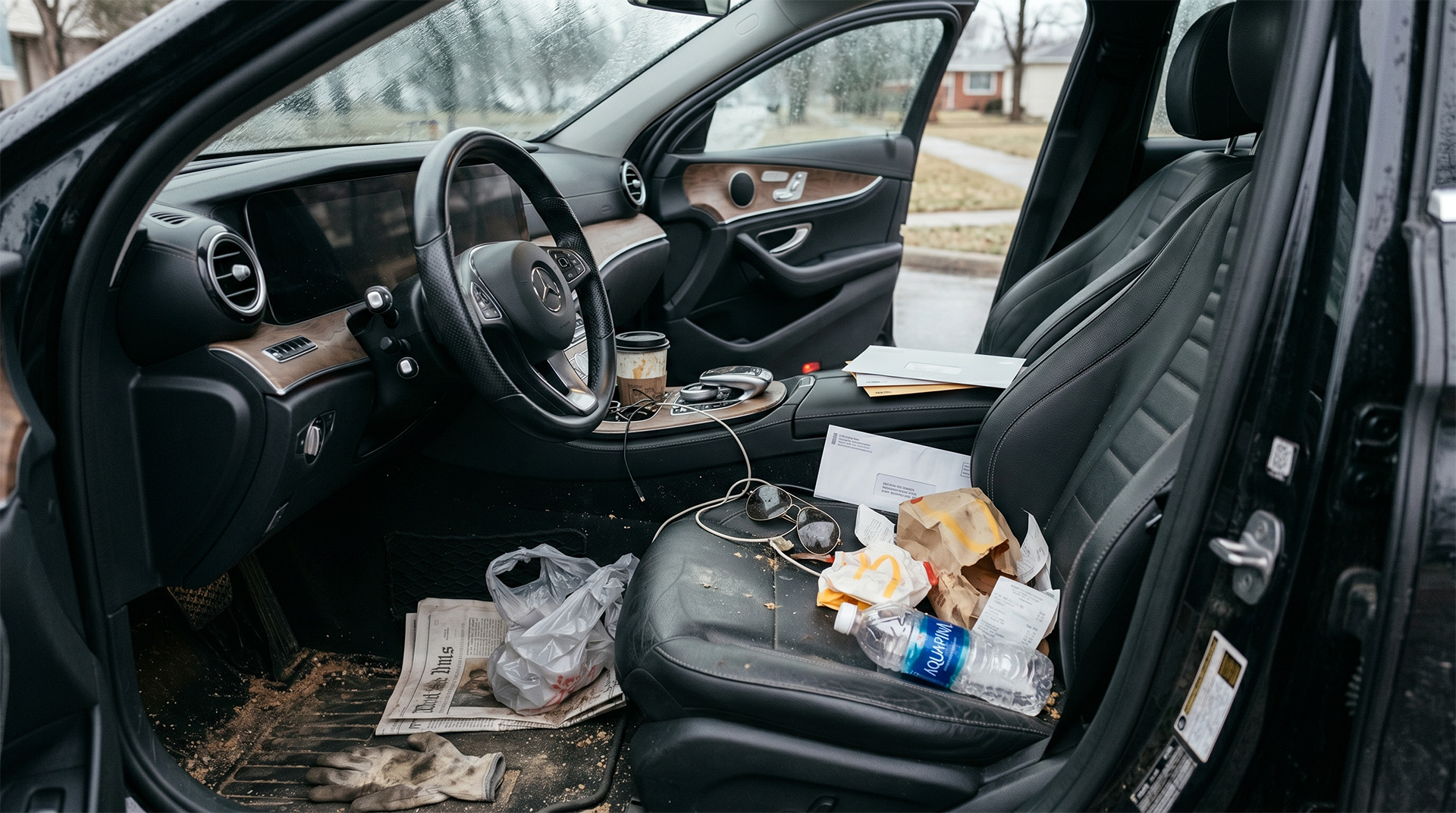
The most diagnostic level, though, isn't what you see from the street. It's what you see indoors, at the most ordinary domestic level. Pizza eaten straight out of the box on the sofa rather than at a laid table. Clothes dumped on a chair rather than hung in a wardrobe or placed on a valet stand. Dishes that accumulate in the sink over days rather than going through the dishwasher. A car not only dented but filthy inside, with old crisp packets, receipts, empty bottles that have entered the furniture of the cabin. These are minimal gestures, almost invisible, each costing thirty seconds, which over the years add up to a practice, or to the absence of one.
Putting a shirt away takes thirty seconds; leaving it on the chair takes none. But the chair isn't a place for shirts, and the person knows it, and chooses, in miniature, not to choose. Laying the table for a tidy pizza takes a minute; eating it from the box on the sofa takes none. But that minute was the gesture that turned refuelling into a meal, and it has been removed. Loading the dishwasher each evening takes three minutes; leaving the dishes in the sink takes none. The dishes remain there, accumulate, and become the message you send yourself every time you walk into the kitchen.
More clinically, those who put off the washing-up also put off the difficult emails, the necessary conversations, the decisions that weigh. Domesticity is the test bench where habits form outside the professional gaze; what you do there you will do elsewhere, sooner or later. Indeed, you are already doing it, but in domains where others don't yet have enough data to notice.
I learned early to look at the guest bathroom when visiting someone's home, not to judge but to understand. Not the master bath, which receives performative care, but the guest bathroom, the place where whatever care remains after the performance ends up. If the mirror is clean, the soap isn't crusted, the dispenser actually has soap in it, I am dealing with someone who thinks of others when there's no immediate need to. Even when the work itself is done by staff, the standard kept is the owner's choice. The same logic applies to the boot of the car: not the cabin, which a passenger sees and which therefore stays presentable, but the boot, where old trainers, forgotten shopping bags and the winter coat in July all end up. Anyone who keeps it in order doesn't do it for you, because you'll never see it. They do it for themselves, on principle.
There is a third circle, and to my mind it's the most revealing of all. It concerns the body. Hair that has stopped being cut at any reasonable cadence, a beard that has become long and unkempt by inertia rather than by choice, nails, hands, teeth, skin. At times even basic personal hygiene. The body is the only object you carry everywhere with you. You can have an untidy house and hide it; you can have a filthy car and park it out of sight. You cannot conceal the way you relate to yourself, because it precedes you into every room you enter.
There is a clinical nuance worth catching here, otherwise this becomes a defence of vanity. Self-care isn't vanity. Vanity is performance, care turned outward, recognisable because it stops at what is visible. Hair perfect at the front, untouched at the back; designer clothing on top, the underwear underneath unchanged for a week. These are cases in which the invisible level has been sacrificed to the visible, and after a while it shows even where it shouldn't. True care is different: it concerns what no one will ever see, the toenails in winter, the way you wash when you're on your own. The person who tends both the visible and the invisible is the one I look for, because the one who tends only the visible can collapse behind the facade at any moment, and the one who tends neither has given up before even knowing what to.
What's interesting, and to my mind worth the whole observation, is that the three circles almost always travel together. Whoever has a car full of rubbish rarely has a well-kept beard and a clean bathroom; the three things come from the same root, namely the renunciation of the small, deliberate gesture repeated thousands of times over the years. I've seen exceptions, formidable people who live in creative chaos and yet have care for an idea, a practice, a book, a ritual. Care manifests itself somewhere. When it manifests nowhere, it is the nowhere that speaks, not the specific category in which it doesn't appear.
This is where the thread comes back together. Care is a slow practice, high-friction against the entropy of the day. Entropy is the default; things move towards disorder on their own, without you having to do anything. To keep them where they should be takes a small gesture, almost invisible, repeated thousands of times over the years. Whoever performs that gesture is saying something about themselves without knowing it. Whoever doesn't is saying something about themselves without knowing it. In both cases they speak; in both cases they speak more clearly than they imagine.
Beautiful things must be treated well, I'd say. But so must ugly ones. So must modest ones. Above all the modest ones perhaps, because there's no economic alibi for keeping them in order, only the choice to do so. It holds for the car, the kitchen, the shirt, the beard. It holds for everything, and for everyone.
If you know, you know. If you don't, that's fine, but the people you'll cross paths with in the years to come will see it anyway, even if you never notice that they are.