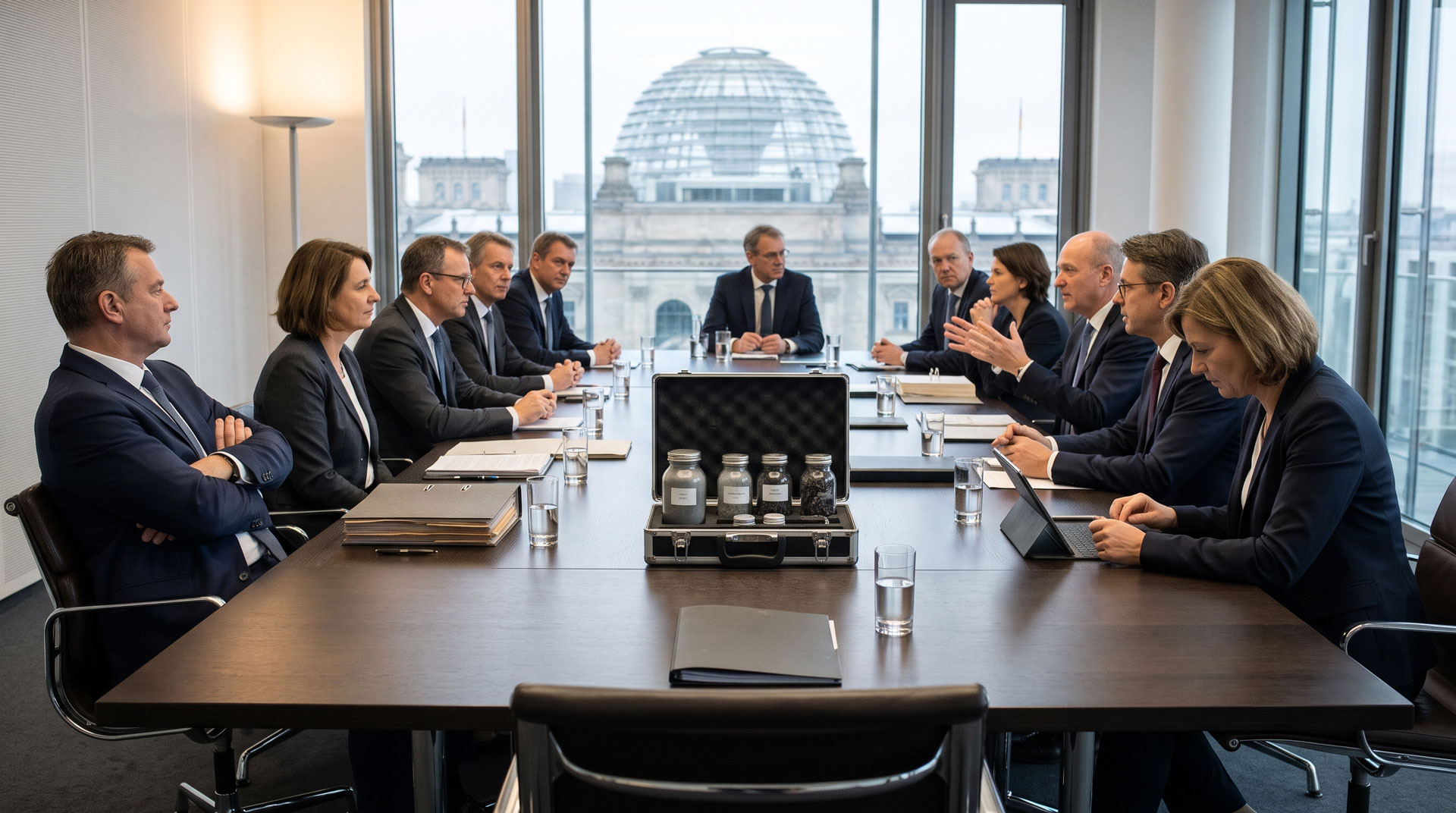
On Thursday 24 October 1985, United Nations Day, Pieter de Koning, who managed the buffer stock of the International Tin Council, told Ted Jordan, chairman of the committee of the London Metal Exchange, that he could no longer meet his commitments. The council was the operating arm of an agreement between tin-producing and tin-consuming governments, Britain among them, which for almost three decades had held the price inside a band by buying and selling metal from a common stockpile financed with government contributions and loans. By that autumn it had borrowed some £900m from banks and brokers to defend its floor price. Tin trading in London was suspended that same day, and when the creditors came looking for their money the member governments disclaimed any responsibility for the council's debts. In March 1986 the LME settled all outstanding tin contracts, which in practice closed the market.
The tin council is worth remembering this week, because on Monday in Berlin forty-five companies from the car, electrical and defence industries, among them BMW, Rheinmetall, Siemens Energy and the magnet maker Vacuumschmelze, presented the Deutsches Rohstoffhandelshaus, a German raw materials trading house that will buy strategic materials jointly and hold them in common stocks, with the longer-term aim of coordinating stakes and supply contracts along the value chain. It is due to be formally founded in mid-2027. Presenting the plan, Johann Wadephul, the Christian Democrat foreign minister, said the dependence had to be reduced as quickly as possible and welcomed the fact that the initiative came from business. On capital, shareholdings, materials and the role of the state, nothing has yet been written down.
It is also the second time German industry has tried this. In April 2012 a dozen large groups, among them BASF, Bayer, Bosch, Daimler, ThyssenKrupp and BMW, registered a company in Berlin called RA Rohstoffallianz, the Raw Materials Alliance. The idea came from the BDI, the German counterpart of the CBI, which wanted a profit-making company owned by industry and run by its own management, able to buy stakes in mines abroad, starting with materials China already dominated, such as rare earths, tungsten and coking coal. Members reportedly paid around €300,000 a year each and Volkswagen joined in December, while the federal government offered its political support. The most advanced deal was a negotiation over Shivee Ovoo, a coal deposit in Mongolia, dropped when the risk finally seemed too high, and in 2016 the company was wound up without completing a single project. Martin Wedig, of the association representing German companies that mine abroad, later told the Berlin daily taz that the venture did not fit the DNA of German industry, which prefers to appear on world markets as a seller of Made in Germany with secure and preferably external financing. The BDI now calls it a trial balloon.
To find an industrial consortium with the state inside that genuinely worked, you have to go to Switzerland in the early 1930s. For years Swiss watchmakers had been fighting chablonnage, the export of unassembled movements and parts that allowed other countries to put together watches in competition with Swiss ones, to the point that a whole industry had grown up that way in Pforzheim, in Germany, from 1922. The Depression turned the problem into a matter of survival, and on 14 August 1931 ASUAG was founded, the General Company of the Swiss Watch Industry, bringing together Ebauches SA, the holding company for raw movements set up in Neuchâtel in 1926, with the makers of balance wheels, hairsprings and escapement parts, the components without which a watch does not run. The Confederation did more than fund it. It turned its contribution of six million francs into shares with voting rights, added a loan of 7.5 million and kept five board seats appointed directly by the Federal Council, the Swiss government. The first chairman was Hermann Obrecht, who in 1935 joined the Federal Council himself.
The rules were simple to state, prices respected and no chablonnage, but what made them binding was Bern's votes on the board, later backed by a body of federal legislation that historians call the watch statute. Inside the holding the family dynasties went on competing with one another, except that none of them could sell parts abroad or undercut prices on its own account, which is precisely the constraint the Rohstoffallianz lacked, since nobody there was obliged to do anything and anyone could step back as soon as a deal looked risky, as indeed they did.
The same arrangement explains the second half of the story. In 1962 about twenty Swiss companies set up the Centre Electronique Horloger in Neuchâtel, a joint laboratory for the electronic watch whose quartz prototypes set precision records at the Neuchâtel Observatory chronometry competition in 1967. Seiko put its Astron on sale on 25 December 1969, while the Swiss reached the Basel fair with the Beta 21 the following April, only four months later. The problem was not invention, which the Swiss laboratories had in hand as much as the Japanese did, but that a system built to defend prices and components had no reason to push a product that made those very components redundant. Ebauches SA opened its electronics subsidiary in 1970, shortly before the cartel collapsed after neglecting the growing market for electronic watches, as the Historical Dictionary of Switzerland records. Between 1970 and 1984 the number of Swiss watch companies fell from more than 1,600 to fewer than 600 and employment from 90,000 to 33,000. More recent historians point out that the strong franc and the recession of the early 1980s played their part too, so quartz was not the only cause.
It was not the state that pulled the industry out of the crisis. In 1983 the banks forced ASUAG to merge with SSIH, the group behind Omega and Tissot, and in 1985, the same year the tin council ran out of money in London, Nicolas Hayek, a Lebanese-born management consultant, bought 51 per cent of the new company with a group of investors for 153 million francs, creating what is now Swatch Group.
The German trading house is being born halfway between these cases. It has more members and more urgency than the Rohstoffallianz, but the role of the state is undefined and Wadephul's satisfaction at an initiative led by business sounds very much like the political support of 2012. Without a referee holding a vote, forty-five members will have to reach agreement among themselves, and their interests diverge before anything has been signed. In a filing to the Bundestag's lobbying register BMW argues that pooling demand and resources brings economic advantages and makes supply more resilient, yet its fifth-generation electric motors contain no rare earths and the sixth generation, built for the Neue Klasse, also does without permanent magnets. Vacuumschmelze, which makes magnets, needs rare earths every day, while the defence industry buys for a public customer on timescales and in quantities the car market does not recognise.
There is one more detail that makes the Swiss comparison less comfortable than it looks. In 1931 Switzerland stood where Beijing stands today, and at the end of 2023 China banned the export of the technology used to extract and separate rare earths, a modern version of the ban on chablonnage. The Swiss monopoly was broken not by a buyers' club but by a product that made the cartel's parts unnecessary, so Beijing's most dangerous competitor may turn out to be a motor BMW assembles in Steyr, in Austria, rather than a trading house in Berlin.
If the state joins the trading house with votes and binding rules, Germany will gain the strength that was missing in 2012 along with the risk ASUAG has already shown, a system built to secure today's materials just as its most advanced members work to need fewer of them. The tin council adds a second condition, since a seat at the table is worth little if the government holding it declines the bill when the stockpile goes wrong. If instead the state stays out, which of forty-five members will be able to impose a choice on the others on the day their interests stop coinciding?
Sources
- Handelsblatt, BMW and Rheinmetall plan a raw materials trading house, 23 November 2026: https://www.handelsblatt.com/unternehmen/industrie/industrie-bmw-und-rheinmetall-planen-handelshaus-fuer-rohstoffe/100271875.html
- Berliner Zeitung, industry plans its own raw materials model, first since the failed 2012 alliance: https://www.berliner-zeitung.de/article/bmw-und-fuehrende-deutsche-konzerne-treiben-neue-rohstoffinitiative-voran-in-der-industrie-waechst-das-misstrauen-gegen-berlin-10551160
- BDI via Presseportal, twelve founding companies of the Rohstoffallianz, January 2012: https://www.presseportal.de/pm/6570/2190045
- CHEManager, BMW and VW join the Rohstoffallianz, federal government's political support, December 2012: https://chemanager-online.com/de/news/bmw-und-vw-treten-deutscher-rohstoffallianz-bei
- Germanwatch, reported annual fee of €300,000: https://germanwatch.org/de/6391
- Wikipedia (de), RA Rohstoffallianz: BDI concept, priority materials, registration April 2012, liquidation January 2016: https://de.wikipedia.org/wiki/RA_Rohstoffallianz
- taz, Shivee Ovoo talks abandoned, dissolution without a project, Wedig quote, BDI's "trial balloon": https://taz.de/Deutsche-Rohstoffstrategie/!5627978/
- Bundestag lobbying register, BMW on pooling demand and resources, 19 December 2025: https://www.lobbyregister.bundestag.de/inhalte-der-interessenvertretung/regelungsvorhabensuche/RV0021564/501984
- BMW Group press, fifth-generation motors without rare earths: https://press.bmwgroup.com/canada/article/detail/T0440602EN/
- CAR magazine, Gen6 motors (EESM and ASM) without rare earths: https://carmagazine.co.uk/car-news/tech/bmw-neue-klasse
- Autoblog, Gen6 motor production in Steyr: https://www.autoblog.com/news/bmw-starts-building-its-most-advanced-ev-motor-yet
- Federation of the Swiss Watch Industry, ASUAG 1931 and the ban on chablonnage: https://www.fhs.swiss/eng/fhhistory.html
- Historical Dictionary of Switzerland, Ebauches SA (1926, cartel neglected electronic watches, EEM 1970): https://hls-dhs-dss.ch/fr/articles/041960/
- Historical Dictionary of Switzerland, Swatch Group (1983 merger, Hayek's 51 per cent for 153 million francs): https://hls-dhs-dss.ch/fr/articles/041990/2018-01-23/
- L'Impartial, 1931, the Confederation's six million in voting shares: https://doc.rero.ch/record/19193/files/19310919.pdf
- L'Impartial, 1931, the 7.5 million loan and five board members appointed by the Federal Council: https://doc.rero.ch/record/19191/files/19311121.pdf
- Swissinfo, Pforzheim built on chablonnage from 1922: https://www.swissinfo.ch/fre/economie/comment-la-menace-%c3%a9trang%c3%a8re-a-fa%c3%a7onn%c3%a9-l-industrie-horlog%c3%a8re-suisse/46637548
- Watchtime, CEH founded 1962, prototypes at the 1967 Neuchâtel competition, Astron on 25 December 1969: https://www.watchtime.com/featured/making-a-case-for-collecting-quartz/
- Gear Patrol, Beta 21 four months after the Astron: https://www.gearpatrol.com/watches/a35863923/beta-21-swiss-quartz-movement/
- Seiko Museum, Swiss companies and employment 1970 to 1984: https://museum.seiko.co.jp/en/knowledge/relation_11/
- Le Temps, the 1975 to 1985 crisis revisited: https://www.letemps.ch/economie/crise-horlogere-suisse-19751985-revue-corrigee
- Wikipedia, ASUAG, the 1983 merger forced by the banks: https://www.Wikipedia.org/wiki/ASUAG
- Taylor & Francis, de Koning informs Jordan on 24 October 1985: https://www.taylorfrancis.com/books/9780203856611/chapters/10.4324/9780203856611-6
- Netherlands International Law Review, buffer stock financed by governments, borrowing of some £900m: https://cambridge.org/core/journals/netherlands-international-law-review/article/abs/insolvency-of-international-organizations-and-the-legal-position-of-creditors-some-observations-in-the-light-of-the-international-tin-council-crisis/6E020CEC1C899AE5207923753BA15838
- Mallory, American University International Law Review, member governments disclaim responsibility: https://core.ac.uk/download/235402589.pdf
- Northern Miner, 29-year scheme, trading halted on 24 October 1985: https://www.northernminer.com/news/the-tin-metal-scheme-that-went-wrong/1000123981/
- USGS Minerals Yearbook, LME settles all tin contracts on 12 March 1986: https://search.library.wisc.edu/digital/A5EUMZZPHM7D5Z8D/text/AWAPCAOJOROVII8W
Working notes (remove before publishing)
What changed from the Italian
- New opening on the collapse of the International Tin Council in London in 1985, which gives a British reader a home precedent and fits the trading house's plan for common stocks.
- The tin council comes back in the Hayek paragraph (same year) and in the closing, where it adds a second condition: having the state at the table is not enough if it refuses to pay when the stockpile fails.
- The BDI glossed as the German counterpart of the CBI.
- Rohstoffallianz section slightly tightened to make room for the new opening.
Verified
- Handelsblatt: 45 companies, BMW, Rheinmetall, Siemens Energy, Vacuumschmelze, joint buying and stockpiling, founding mid-2027, Wadephul's remarks; no data on capital, materials or the state's role.
- Rohstoffallianz: founders, BMW and VW joining in December 2012, political support, priority materials, liquidation 2016, Shivee Ovoo, Wedig, "trial balloon".
- ASUAG: 1931, chablonnage, Pforzheim 1922, six million in voting shares, 7.5 million loan, five board members; CEH 1962, 1967 records, Astron 25 December 1969, Beta 21 April 1970; 1970 to 1984 figures; 1983 merger; Hayek 1985.
- BMW Gen5 and Gen6 motors without rare earths, Gen6 built in Steyr.
- Tin council: 24 October 1985, de Koning and Jordan, about £900m, governments disclaiming the debts, trading suspended, LME settlement on 12 March 1986.
Still open
- China's December 2023 ban on exporting rare earth extraction and separation technology: from general knowledge, not checked in this session.
- Obrecht joining the Federal Council in 1935 and Hayek being Lebanese-born: from general knowledge.
- Britain as a member of the tin agreement: from general knowledge, consistent with the sources but not stated in them explicitly.
- The €300,000 fee is reported second-hand by Germanwatch, hence "reportedly".
Image Same cover as the Italian piece, file renamed with the UK slug.