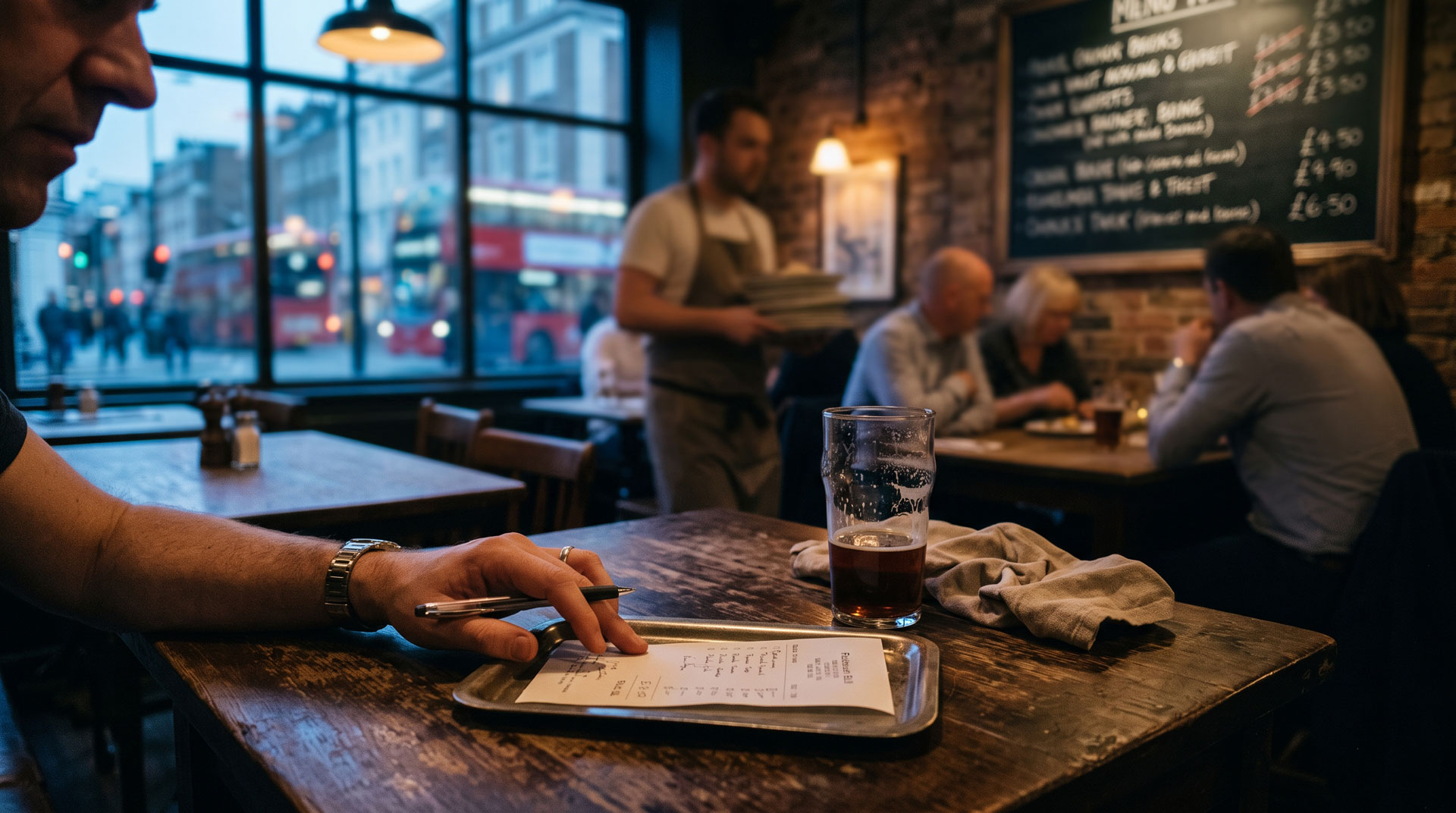
A hospitality VAT cut does not reach the table
Posted on: 16 September 2026
On the eve of the business reception Andy Burnham was due to host at Downing Street on Monday, more than eight hundred hospitality businesses wrote to him asking how he plans to deliver the lower rate he publicly backed in February. The campaign is called VAT's The Problem and wants VAT on restaurants, pubs and hotels brought down from 20 to 10 per cent. The signatories include Heston Blumenthal and Tom Kerridge, chains such as Wagamama and Pizza Express, brewers such as Fuller's and Greene King, then Wetherspoon, Center Parcs and Marriott International. HMRC estimates the measure would cost £10.5 billion in 2026/27 alone.
Anyone reading the news as a customer, perhaps with a weekend away already booked for the spring, tends to do the simplest sum, which is ten points less tax and therefore a cheaper dinner. The sum is wrong, and the signatories say so themselves without meaning to, since Kerridge justified the request by explaining that 20 per cent VAT holds the sector back because so much of what venues take goes on staff. That is an argument about margins, yet nobody in the letter mentions the price the customer finds on the bill.
To see what happens to the price, Germany is the place to look, because in six years it has been round the whole cycle. VAT on food eaten in restaurants fell from 19 to 7 per cent in July 2020 as an emergency measure, stayed there through one extension after another until the end of 2023, returned to 19 on 1 January 2024 and has been back at 7 since 1 January 2026, this time with no expiry date, while drinks stayed at 19 throughout.
There is a causal estimate for the 2024 rise, because Matthias Firgo, a tourism economist at Munich University of Applied Sciences, reconstructed how restaurant prices would have moved without the increase, using twenty-five spending categories the reform did not touch as the comparison. By January 2024 restaurants had already passed 31 per cent of the increase on to customers, and by July the figure had reached 58, a price rise attributable to the tax alone of about 6.5 per cent. Menus had started going up as early as November, straight after the government's announcement and before the new rate took effect. The paper is a preprint and should be read as one, although the direction it points in is clear.
This year brought the descent, with results that look paradoxical at first sight. In its first January estimate the Bavarian statistics office recorded prices at restaurants, cafés and street stalls 3.9 per cent higher than twelve months earlier, while the Brandenburg office found a rise of 3.8. By the end of February the German broadcaster ZDF was reporting that hardly any venue had lowered its menu prices, which should have surprised nobody, since Lars Schwarz, who chairs the hotel and restaurant association Dehoga in Mecklenburg-Western Pomerania, had warned as early as 3 January that the cut would not reach menus one for one.
A caveat is needed here, otherwise the argument rests on a number that does not prove what it appears to. On the same 1 January the German minimum wage rose from €12.82 to €13.90 an hour, an increase of 8.4 per cent, in a sector where labour weighs on costs more heavily than almost anywhere else. The January figure therefore does not isolate the VAT effect, and anyone using it to claim that restaurateurs pocketed the cut would be cheating. For the person sitting at the table the conclusion does not change, given that the lower tax went on higher wages and the bill went up anyway.
The cleanest and longest measurement comes from France, where in July 2009 VAT on sit-down restaurants fell from 19.6 to 5.5 per cent. Youssef Benzarti and Dorian Carloni followed the accounts of individual restaurants against businesses the reform did not cover, and published the result in the American Economic Journal in 2019. Owners kept more than 55 per cent of the cut, the rest was shared with employees and suppliers, and customers received the smallest share. In the six months after the reform restaurant meal prices fell by 1.8 per cent relative to other services, despite a tax cut of more than fourteen points, while employment barely moved.
The finding that matters most, though, concerns the direction of travel. In 2020 Benzarti, together with Carloni, Jarkko Harju and Tuomas Kosonen, showed in the Journal of Political Economy that prices respond about twice as strongly to VAT increases as to decreases, and that the asymmetry lifts profits and mark-ups for good, since the gap is still visible years later. A third finding bears directly on this week's letter, because the firms that behave most asymmetrically are those operating on thin margins, which are precisely the struggling venues in whose name the cut is being demanded. When the tax falls they keep it to stay open, and when it rises they pass it on because they have nowhere to absorb it.
Explaining this does not require anyone to invoke greed, as Kahneman, Knetsch and Thaler had already measured it in 1986 through telephone surveys in Canada, which found that people think it fair for a shopkeeper to raise prices when costs go up and do not feel cheated if prices stay put when costs come down. A restaurateur who leaves the menu alone after a tax cut loses no customers, whereas one who reprices after an increase is understood, so the fairness norm works like a ratchet that turns one way only.
Britain has already run this experiment, and on hotels in particular, which for anyone travelling are the largest item in the budget. From 15 July 2020 the rate on hospitality and attractions fell to 5 per cent, rose to 12.5 in October 2021 and returned to 20 in April 2022. A group of economists from Cardiff and Genoa compared prices for rooms with identical characteristics in the UK and elsewhere, and found that between 20 and 50 per cent of the cut reached customers, with the peak in the second week. For rooms sold two months later the discounts had all but disappeared, so anyone booking in the autumn paid roughly as if the tax had never fallen.
It was said on the day itself, when Kate Nicholls, then chief executive of UKHospitality, stated that businesses should not be obliged to take the tax off the bill and that cutting prices was only one of the options open to them. The big chains did the opposite, very visibly, and Nando's took its quarter chicken from £4.25 to £3.70. Yet UKHospitality's own 2023 report, arguing for a 12.5 per cent rate, forecast a 3 per cent fall in prices on the assumption that half the cut would reach customers, which means the sector's own documents budget for the other half staying on venues' books.
There is a second ratchet, which runs through parliaments rather than menus. I split my time between Stabio and London, and in Switzerland this mechanism is thirty years old. Since 1996 hotels and other accommodation providers have paid a special rate, now 3.8 per cent against a standard rate of 8.1, which was introduced as a temporary measure for a struggling sector and has been extended again and again. On 15 April the Federal Council sent Parliament the bill extending it to 2035, as a parliamentary motion required, while continuing to argue on the merits that after years of record results the sector no longer needs the support, whose cost to the federal budget is put at around 300 million francs a year. In Germany the 2020 emergency cut became permanent in a little over five years, with a two-year interruption, while in Britain, four years after the return to 20 per cent, the request is now for a permanent reduced rate.
The pattern is the pricing one lifted to the level of legislation, because a reduced rate creates a group of businesses with a great deal to lose from its end, while the gain from ending it is spread across millions of taxpayers with no organised voice. On Friday I wrote about American tariffs and how the exemption ends up being the product. I come back to it because the same dynamic shows up here on the tax side, where the bespoke treatment is not requested from an official but written into a table of rates, from which it rarely leaves.
There is an objection that deserves respect. For an operator who cannot make the month's numbers add up, the retained margin is the whole point of the measure, and some of the signatories say so openly. It also remains possible that over horizons longer than those measured so far competition forces venues to pass on more; Tax Policy Associates, which published a critical analysis of the proposal in June, notes that the available evidence covers the short and medium term. If that is the case, though, the proposal should be called by its name, which is a sector subsidy delivered through the tax code. It should then be weighed against direct support, which would at least appear in the Budget with an amount and a named recipient, whereas selling it as a discount for people who eat out is something else.
The test comes on 28 October, when John Healey delivers his first Budget. If the cut is in it, ONS price indices for restaurants and hotels over the following six months will show how much of it reached customers relative to other services. Should more than half end up in prices and stay there, this reading belongs in the bin. If the Budget leaves it out, this week's letter will have been only the first round of a conversation that in Switzerland has been running since 1996.