Where the water goes instead
Posted on: 10 August 2026
In July 2022 the Greater London Authority wrote to developers in Hillingdon, Ealing and Hounslow to explain that new housing schemes might not be connected to the electricity grid until the mid 2030s, because the data centres along the Slough corridor had absorbed the available capacity. The letters caused a brief flurry of comment and then the subject moved on, as these things do. What the episode established, and what has been quietly true ever since, is that computing infrastructure does not arrive as an abstraction. It arrives as a claim on a physical system that somebody else was already using, and the argument that follows is never really about servers. It is about who holds the prior claim and who can be persuaded to stand down.
That argument is now being conducted at a considerably larger scale outside Visakhapatnam, on the Andhra Pradesh coast, where a hillside at Tarluvada has been stripped to red earth and cut into terraces. Reuters photographed the excavators still working the exposed ground on 3 August. Beneath them will sit fifteen billion dollars of Google investment, the company's largest commitment in India, built with the Adani group and accompanied by a state government promise of one hundred and eighty eight thousand jobs which is repeated at every opportunity. Activists from Green Visakha have been marching in the city with children carrying placards observing that data cannot be drunk. The state High Court has asked the government to answer a petition from Jal Biradari alleging that the project will exhaust a catchment that is already short.
Asked by Reuters about water, Google said it would deploy advanced air cooling to protect vital local water resources. The sentence is technically accurate and politically immaculate, and it repays a second reading, because what it establishes is that the water will not be taken there. It does not establish that the water will not be taken. This is the only genuinely interesting feature of the dispute and neither side is discussing it: not the demonstrators, and not those who dismiss them as sentimentalists standing in the way of development.
Air cooling is not free cooling. The heat has to leave the building regardless, and if evaporation does not remove it then compressors must, which means electricity. In a humid coastal tropical climate, where the wet bulb temperature stays high for much of the year, the efficiency gap between an evaporative plant and a fully air cooled one sits prudently somewhere between fifteen and twenty five per cent of total consumption. Applied to a campus announced at gigawatt scale, that is roughly seventeen hundred additional gigawatt hours a year, and the current has to come from somewhere. It comes from the Indian grid, which in the 2025-26 financial year generated one thousand two hundred and eighty one billion units from coal, a little under seventy per cent of the total, down four per cent for the first time in the country's history but still dominant. Coal, in turn, drinks. The Ministry of Environment notification of 7 December 2015, amended on 28 June 2018, caps specific water consumption at three cubic metres per megawatt hour for plants commissioned after January 2017, and when the Centre for Science and Environment examined one hundred and fifty four gigawatts of installed capacity it found that roughly half the freshwater based plants did not meet the threshold at all, with real average consumption closer to four.
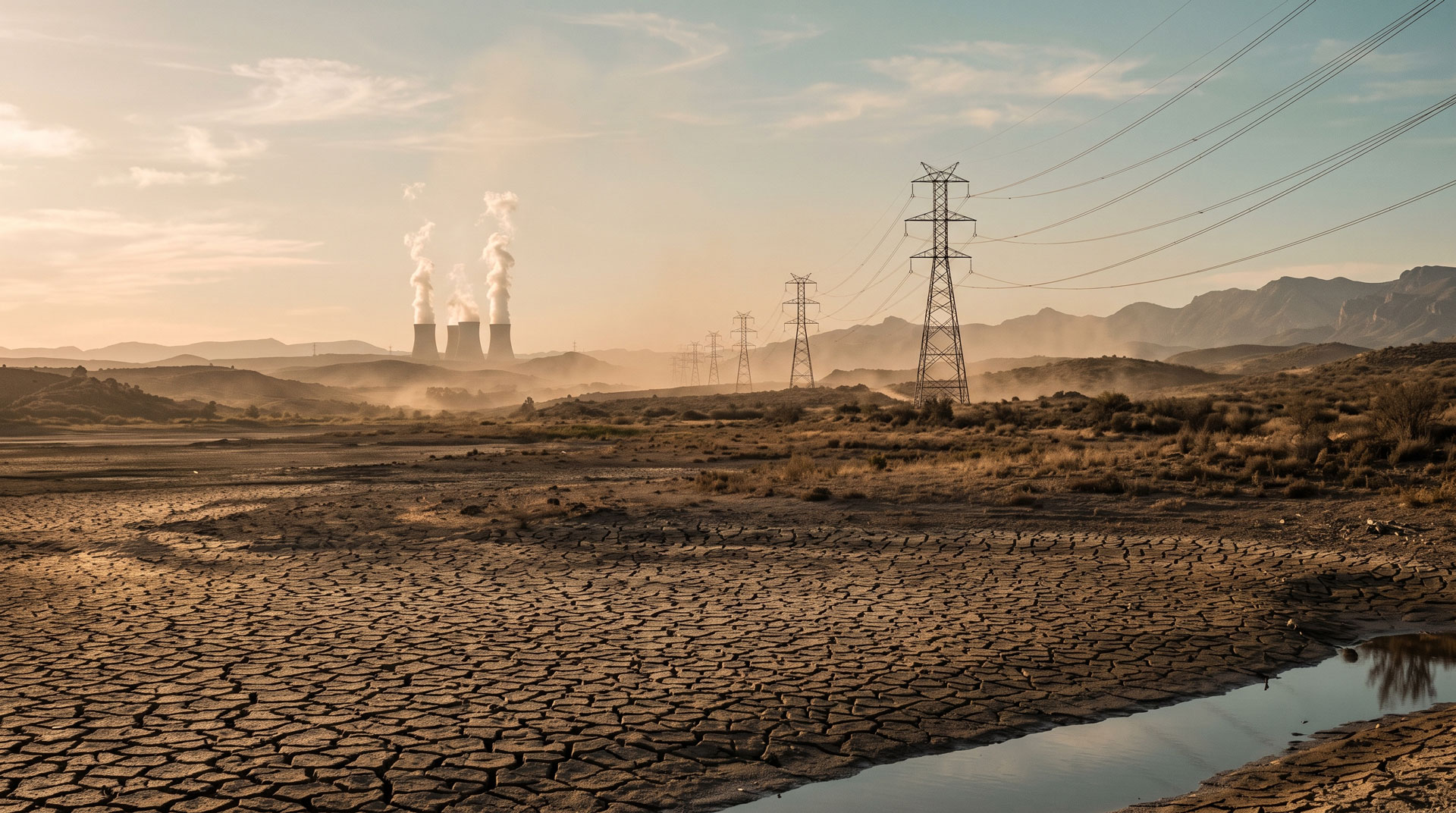
The arithmetic is worth doing openly, assumptions included. Seventeen hundred gigawatt hours multiplied by three cubic metres gives a little over five million cubic metres a year, which is fourteen million litres a day, rising to nineteen if the observed figure is used rather than the regulated one. A hundred megawatt facility on evaporative cooling consumes around two million litres a day on Dialogue Earth's estimates, so twenty million for a gigawatt campus. The comparison is banal and unforgiving. In an electricity system configured like India's, air cooling does not meaningfully reduce total water consumption. It relocates it. It removes it from the Mudasarlova catchment, where the cameras are and the litigation is and the children with the placards are, and deposits it in the basins of Odisha and Chhattisgarh, where the power stations stand, where cooling towers do the drinking and where no Reuters correspondent will be passing on Monday morning. The environmental undertaking is true within the boundary in which it is measured, and the boundary, not the chiller, is the engineering achievement.
Scale is where most commentary cheats, and it cheats in both directions. Indian data centres consumed roughly one hundred and fifty billion litres of water in 2025 on estimates from Mordor Intelligence corroborated by the Council on Energy, Environment and Water, with a projection of three hundred and fifty eight billion by 2030. The figure looks enormous until it is set against national abstraction, measured in hundreds of billions of cubic metres and running better than eighty per cent to agriculture, at which point it becomes statistically invisible. Anyone citing that comparison to conclude that there is no problem is right about the arithmetic and wrong about everything else, because water is not a national market. It cannot be shipped. It cannot be arbitraged between basins. It is the one industrial commodity that remains stubbornly local, and locally the numbers speak a different language. Visakhapatnam receives four hundred and ten million litres a day from its reservoirs and rivers against a stated requirement of four hundred and eighty. Two and a half million people for whom rationing is routine rather than emergency. Seventy million litres a day of structural shortfall, against which an evaporative campus at gigawatt scale would have claimed something close to a third for itself, and at that point the protest stops being ideological and becomes an accounting matter. Air cooling is not an environmental concession. It is the minimum condition for obtaining consent.
Which brings us to the question that is asked constantly and answered rarely, namely whether data centre water consumption is a serious constraint or a campaigning construction. The answer lies in geography rather than politics. In July there were one hundred and forty two protests across forty two American states against data centre projects, in Virginia, Georgia and Texas among others. Anyone who believes this is a phenomenon of the left has not looked at the map, and the map is the easiest thing in the argument to check. What is moving is not an ideological position. It is the price of an input, and that is what connects the Visakhapatnam story to the opening of Microsoft's largest Indian hub at Hyderabad, part of a seventeen and a half billion dollar programme that is the company's biggest commitment anywhere in Asia. The official explanation is the market: more than a billion internet users, Copilot at thirty dollars a month, fifty thousand licences apiece at Infosys, Tata Consultancy Services and Cognizant. True, and partial. The structural explanation is regulatory, since the Digital Personal Data Protection Act requires residency and sovereignty of data for entire classes of workload, and Microsoft sells Hyderabad explicitly as compliance infrastructure before it sells it as compute. Calculation follows jurisdiction rather than latency. Then there is the third layer, which appears in no press release: a state government aligned with Delhi, a national champion supplying land, permits and power in a single package, and a public that marches in the street without stopping the site for eight years. The cost of local consent is rising in the United States faster than the cost of a kilowatt hour is falling, and capital behaves as it has always behaved when an input becomes expensive. It changes country.
Anyone who has worked in primary aluminium has watched this film before. Aluminium is solidified electricity, electrolytic smelting admits no alternative, and for the better part of a century production has followed jurisdictions offering cheap power and a tolerance for consequences. Kinlochleven in 1909 and Lochaber twenty years later were built where they were built because the Highlands had water falling from a height and very few people to object to what happened next; the British Aluminium Company was in the business of hydrology as much as metallurgy. Akosombo in Ghana was completed in 1965, and the Volta Aluminium Company secured tariffs fixed for decades on a smelter that absorbed the greater part of national electricity generation while the value added in fabrication stayed elsewhere. Then Iceland. Then Mozambique. Every time the same structure: local energy, local externality, margin somewhere else. The token today is water and electricity in a legible form, and the map it is drawing looks a great deal like the old one.
There is a way to establish whether this analysis is wrong, and it is available to anyone. Google has committed publicly to replenishing one hundred and twenty per cent of the water it consumes by 2030, which means offsetting, and hydrological offsetting works only within the same catchment. Recharging an aquifer in California does nothing for a reservoir in Andhra Pradesh. The question to put is therefore not how much water the site will use, since that has already been answered, but what the hourly power profile of the campus will be, what share of it is renewable and covered by storage through the night, and under what contracts that can be verified. If Adani publishes the profile and it holds, this piece can be discarded. If the figure does not exist, its absence is itself the finding.
In 1998, working in Soho on the first digital intermediate workflows, one spent more time arguing about air handling than about codecs. The constraint was never processing power. It was shifting the heat that the processing produced, and the electricity bill belonged to somebody else. Moving the cost of a degree centigrade onto a third party is an old trade. It is now being conducted at the scale of a subcontinent.