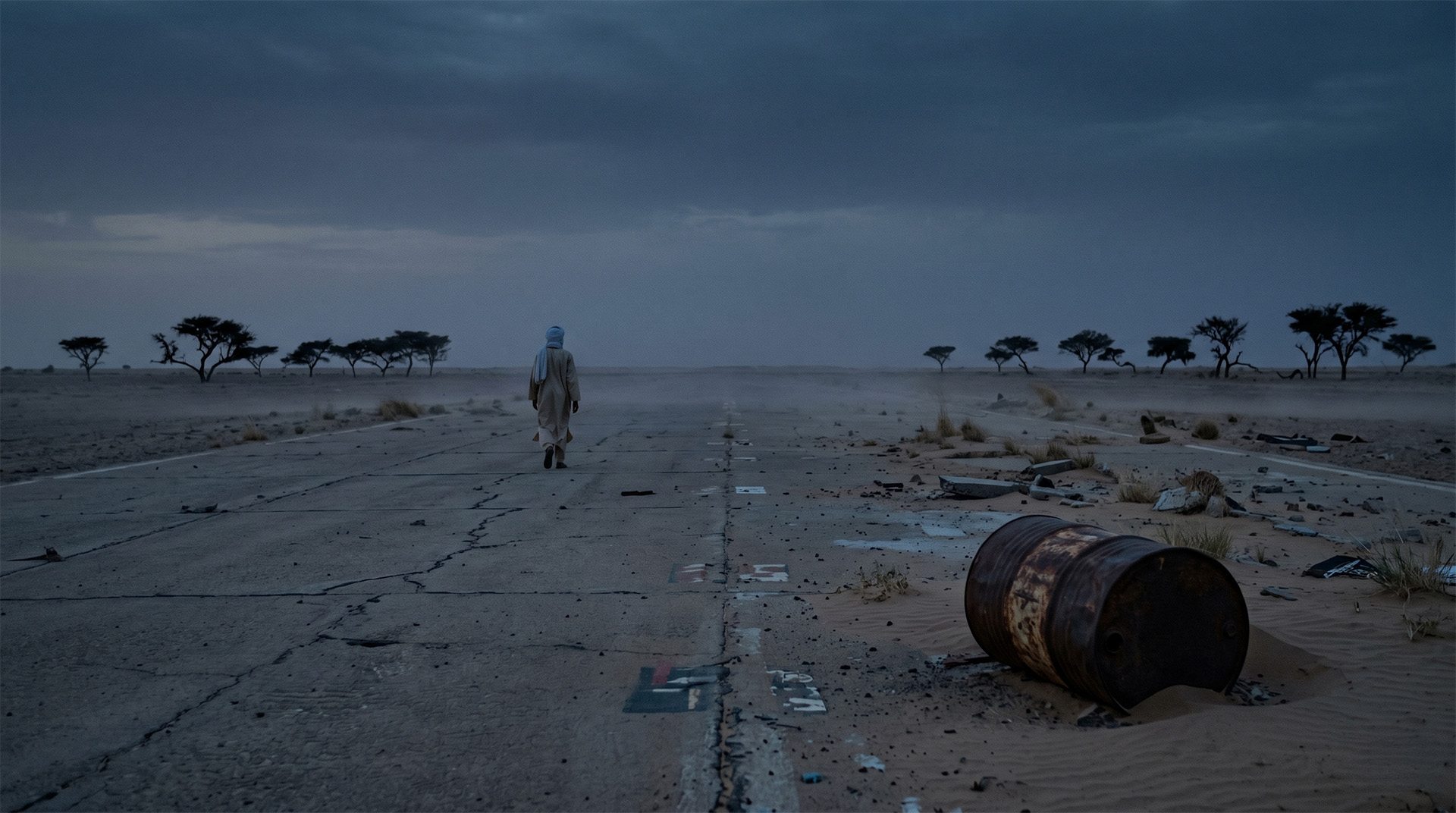
When the French leave, what remains are vendors without reputation
Posted on: 13 May 2026
In late April, on a night the wire agencies covered with the usual indifference reserved for sub-Saharan Africa, several hundred Russian mercenaries of the Africa Corps drove out of Kidal in trucks, having negotiated their exit through Algerian mediation. They left behind weapons caches, entire drone stations, a downed helicopter. Thirty months after raising the Russian flag in the same town, the same men, or what remains of the organisation that absorbed Wagner after Prigozhin's death, fled in front of a joint Tuareg-jihadist offensive that simultaneously struck Bamako and killed the Malian defence minister in his home in Kati. The Konrad Adenauer Foundation analyst quoted by Radio Free Europe was blunt: the Africa Corps pretended to do many things, in the end it failed.
The event has been read through two predictable mainstream scripts. The anti-imperialist left has whispered it as proof that even the Russian model is showing its cracks, finally, after the French model was dismissed from 2022 onwards as a dignified end to Françafrique. The geopolitical right has run headlines about "the most consequential battlefield setback Russia's African project has ever suffered", quoting The Sentry of Washington directly. Both readings are, as ever, partial in the same way, because both treat the event as a contingent fact attached to a piece of war news. It is not. What is happening in the Sahel is the textbook operation of a market mechanism that has a precise name and a foundational paper from 1970: adverse selection. It is worth explaining, because anyone reading the region in geopolitical terms will continue to see victories and defeats while the underlying pattern produces exactly its predicted effects, all the way through.
The principle is simple and applies to any market where product quality is opaque to the buyer. When the good vendors withdraw for whatever reason, rising costs, loss of political tolerance, reputational failure or similar, the average nominal price drops. This looks like good news for the buyer but it is not, because simultaneously the average quality collapses. The market is left with operators who have the margin to offer low prices, and those are operators with less reputation to defend and therefore fewer reputational costs to internalise. The buyer ends up choosing in a universe of apparently affordable alternatives that are in fact all of quality asymmetric to the stated price. Akerlof in 1970 described the phenomenon on the used-car market. It applies with surgical precision to the market for military protection in the post-French Sahel.
The French were pushed out of Bamako in August 2022, out of Ouagadougou in February 2023, out of Niamey in December 2023, out of N'Djamena in January 2025, out of Abidjan in February 2025. The names will mean little to most British readers, but the sequence matters because it traces the exact exit curve of the reputational operator. Post-colonial France carried enormous defects, residual colonial narrative, very high political costs, opaque military presence, a record of interventions often friendly to regimes unpalatable to its own electorate. It also carried, however, a structural attribute that the market for military protection recognised: reputational skin in the game. A French soldier killed in Sahel operations became a front-page headline in Paris, the object of parliamentary questions, a measurable political cost for the government. This internal accounting, however irritating to local regimes, guaranteed a certain operational standard, a certain level of training, a certain projection capability. When the French departed, the standard was not replaced by an equivalent standard but by operators who structurally have less to lose and therefore can afford to charge less.
The British reader has a useful frame here. The Sierra Leone experience of the late 1990s, when Executive Outcomes and later Sandline operated with effective but reputationally exposed presence, and the long Iraq and Afghanistan cycle that produced the Blackwater-DynCorp-G4S ecosystem, both showed that the market for armed protection rewards reputational discipline only when the buyer can read it. Where the buyer is a fragile state with internal legitimacy problems, the buyer's preferences invert: opaque operators become more attractive precisely because they do not impose conditionality, do not file uncomfortable reports, do not generate questions in foreign parliaments. The post-French Sahel is this dynamic at full operational temperature.
Wagner first and the Africa Corps next offered apparent protection at a more politically digestible price: no French press conferences on human rights, no European conditionality, no colonial memory to bear. The problem, as Akerlof would have put it, is not what you see in the shop window, it is what you do not see and what emerges only after you have signed the contract. The real quality of the Russian operator in the Sahel came out through small progressive signals, legible only if you knew what to look for. In July 2024 at Tinzaouaten the Tuareg killed and wounded dozens of Russian mercenaries together with Malian soldiers; at least twenty Wagner dead according to Russian war bloggers. By June 2025 Wagner announced a formal withdrawal from Mali declaring it had "completed its mission", the classic formula of those who leave behind ruins. The Africa Corps stepped in with a far more defensive profile, less aggressive, less risk-tolerant: a hundred men in Niger, between one hundred and three hundred in Burkina Faso, numbers that in military terms do not amount even to the critical mass of a medium-sized Western brigade. In November 2025 the Kremlin suspended the Port Sudan naval base project. In April 2026 the flight from Kidal. The sequence, to the clinical eye, is not a sudden crisis. It is a progressive degradation along precisely the trajectory predicted by the Akerlof model: the lemons operator does not collapse at once, it gradually empties of capability while the nominal price stays low or even falls, and the buyer keeps paying believing he has made a good deal.
The structurally important point is that this dynamic does not close in a benign new equilibrium, because the cruellest property of the lemons market is recursive. When the protection operator's quality collapses, the buyer does not return to the previous reputational operators, for two reasons. First, the internal political cost of calling the French back would be unbearable for the Sahelian juntas, which built their popular legitimacy on expelling the colonial master. Second, and this is the point mainstream misses, the surviving reputational operators accelerate their own exit. Staying in a market where customers have demonstrated their willingness to accept degraded quality in exchange for politically acceptable prices is structurally a losing game for anyone with reputation to defend. For this reason, once the French were thrown out, they will not come back, and no other operator with comparable standards will replace them. The vacuum will be filled by operators of further asymmetric quality, and this is precisely what we are beginning to see: the Azawad Liberation Front taking back Kidal, JNIM factions affiliated with al-Qaeda striking Bamako, gold becoming substitute payment when fiat currency no longer works, migration routes and strategic minerals serving as exchange goods in opaque contracts with Turkish, Chinese and assorted paramilitary operators who will introduce themselves over the coming months.
The testable prediction emerging from the framework is specific and worth putting on record so it can be verified. Over the next twenty-four months we will see continuous rotation of security operators across the three Alliance of Sahel States countries, with contracts progressively renegotiated downwards on real quality (number of men, operational capability, training, equipment), while the nominal price remains compressed by a combination of internal fiscal pressure on the juntas and the arrival of new opaque competitors. We will see settlements in gold, mining concessions, territorial exploitation agreements, all signals that conventional currency has ceased to function as a medium of exchange in that market. If instead over the next twenty-four months the Africa Corps consolidates, Sahelian regimes stabilise without further coups or alliance shifts, and the price of protection normalises to a recognisable standard, then the adverse selection framework will be falsified and another explanation will need to be found. This is the difference between clinical analysis and geopolitical commentary: one declares what would disprove it.
There remains the question of what this means for the European reader, and in particular for the British reader who watches the continent from outside the Eurozone perimeter. The understandable reflex is "let us go back in to stabilise", perhaps under European Union flag rather than French, perhaps with a less unpalatable Brussels-branded mission. In my view, this would be the perfect repetition of the structural error that produced the problem in the first place. A reputational operator re-entering a market where the buyer has demonstrated preference for degraded quality will find itself competing on a plane where its structural advantages, training, standards, capability, are perceived as costs rather than value. It would lose the price competition and emerge more reputationally weakened than before. For industrial investors with mining, energy or infrastructure exposure in the three countries, the reflex of "let us diversify with local partners" is equally mistaken, because the problem is not the quality of the partner but the quality of the state that should guarantee the contracts, and that quality is following a trajectory of structural degradation that will last years. For armchair geopolitical readers, finally, the most important "don't" of all: stop reading the region as Russian victory or Western retreat, because that frame prevents you from seeing the structural pattern underneath, which has its own timescales, predictable, legible, independent of imperial narratives of who wins and who loses.
The region is filling up with lemons, which historically work for a while, then stop working, and at that point the market does not return to its previous state: it drops one further step. Akerlof gave us the tool to read the phenomenon in 1970, and the fact that fifty-six years later it applies with chirurgical precision to the post-French Sahel says something interesting about the useful life of good economics papers, and something more melancholic about our difficulty in using them when we actually need them.