When London starts to feel feral
Posted on: 7 May 2026
I am, fundamentally, a country boy. I grew up in Franciacorta, in Italy, among the vineyards and the slow, unfussy habits that in my part of the world were simply how one lived. As an adult I chose to settle in Switzerland, but London, where I work and spend a good part of the year, has been my second home since I was young and the social codes of certain of its circles I have never really learned, or perhaps I learned them only by approximation and now and then they felt tight on me. That particular RP register that conceals a hierarchy, that coded conversation that takes your measure without quite looking at you, the constant social pressure of having to be appropriate at all times. Here in Canary Wharf, and I realise how strange this sounds, that pressure is absent. I cannot explain it well. What I do know is that, apart from my walks along the Thames Path, I rarely leave Canary Wharf when I am in town, because for me London by now is this, not the chaos of Leicester Square that impresses the tourists so much.
Yesterday I walked the Thames Path around the Isle of Dogs. You set off from Westferry Road, drop down to the river, and walk for a good hour following the water as it curves, until you find yourself back where you started. It is an almost perfect loop and walking it you grasp something that from the 37th floor you cannot see: Canary Wharf is not a neighbourhood, it is an island within an island, on what is called the Isle of Dogs, which is not actually an island either.
All around it sit the older communities, Cubitt Town, Island Gardens, the odd Range Rover parked outside a tired 1970s block, 1930s council housing next to 1960s modernist slabs, post-war reconstruction blurring into more recent regeneration. The Samuda Estate, along Manchester Road, is the perfect example: from the north it has the air of a refurbished vintage residence, from the south it looks almost like a sink estate and yet it is the same building. It feels working class even where it no longer is and not working class where it arguably still ought to be. You can see it has grown by stratification, but a strange kind of stratification, made of bombs, reconstructions, privatisations and asymmetric regeneration. Not of continuity. Then you look up and at the centre you see the towers, you understand that the relationship between inside and outside is not a gradient. It is a threshold.
Two days earlier I had walked the other Thames Path, the one that takes you towards Tower Bridge through Wapping, Shadwell, Limehouse. There too you find pleasant neighbourhoods, new high-end buildings facing the river, square-metre prices that would make half of Europe blanch, but it is not the same thing. There the wealth is distributed, it mingles with what was already in place, you can have a pint at the pub next to someone who works as a gardener and someone who works in a bank. In Canary Wharf, no. In Canary Wharf the pub is inside the perimeter and inside the perimeter only those with a reason to be here come in.
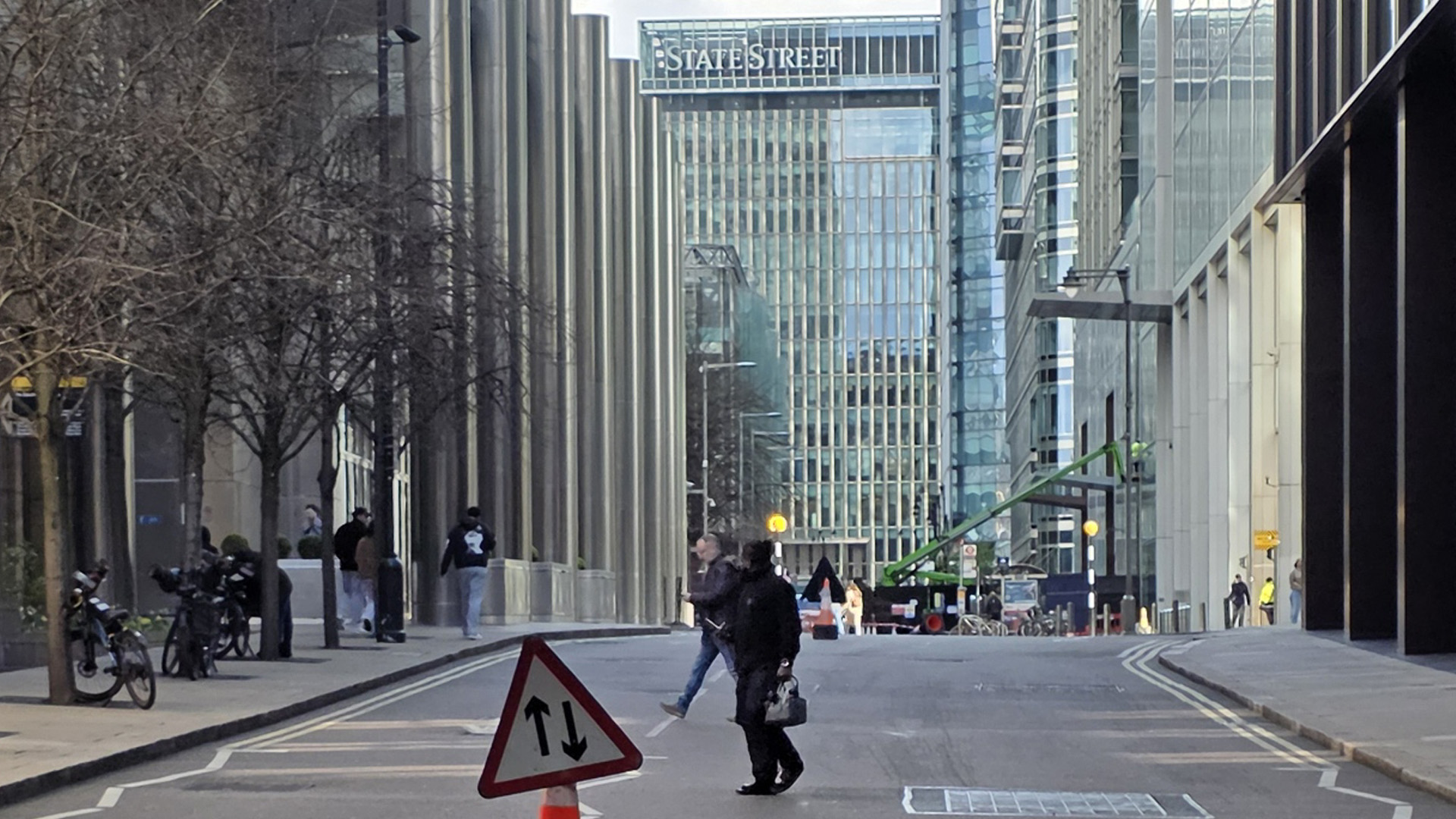
One thing you notice quickly, even if it takes you a while to bring it into focus, is that there are no cars here, or rather you see almost exclusively service vehicles, delivery vans, the occasional cab. And yet beneath the towers there are car parks that hold thousands of vehicles. They are there, the cars, and what cars, only buried and almost no one ever uses them. To leave you call Addison Lee. Leaving is already an exception, and the exception is handled with an app. The very fact that getting around is rare is the sign that the system is internally complete. There is the gym, the supermarket, the restaurant, the doctor, the dentist, the hairdresser, the dry cleaner. In the underground shopping mall, which is endless, you find everything you need to never come back up.
And then there are the key cards, one for everything. To enter the building where I live, key card. To take the lift to the right floor, key card. To get into the gym on the 57th, key card plus QR code. The cinema on the first floor, the residents' lounge, the pool, all of it. At first it is unsettling and you have the sense of being constantly verified, authorised, tracked. Then you get used to it, and after a few weeks the gesture of pulling out your phone and letting it be read by the scanner is as automatic as turning a key in your front door. In fact, you do it without even looking.
This is the point at which something shifts, but you only notice if you have somewhere else to return to. I do, the Mendrisiotto area, a house in Switzerland where security is high too, but of a different kind, ambient, shared. When I come back to London after a stretch there, the first sensation crossing the centre is that the city feels feral to me. Trafalgar packed with tourists, Oxford Street overrun, someone asking for spare change at Liverpool Street, a level of noise and social friction that previously struck me as simply being London. Now it strikes me as the exception, and Canary Wharf as the rule. The fact that I think this is already the sign that something in my perception has slipped.
Sunday morning, in the lift on my way to the gym on the 57th, a Chinese gentleman in his sixties stepped in. We caught each other's eye and exchanged a greeting. "Hiya mate," I said, and he replied "morning, alright?". A few words about the weather, spring really has arrived, yes incredible after the winter we have had. Nothing remarkable. Except that thinking about it later, while I was working through some kettlebell swings, I realised that that "mate" out of a Camden pub, spoken on the 57th floor of a Canary Wharf tower, is the strongest signal of all. Because it is exactly the opposite of what you would expect. You would expect formality, distance, perhaps a polite nod and nothing more. Instead the intimacy is that of any two adopted Londoners crossing paths in the street. It is casual, it is warm, it is the manner of people who recognise one another, only we had never met before.
The key card that both of us had passed two minutes earlier had already done all the selection work that needed doing. There is no need to perform distance, because anyone who does not belong is simply not physically there. The community you sense in that "Hiya mate" is a community built by subtraction, where belonging is guaranteed by the system rather than by shared biography. It looks like Cubitt Town in vertical form, but Cubitt Town has nearly two centuries of stratification behind it, whereas here the same effect is produced by a QR code on a smartphone.
The same thing happens with the service staff you encounter every day. The security guards at the entrance to the building, the cleaning ladies you pass in the lobby first thing in the morning, the gardeners working the planted areas of the Canary Wharf Estate. Outside the perimeter, in another urban context, they would be invisible in the way that people doing that kind of work are invisible everywhere. Not here. Here you talk to them, you know their names, you ask how their weekend went. They are part of your daily entourage, almost part of the household. And they have a dignity here that they would not have outside, because you do not treat them as service, you treat them as collaborators who help you keep this corner of the world running, a corner you share with them. It is not a moral act. It is that inside the perimeter the principal line of demarcation is no longer between those who pay and those who serve, but between those who are in and those who are out. And they, like you, are in. They too show their pass every morning. They too live within the system. The fact that they work and you do not stops weighing as much as it weighs outside, because the real filter has already been applied upstream. You are more humane inside because the system has already selected out everyone you would not have been humane towards anyway. It is genuine kindness, but built on a premise you would rather not examine too closely.
And then there is the thing I am most uncomfortable admitting, and which is probably the real reason I am writing this piece. Even when in spring I walk around in cargo shorts and a T-shirt, dressed exactly as a tourist who has wandered up from Greenwich might be dressed, here I am not read as a tourist. I am read as one of them. And I feel it, and they know that I feel it, and nobody says anything. The signals do not pass through clothing. They pass through the way you move, through the fact that you do not look up at the towers, that you walk into Waitrose as if it were your Waitrose, because in effect it is. The tourist in shorts is visible at twenty paces. I in shorts am not visible. Same fabric, opposite reading.
This is the moment at which you feel special even though you are doing nothing different from everyone else outside the perimeter of the towers. It is not arrogance, it is not a posture, it is not something you decide. It is the system that hands that sensation back to you structurally, as a side effect of merely being inside. And the strangest part is that you cannot even tell anyone who has not experienced it, because it inevitably sounds like the boast of someone who fancies himself. When in fact it is the opposite. It is the confession that you have been placed inside a bubble so well constructed that after a while you stop seeing that it is a bubble, and when you step back out, it is the outside that feels strange.
I think it is called integration. I think.