What the shop assistant knows and no database records
Posted on: 26 June 2026
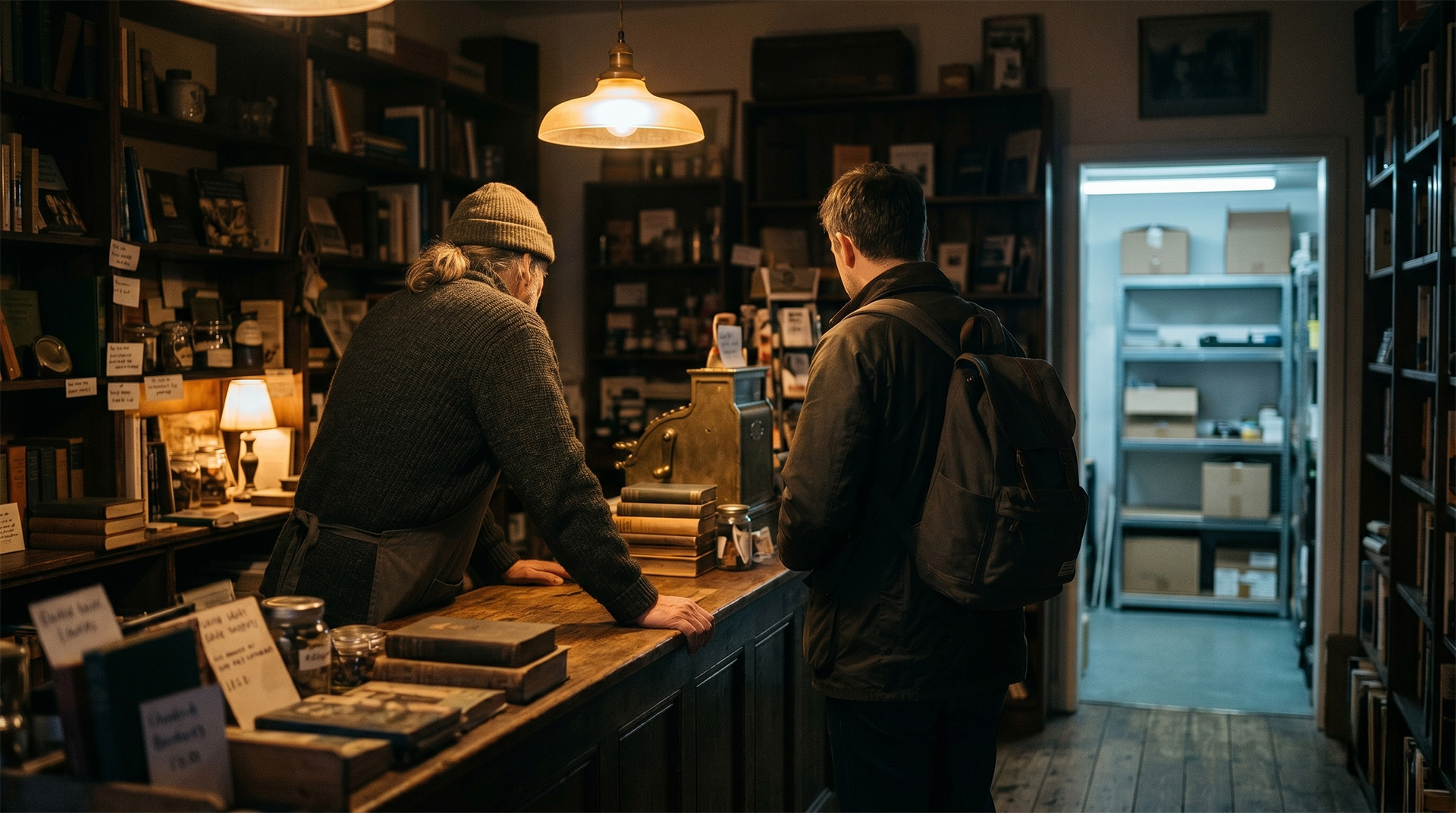
The argument surfaces every so often in retail commentary, usually in the register of lament. The most valuable thing a brand knows about a customer is not held in the CRM but in the head of the shop assistant who recognises them by name, and that assistant has no incentive to pour what they know into the system, because it is their advantage rather than a field to be completed. All true. Yet it stops a step short of the floor, because it leaves standing the assumption that the system wants to capture that knowledge in the first place. It does not, and that is where the more interesting story begins.
The CRM was sold for two decades as the capture of tacit knowledge while it operates, in practice, as a project to make that knowledge unnecessary. The two are opposites wearing a single costume. To capture what the assistant knows would mean conceding that the knowledge is the product and paying for it accordingly, while to render it redundant means the reverse, building the infrastructure that lets the assistant who recognises be replaced by an interchangeable staffer plus a piece of software that profiles, lowering the cost of labour and shifting the value from the person to the system. Profiling is not a thin version of recognition. It is a different thing built for a different purpose, answering the question of what you want to buy now rather than who you are over time, and those two questions do not converge with the years. They drift apart.
Anyone who has watched distribution move through three or four technological cycles will recognise the shape of it. Each cycle deskilled almost everything it touched, the stockroom, the pricing, the display and the logistics, turning trades into procedures and procedures into lines of code. The relationship was the last redoubt, and it held not because anyone defended it but because recognition does not submit to industrialisation. It is artisanal by constitution. It asks for presence and for long time, for the memory of one particular customer laid down in one particular assistant, and none of that scales. The real blind spot is therefore not technological but subtler, because the assistant is not obstructing a system that wants what they have, but keeping something the system has already decided it does not want, given that wanting it would cost too much.
Which brings the matter to the part the nostalgia tends to cover. That warm recognition, the assistant who greets you by name when you come back in, was never only superior service. It was also an insider economy that rewarded the regular, rewarded the local and rewarded whoever walked in with the right credentials already written across them; in the very same gesture it quietly penalised anyone outside the circle. The customer who came from elsewhere, who did not have the right face or the right accent, received a different version of the same shop. In Britain that last point needs no elaboration. The assistant's knowledge was never neutral, because no embodied knowledge is, and the assistant knew whom to welcome and knew whom to hold at arm's length. That second competence stayed invisible precisely because it fell on those with no voice to object.
The database, by comparison, is vulgar, second rate. It does not recognise you, it does not welcome you, it does not make you feel seen, it simply treats you as an identifier and measures you as a segment, and yet it does the one thing the assistant could not, which is to treat you like everyone else. The same price and the same access, however you happen to be dressed when you walk in. What we call the loss of recognition is the replacement of a warm and opaque hierarchy with a flat and transparent coldness, and it is far from obvious which of the two served better those at the back of the queue.
Artificial intelligence enters this scene without resolving any of it, as it tends to when the architecture is left untouched and sick procedures are merely automated. It will not reproduce recognition, because it cannot accumulate the relationship that produces it, but it will manufacture a surrogate convincing enough to make it uneconomic to keep the human who offered the real thing on the floor. The danger is not that the machine fails to imitate us, but that it succeeds just well enough that we stop paying for the original, and the surrogate will inherit the egalitarian coldness of the database without the warmth of the assistant, or worse, it will learn to simulate that warmth too, profiling well enough to make you feel recognised by a system that does not recognise you at all.
What remains is the question neither side cares to put in full. When the best assistant leaves and takes with them everything they knew, do we lose something real, or do we lose only the privilege of some being remembered while others were forgotten on purpose. The answer depends on where you were sitting, inside the circle or outside it, and perhaps the one thing the machine finally makes explicit is that the circle was always there.