What a portrait lends you, a meeting collects
Posted on: 31 July 2026
Nobody has ever looked at Holbein's Henry and imagined the painter had caught him unawares. The portrait tradition that produced that image was honest about its own procedure: a sitter commissioned a version of himself, an artist supplied it and the result was understood by everyone concerned to be an argument rather than a record. Photography broke that understanding. It kept all the construction of the painted portrait, the pose and the light and the flattering angle, while adding one mechanical guarantee the painter could never offer, namely that a body had genuinely been there, in front of that lens, for the fraction of a second the shutter stayed open. That guarantee is the thing now dissolving, and its disappearance is the smaller half of the story. The larger half concerns something photography was never honest about in the first place.
Begin with the case that looks innocent. The pictures we take of one another, at the table or on the walk, appear to be the degree zero of the image. No posing, no lighting, no intention beyond keeping the day. They ought therefore to be the fairest record we have of what a person actually looks like. They are nothing of the sort. They are systematically unjust, and the reason is measurable.
In 2012 Robert Post, Jason Haberman, Lica Iwaki and David Whitney published six experiments in Frontiers in Psychology describing what they named the frozen face effect. The design was straightforward. Participants were shown short video clips of people talking in ordinary settings, then shown the individual frames drawn from those same clips, and asked how flattering each stimulus was. The videos consistently beat their own constituent images, and went on beating them when the researchers inverted everything in order to rule out familiarity or recognition as the driver. Seven years later Malerie McDowell and Jason Haberman extended the finding in PLOS ONE beyond faces altogether, to bodies and to objects in motion, which suggests the penalty carried by a still frame is not a fact about faces but a property of perception itself. The favoured explanation concerns temporal integration. Confronted with a moving face we do not register one snapshot after another; we compute a rolling average, and that average smooths away everything a single frame preserves as an oddity, the half closed eyelid, the mouth caught midway through a word, the expression photographed in the instant it was turning into a different expression. An isolated frame is very nearly always an accident. The average is not.
Which yields a conclusion most people resist: the holiday photograph does not depict you, it subtracts from you. Every frozen instant of your life is worse than you are, not because you happened to come out badly in that particular shot but because any shot whatever is by construction an unlucky sample from a distribution which, in the flesh, is smoothed before anyone judges it.
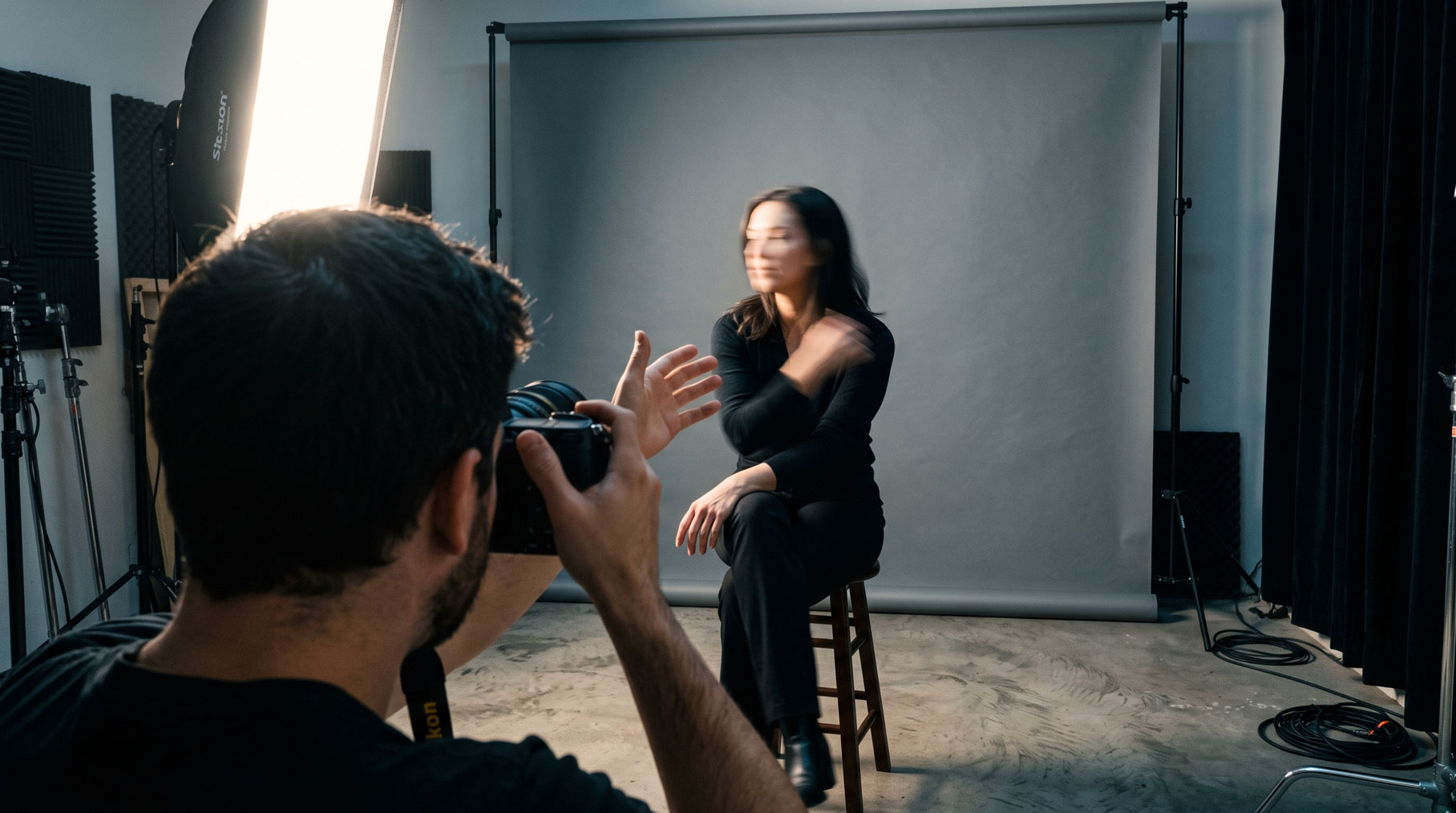
The professional photographer practises the inverse craft, and that is what the fee buys. He does not capture, he selects. Three hundred frames in a session, one delivered, and that one is by definition unrepresentative: it is the upper extreme of the distribution, chosen by someone whose entire competence consists in recognising it. Add the lighting that corrects the architecture of a face, the direction that loosens a posture, the retouching that removes the noise, and the result is an image which beats not merely the other two hundred and ninety nine frames but the living person as well, because it beats the moving average that anyone meeting you will compute regardless.
Two errors of opposite sign therefore surround the same individual. The amateur photograph sits below the average, the professional portrait sits above the maximum and neither of them contains the person. The asymmetry that matters is that only the second error creates an obligation. A very good portrait is an advance drawn against a performance not yet given. Whoever looks at it does not file an image away, they form a hypothesis, and the hypothesis will be tested at the first meeting. The better the portrait, the higher the bar somebody has to clear simply by walking into a room.
Years ago I met a person I had known only through an online conversation, back when that format was still improvised rather than industrial. The face was pleasant enough and slightly less striking than in the photograph, though within half an hour the physical discrepancy had stopped registering entirely. What did not stop registering was that she had very little to say. Few subjects, nothing much worth recounting, a conversation that had to be held upright from outside. In the photograph I had been looking at for weeks there was an absorbed gaze of the sort that appears to pass through the lens and settle somewhere further back.
It took me an embarrassingly long time to identify the error precisely, and longer still to notice that everyone makes it. An absorbed gaze lasts a twentieth of a second. It is a state, not a trait. The photographer isolates it because isolating it is the job; the viewer reads it as a stable disposition of character, concluding that here is a person of some depth, with an interior life, holding something unresolved behind the eyes. But nobody is absorbed as a permanent condition, any more than anybody is delighted in the manner of the instant they were photographed mid laugh. The successful portrait does not merely overstate appearance, which half an hour of presence corrects anyway. It overstates interiority, and that particular credit never quite closes, because no real conversation can live up to a promise that was never made in words.
None of which amounts to an accusation of fakery, and the distinction matters, since without it the argument collapses into the usual complaint about filters. A good portraitist invents nothing. He genuinely obtains, in twenty minutes, a state the sitter genuinely had. He arrives at it by talking to them, waiting them out, arranging conditions under which they stop supervising themselves. The gaze existed. What is easy to miss is that it existed there, in front of that man with that camera, produced by a relationship lasting half an hour which the person looking at the print did not have and never will. The image is a truthful document of one encounter and a poor prediction of every other. I had not believed a lie. I had believed that a state available to a competent photographer would be available to me, in a bar, having done nothing whatever to earn it.
This is also where the word sensitivity needs handling with some care, because the hierarchy that suggests itself is usually the wrong one. The fashion photographer is not less sensitive than the portraitist. He is working on a different object, building a figure rather than interrogating a person, with the body in front of him serving as an armature for the light and the clothes. The photographer covering a wedding by working through the mandatory shot list is practising a logistics profession dressed as a looking profession, which is why those images resemble one another even when they are technically impeccable. The distinction that governs the outcome is one of task and not of talent, and the portrait that opens a genuinely large credit is only ever the work of someone who has taken the person as the task. There are not many of them.
The same mechanism accounts for a reaction almost everyone has and almost nobody interprets correctly, which is the discomfort of looking at photographs of oneself. It is not insecurity and it is not dysmorphia. It is a statistically sound judgement. The subject knows, without knowing that she knows, that the image misrepresents her, and she is right twice over. If it is a casual snap it is underselling her; if it is a well made portrait it is overselling her, and some part of her is already registering the bill that will be presented later.
That asymmetry has not always taken its present form. For a century and a half the professional portrait functioned as a signal in the technical sense, which is to say as information made credible by the cost of producing it. A session required money, time, a physical journey and the decision to treat one's own image as an investment. Anyone displaying a well made portrait was demonstrating something true quite apart from how they looked in it: they were demonstrating that they had paid. The signal discriminated precisely because not everyone could afford it. Those numbers are documented. A survey of more than seven hundred American photographers' listings puts the median session at around two hundred and fifty dollars, with two thirds of packages returning three finished images or fewer, and the figure climbs quickly in the major markets. A generated package built from a handful of phone photographs now costs between twenty and forty dollars and returns dozens of variations in background, wardrobe and lighting. The ratio between those prices is not an incremental improvement. It is a change of product category.
When the cost of manufacturing a signal collapses, the signal stops separating and whoever has to decide moves the verification elsewhere. The degree did it when it went to scale, the bespoke suit did it when industrial tailoring caught up, the competently built website did it when templates made the studio indistinguishable from the bedroom. The pattern holds each time: the signal empties out rather than disappearing, and the cost of assessment shifts downstream onto whatever remains harder to fake. The defensive reaction is already visible, and it is the part of the story that complicates the tidy version. Organisations in regulated client facing sectors have begun prohibiting generated portraits on compliance grounds; recruiters working at volume claim to recognise generated sets by the way skin and eyes are rendered; a 2025 poll reports that just under four respondents in ten describe generated portraits as soulless. The sources for all of this are photographic studios and vendors of competing services, so they should be read as the interested indications they are. The direction nonetheless fits the mechanism. Signals stratify rather than dying. A higher tier appears, the photograph certified as authentic, which costs money again and therefore discriminates again, until the next collapse in price.
The deeper consequence has nothing to do with the ethics of the thing. If the value of a portrait lay in a state produced by a relationship, then the model is not a cheaper version of that work but an operation of a different kind, because there is nobody on the other side of the lens doing any looking and consequently no state to obtain. The system returns a smoothed average of the faces it was trained on, mapped onto your particular geometry. That is why the results read as slick even when they are flawless: what is missing is the only information the portrait was ever really carrying, which is that somebody was paying attention. Competent retouching, assuming one knows what one is after, will fix the light and clean up the skin, and that is not nothing. It will not produce the moment a person stops defending themselves, because that moment is not a rendering problem.
For anyone who has built a professional position on an image, the operational consequence runs against instinct. In an environment where images are infinite, immaculate and effectively free, the thing that recovers its power to discriminate is presence: the voice, the reaction time, the handling of a question nobody saw coming. Short video is already more informative than any portrait for exactly the physiological reason the frozen face effect describes, which is why those hiring at volume increasingly ask for it, but it remains a proxy. The real terminal of verification is the room, and in the room the gaze counts for very little against whether you have anything to say. The calculation worth making, and almost nobody makes it, is the size of the gap between the portrait on display and whatever will be found when the meeting finally happens. Where the gap is small the portrait works and goes on working. Where it is wide every new encounter opens at a loss and no amount of preparation recovers the first ninety seconds. An image slightly below one's own right tail is an asset. An image well above it is a debt of uncertain maturity.