The airbag asked for on a straight road
Posted on: 5 August 2026
The secateurs used in the gardens at Highgrove are made in a village in the Swiss Jura by a company that sells ninety-five per cent of its output abroad, and that company is now asking Bern for something rather more unusual than an export credit. Felco has drawn up a mutual fund, the Swiss Export Shield, into which exporters would pay premiums and from which they would be compensated whenever the franc rises beyond an agreed band against the dollar or the euro. Nabil Francis, the chief executive, calls it an airbag: it cushions the impact without preventing the collision. He argues it would come cheaper than the forwards and options sold by the banks, partly because pooling spreads the risk and partly because the scheme could lean on Switzerland's triple A rating to borrow at low cost. The objection is not political. It is actuarial, and it lives entirely inside that second clause.
Insurance works when the insured event is rare, unpredictable in the individual case and, above all, independent between one policyholder and the next. A house burning down in Lugano does not set fire to a house in Neuchâtel, which is why the premiums of the many who do not claim can cover the few who do. Currency does not behave that way. When the franc appreciates against the euro it appreciates for every participant in the same minute, at the same intensity, in the same direction. There is no lucky member who pays in that year and takes nothing out. Hans Gersbach, who runs the KOF, the economic research unit of the federal technical university in Zurich, walks up to this observation when he asks who bears the risk and notes that many companies could claim simultaneously with payouts exceeding reserves, then stops a step short of the conclusion. A pool in which everybody claims together is not a pool. It is a list of beneficiaries waiting for somebody to stand behind them.
There is a further problem that has not surfaced in the coverage, and it makes the arithmetic considerably worse. Only firms with naked exposure would join: those billing in foreign currency while paying costs in francs. Anyone already carrying a natural hedge, because they manufacture abroad or buy inputs in euros, would stay out without a moment's hesitation. The fund therefore fills up with precisely the profiles most correlated with one another, in an adverse selection that no premium calculated in advance can correct. The better it performs as promised, the more efficiently it attracts the cases that will eventually break it.
So who does stand behind it? Francis says so himself with admirable directness, making no attempt to obscure the point: the scheme would need state backing in order to borrow cheaply against the Swiss rating. Which means that the price advantage over the banks does not come from superior organisation. It comes from moving part of the risk onto a balance sheet that does not invoice for the service. A bank selling a currency hedge holds capital against it and charges a margin on top; a fund with a federal guarantee obtains the same protection at a price that does not reflect the cost of the tail, because the tail now sits somewhere else. Benjamin Mühlemann, the Glarus member of the Council of States who co-chairs the FDP, senses this when he warns about false incentives and insists the model must stand on its own without turning the Confederation into the exchange rate insurer of an entire export sector. The sharper formulation is that a model of this kind stands on its own for exactly as long as nobody needs it.
British readers have an unusual vantage point here, because this country ran the opposite experiment for seventy years and has the results.
Sterling was devalued in 1949 and again in 1967, when Harold Wilson went on television to explain that the pound in your pocket had not been devalued; it left the Exchange Rate Mechanism on a single afternoon in September 1992; it fell heavily again after June 2016. Each episode was accompanied by the same argument, that a cheaper currency would restore the competitiveness of British manufacturing and rebalance the economy towards exports. Each time the relief was real and immediate. Each time the rebalancing failed to arrive. What a persistently weak currency actually delivered was permission: permission to defer the investment, to keep the product where it was in the range, to compete on price for another cycle rather than move to a position where price is not the argument. A soft currency is an anaesthetic administered to an economy, and Britain has been on the drip long enough to know what the withdrawal looks like. The Swiss proposal is a request to buy, at a modest premium, the one thing this country received free of charge and came to regret.
The company making the request has a history that sharpens the point considerably.
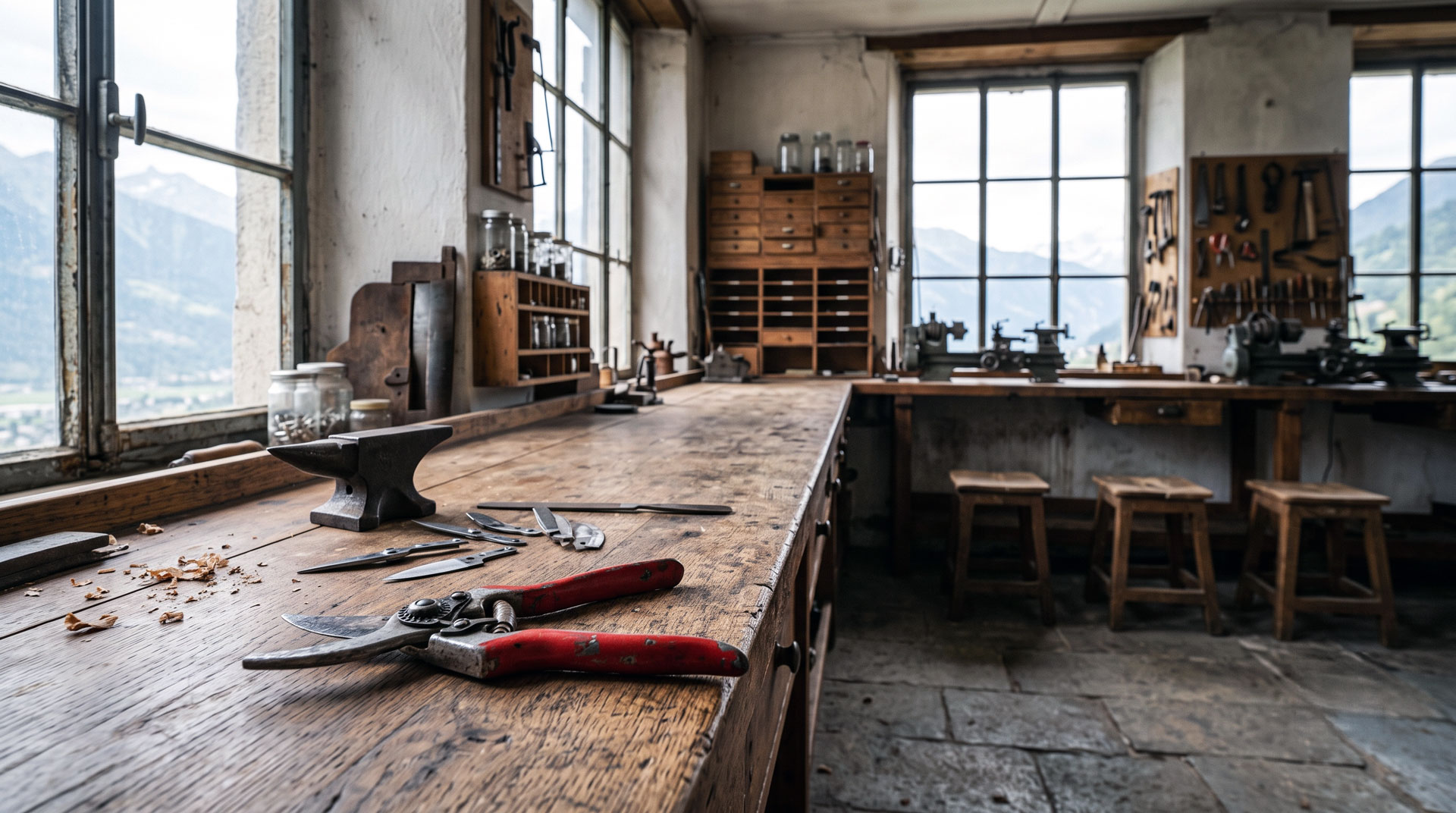
In 1945 Félix Flisch, an Appenzell mechanic who had come to Neuchâtel as a boy to learn French, bought a disused watch dial factory in Les Geneveys-sur-Coffrane and installed a workshop for making pruning shears. Disused. In the heart of the watchmaking valley, inside the empty shell of an industry that an earlier round of selection had already hollowed out, he founded the firm that now turns out more than a million tools a year. The FELCO 2 appeared in 1948 and has sold nineteen million units, with replaceable blades and spare parts available for decades, which is another way of saying that nobody on earth buys those shears because they are cheap. Nobody.
Then look at what happened around that building, and at what happened here at the same moment. Swiss watchmaking peaked in the late 1960s with close to ninety thousand people employed across roughly fifteen hundred firms. Quartz arrived from Japan, the oil shocks arrived, and the franc appreciated: the Confederation's own official account lists the rising currency explicitly among the causes. By the mid 1980s employment stood at thirty thousand across five or six hundred firms. Two thirds of a sector erased inside fifteen years, in the same valleys, often in the same villages.
The British motorcycle industry was destroyed in the identical decade by the identical competitor. Honda, Yamaha, Kawasaki and Suzuki did to Meriden and Small Heath what Seiko did to Bienne. What differs is not the shock but the response. In 1973 the Heath government put public money into BSA and Norton on condition that they merge into Norton Villiers Triumph, and when NVT tried to close Meriden the workers occupied the plant for eighteen months until a Labour government funded a co-operative to keep it open. The money was spent on preserving the existing arrangement. NVT was in receivership by 1978 and the Meriden co-operative was gone by 1983. Triumph exists today only because John Bloor bought the name from the liquidators and rebuilt the entire enterprise from nothing at Hinckley, and the first machine did not leave that factory until 1991.
Switzerland was not more virtuous. It was rescued too, and on a large scale: between 1981 and 1983 the creditor banks put more than nine hundred million francs into ASUAG and SSIH, having first commissioned Nicolas Hayek to audit whether the sector was solvent at all. The difference is the sequence and the condition attached. That money arrived after the selection rather than instead of it, and it was tied to becoming a different industry rather than to continuing as the same one. The Swatch itself was already being developed inside ETA under Ernst Thomke and reached the market in March 1983; what the restructuring supplied was the scale to exploit it, the move upmarket, the mechanical watch sold as an object of desire rather than as an instrument for telling the time, and eventually a sector exporting enormous value on modest volumes to customers who do not argue about the price. The distinction between capital conditional on transformation and a cushion that permits everything to stay as it was is the whole distance between Bienne and Meriden.
Felco is a child of that logic rather than a survivor of it. A firm carrying Swiss costs and selling into a hundred and twenty countries has exactly one available road, which is to build something that lasts thirty years, can be repaired indefinitely and is bought for what it is. Jean-Philippe Kohl of Swissmem describes the strong franc as a carpet permanently on fire beneath your feet, a better metaphor than he perhaps intends, because the fire is not the affliction. It is the engine. It is the mechanism that has stopped half a century of Swiss manufacturing from sliding into the middle of the market, where you compete on price and lose to anyone with lower costs, which is to say everyone.
Note also the timing, which tells its own story. The euro sits at around ninety three centimes and has been broadly flat for a year; Reuters observes that the appreciation has slowed. The airbag is being requested on a straight road rather than in a bend. Anyone who has watched institutions operate knows exactly why. Permanent instruments are built when nobody is shouting, because emergencies produce temporary measures and temporary measures are rarely renewed. The moment has been chosen well. It has been chosen extremely well. This is not the naivety of a manufacturer of garden tools; it is craft.
Which leaves the question nobody has put in these terms, and it is not whether the fund would hold.
The serious risk is that it works. Insurance against structural pressure does not produce protected companies, it produces companies that stop having to be exceptional in order to survive, and the erosion of that capability shows up in no quarter and in no annual report. It shows up twelve or fifteen years later, when the cover lapses for whatever political reason and it turns out that the muscle has wasted, that the position is no longer defensible, that the range has drifted downward while the currency carried on quietly in the direction it was always going. By then the only thing still standing is the fund. Which does not prune anything.