Grooming for the codec
Posted on: 4 August 2026
Put a still of Sean Connery walking out of the water in Dr No next to one of Daniel Craig doing the same thing forty-four years later and you have, in two frames, the whole of the change under discussion. The first body is covered. The second is not. Nothing in between was decided by anybody, no committee sat, no memorandum was circulated, and yet across half a century the male torso as publicly displayed in Britain has been progressively stripped of one of its ordinary features. I should declare an interest before going further. I was raised, in a different country and a different decade, on the assumption that a man keeps his hair wherever it happens to grow, and I have never had cause to revise the view. What follows is not an attempt at neutrality. It is an attempt to understand why an enormous number of men now do the opposite, and why the reason they offer for doing it cannot be the real one.
The reason offered is hygiene. It does not survive thirty seconds of examination. If body hair were dirt then the hair on the head would be the first thing to go, and instead it is the only hair whose loss reliably produces distress, a transplant industry with charter flights to Istanbul and a market in topical treatments that expands every year. What is at stake is not cleanliness. What is at stake is visible surface, and the entire question lives in that distinction.
The numbers are worth fixing before anything is built on top of them, because the style pages have been announcing the return of the hairy man for several years and the data show nothing of the kind. The only large-scale survey ever conducted in Britain, by Mintel, put the figure at forty-six per cent of men removing at least some hair below the neck. That British newspapers still quote it today tells you most of what you need to know about the quality of the available evidence. On the American side a probability-based Ipsos panel survey conducted in April 2023 found 46.7 per cent of men reporting pubic hair removal at some point and 29.2 per cent within the previous thirty days. The male segment of the body grooming market continues to grow at a little over four per cent a year and is the segment pulling the wider hair removal category along behind it. There has been no reversal. The furred chest has returned to the runway captions and nowhere else.
The interesting part of the Ipsos work is not the headline figure, which on its own says very little, but the variables that turned out to be statistically associated with the practice: age, recent sexual activity, sexual orientation and social media use. It is the last of these that repays attention, since it is the only one that has nothing to do with the body and everything to do with the body's representation.
The explanation that circulates in gyms is that hair conceals muscle. This is true within limits considerably narrower than the people repeating it appear to realise. Hair does erase definition when the light is hard and frontal, when body fat is down at competition levels and when what has to read is not volume but striation and vascularity. On a bodybuilding stage it matters a great deal. Away from that stage it works the other way, adding apparent density to the chest and signalling a degree of hormonal maturity that no amount of training can manufacture. A hairy man who trains does not look less trained. He may look older, which is a different problem and one worth being honest about.
Here is the gap that made the piece worth writing. A technique that originated where it produced a measurable effect has migrated to contexts where that effect does not exist. In a bar a smooth chest does not reveal musculature that would otherwise stay hidden. It reveals a willingness to be looked at as though it did. Which raises the question of where, precisely, the looking is expected to happen.
The answer, I think, sits somewhere nobody associates with grooming, namely the engineering of video compression.
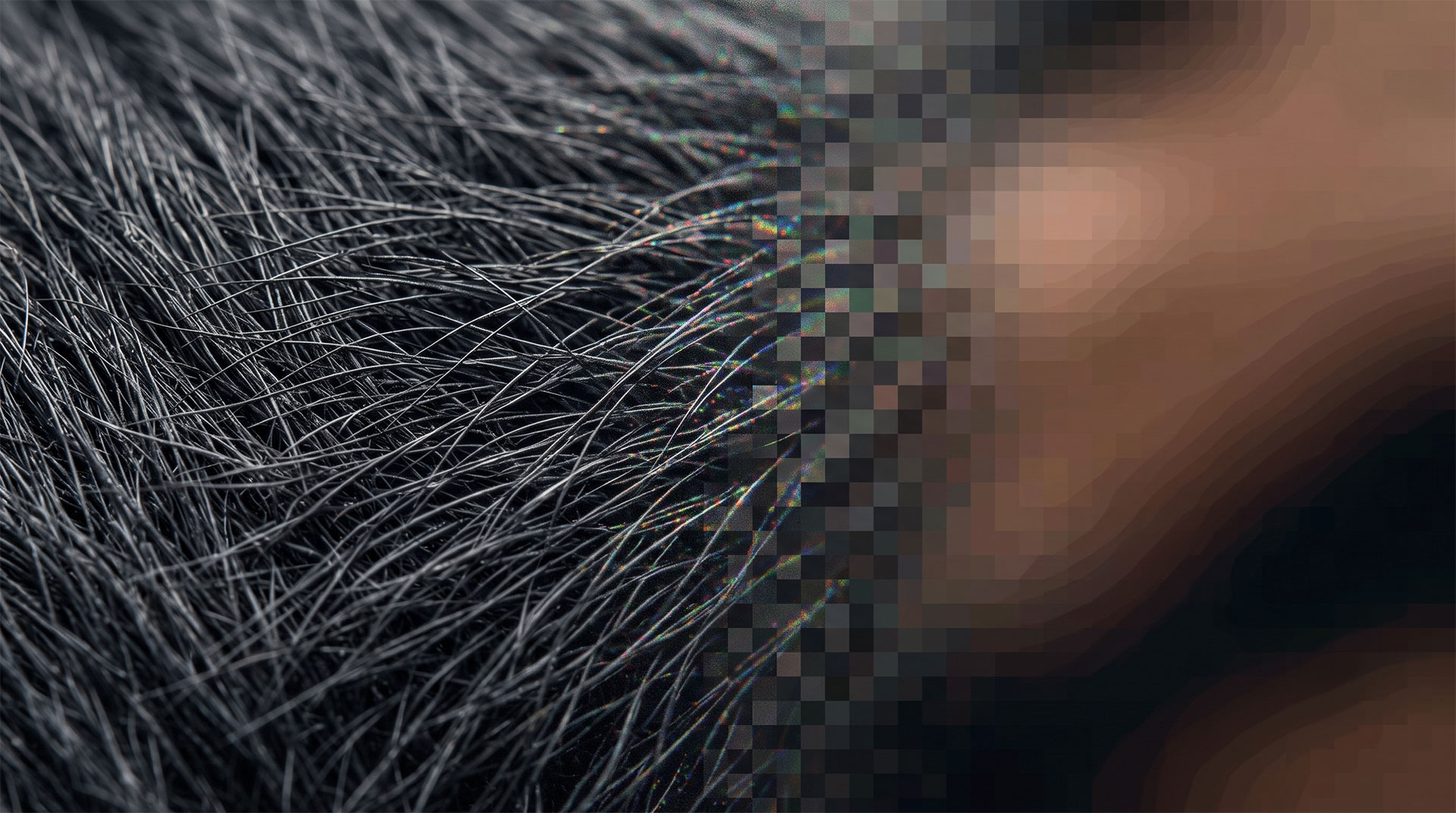
Body hair, considered as signal, is high-frequency detail. It falls into precisely the category of information that a codec discards first when file size has to come down. The quantiser works on blocks and throws away the components the eye is least likely to miss on average, and fine textures go earliest: hair, grass, tightly woven fabric. The consequence is not that hair is rendered slightly less well. The consequence is that it turns into a smear. Along moving edges you get what engineers call mosquito noise, a shimmer of speckling around sharp transitions which is invisible on a paused frame and obvious in playback. Anyone who has uploaded a video to a social platform and watched it again after re-encoding knows the effect without knowing its name. Skin holds. Hair falls apart.
Beauty filters finish the job and do it more bluntly, since their stated purpose is to even out the surface of the skin. An algorithm that smooths a complexion has no way of distinguishing an enlarged pore from a hair. Every time a filter passes over a torso, that torso is depilated in software, and the body that emerges was never hairy in the first place.
Generative video closes the circle. Anyone working with the current models knows that hair is where they break: hair against sky flickers, curls the wrong way, changes direction between one frame and the next. The technical literature is candid about it, high-frequency reconstruction remains the unsolved problem even in neural compression systems, and the first practical recommendation circulating among people who generate video is to blur fine textures before feeding them to the model. Blur first. That is what an electric trimmer does to a chest.
Framed this way the phenomenon changes category. Mass male depilation is not an aesthetic. It is preprocessing. It is the removal, upstream and in the flesh, of information that the transmission chain cannot handle downstream. The body is preparing itself for the codec.
Nobody intended any of this, and that is the structurally interesting part. No engineer in Cupertino determined that the male chest should be smooth, no art director issued instructions. What happened is that a certain kind of body rendered better through a certain kind of pipe, that this body attracted more response, that the response selected for such bodies and that bodies duly adapted. Merton called it the unanticipated consequence of purposive social action. Every individual step is rational and the outcome was chosen by no one.
Nor is it the first time. Bodies have always adapted to the dominant medium, and anyone who has worked long enough in industries where the image is the product has watched some version of it happen. I spent part of my working life inside the shift from analogue to digital in exactly such an environment, and I remember clearly the period in which everything was redesigned around what the new carrier could actually hold. Taste was not the subject of discussion. What survived the chain was the subject of discussion. The polished torsos of the early nineties underwear campaigns arrive at a specific moment in that history, when glossy print and retouching begin to define an ideal that no real body possesses. Low-resolution digital in the following decade generalised the standard to anyone holding a camera, and compressed vertical video has now put it on everybody.
From which follows the thing that separates this from a merely suggestive reading, which is the condition under which it dies. If the mechanism is as described, improvements in technical rendering should relieve the pressure, and should do so first in the most heavily mediated segments. Newer codecs handle fine texture better, generative models are closing the gap precisely on high frequencies and the average resolution of what we look at keeps rising. If hair is rendered correctly a few years from now and depilation continues to grow regardless, then my explanation is wrong and the driver was something else: a norm that has settled, transmits by imitation and no longer requires the cause that produced it. Norms routinely outlive the conditions that generated them, and that outcome would be entirely unremarkable.
What remains worth carrying away is this. The man who shaves is not choosing one aesthetic over another. He is executing an adaptation to an infrastructure he did not design and whose constraints he has never examined. And the man who defends body hair in the name of nature is making the symmetrical error, since the hairy chest of the nineteen seventies was not nature either. It was the convention of a decade that needed a way of telling the adult man from the boy, and it has aged the way conventions do.
I intend to keep mine. Not because they are natural, but because I have no plans to do unpaid preparatory work for a machine that has not hired me.